
Aerospace Engineering
GATE AE Airplane Performance PYQs
Build your understanding with focused practice from past exam papers.
Questions 21–30 of 43. Imported answers require independent review unless marked reviewed.
Question 30
Open questionAEMCQ2 marksNeeds review
For a conventional fixed-wing aircraft in a 360° inverted vertical loop maneuver, what is the load factor (
) at the topmost point of the loop? Assume the flight to be steady at the topmost point.Your answerChoose one option.
Log in to check the answer
You can attempt this question now. Sign in to view the answer key, explanations and discussion.Log in to check answerQuestion 35
Open questionAEMSQ2 marksNeeds review
Which of the following statement(s) is/are true?
Your answerSelect all correct options. You can choose more than one.
Log in to check the answer
You can attempt this question now. Sign in to view the answer key, explanations and discussion.Log in to check answerQuestion 53
Open questionAENAT2 marksNeeds review
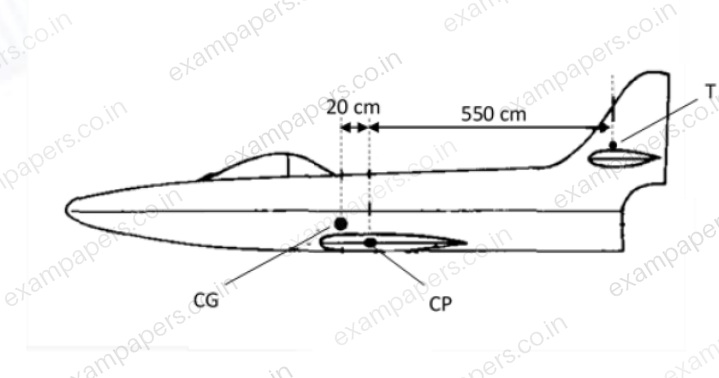
An airplane weighing 5500 kg is in a steady level flight with a speed of 225 m/s. The pilot initiates a steady pull-up maneuver with a radius of curvature of 775 m. The location of center of gravity (CG), center of pressure on wing (CP) and point of action (T) of tail force are marked in the figure. Use g = 9.81 m/s². Neglect drag on the tail and assume that tail force is vertical. Assuming the engine thrust and drag to be equal, opposite and collinear, the tail force is______________ kN (round off to one decimal place).
Log in to check the answer
You can attempt this question now. Sign in to view the answer key, explanations and discussion.Log in to check answerQuestion 54
Open questionAENAT2 marksNeeds review
A jet aircraft weighing 10,000 kg has an elliptic wing with a span of 10 m and area 30 m
. The
for the aircraft is 0.025. The maximum speed of the aircraft in steady and level flight at sea level is 100 m/s. The density of air at sea level is 1.225 kg/m
, and take
m/s
. The maximum thrust developed by the engine at sea level is _____ N (round off to two decimal places).Log in to check the answer
You can attempt this question now. Sign in to view the answer key, explanations and discussion.Log in to check answerQuestion 25
Open questionAENAT1 markNeeds review
An airplane of mass 5000 kg is flying at a constant speed of 360 km/h at the bottom of a vertical circle with a radius of 400 m, as shown in the figure. Assuming that the acceleration due to gravity is 9.8 m/s
, the load factor experienced at the center of gravity of the airplane is ______ (round off to two decimal places).

Log in to check the answer
You can attempt this question now. Sign in to view the answer key, explanations and discussion.Log in to check answerQuestion 46
Open questionAENAT2 marksNeeds review
A single engine, propeller driven, general aviation airplane is flying in cruise at sea-level condition (density of air at sea-level is 1.225 kg/m³) with speed to cover maximum range. For drag coefficient
and wing loading
N/m², the speed of the airplane is ______ m/s (round off to one decimal place).Log in to check the answer
You can attempt this question now. Sign in to view the answer key, explanations and discussion.Log in to check answerQuestion 54
Open questionAENAT2 marksNeeds review
An airplane of mass 400 kg and wing reference area 25 m² flying at sea level has a maximum lift coefficient of 1.65. Assume density of air as 1.225 kg/m³ and acceleration due to gravity as 9.8 m/s². Using a factor of safety of 1.25 to account for additional unsteady lift during a sudden pull-up, the speed at which the airplane reaches a load factor of 3.2 is ______ m/s (round off to two decimal places).
Log in to check the answer
You can attempt this question now. Sign in to view the answer key, explanations and discussion.Log in to check answerQuestion 8
Open questionAEMCQ1 markNeeds review
When a propeller airplane in ground-roll during take-off experiences headwind, which of the following statements is FALSE?
Your answerChoose one option.
Log in to check the answer
You can attempt this question now. Sign in to view the answer key, explanations and discussion.Log in to check answerQuestion 17
Open questionAENAT1 markNeeds review
The power-off glide range for an airplane with a maximum Lift to Drag ratio of 18, when the glide starts at an altitude of 4 km, is ______ km (round off to the nearest integer).
Log in to check the answer
You can attempt this question now. Sign in to view the answer key, explanations and discussion.Log in to check answerQuestion 18
Open questionAENAT1 markNeeds review
For an airplane flying in a vertical plane, the angle of attack is 3°, the horizontal and vertical components of velocity in wind axis are 300 km/h and 15.72 km/h, respectively. The pitch attitude of the airplane is ______ degrees (round off to 2 decimal places).
Log in to check the answer
You can attempt this question now. Sign in to view the answer key, explanations and discussion.Log in to check answer