
Aerospace Engineering
GATE AE Airplane Performance PYQs
Build your understanding with focused practice from past exam papers.
Questions 31–40 of 43. Imported answers require independent review unless marked reviewed.
Question 40
Open questionAENAT2 marksNeeds review
The airplane shown in figure starts executing a symmetric pull-up maneuver from steady level altitude with a constant nose-up pitch acceleration of 20 deg/s
. The vertical load factor measured at this instant at the centre of gravity (CG) is 2. Given that the acceleration due to gravity is 9.81 m/s
, the vertical load factor measured at point P on the nose of the airplane, which is 2 m ahead of the CG, is ______ (round off to 2 decimal places). 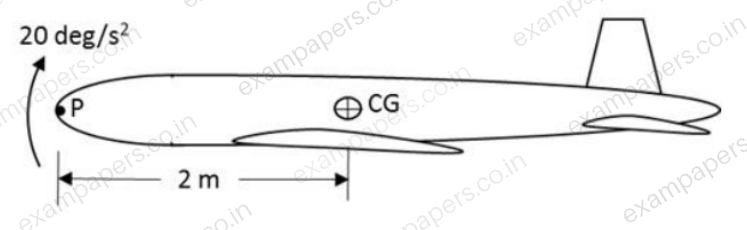
Log in to check the answer
You can attempt this question now. Sign in to view the answer key, explanations and discussion.Log in to check answerQuestion 41
Open questionAENAT2 marksNeeds review
Consider an airplane with a weight of 8000 N, wing area of 16 m
, wing zero-lift drag coefficient of 0.02, Oswald’s efficiency factor of 0.8, and wing aspect ratio of 6, in steady level flight with wing lift coefficient of 0.375. Considering the same flight speed and ambient density, the ratio of the induced drag coefficient during steady level flight to that during a 30° climb is ______ (round off to 2 decimal places).Log in to check the answer
You can attempt this question now. Sign in to view the answer key, explanations and discussion.Log in to check answerQuestion 43
Open questionAENAT2 marksNeeds review
A propeller driven airplane has a gross take-off weight of 4905 N with a wing area of 6.84 m
. Assume that the wings are operating at the maximum
ratio, the propeller efficiency is 0.9 and the specific fuel consumption of the engine is 0.76 kg/kW-hr. Given that the density of air at sea level is 1.225 kg/m
and the acceleration due to gravity is 9.81 m/s
, the weight of the fuel required for an endurance of 18 hours at sea level is ______ N (round off to the nearest integer).Log in to check the answer
You can attempt this question now. Sign in to view the answer key, explanations and discussion.Log in to check answerQuestion 4
Open questionAEMCQ1 markNeeds review
A jet aircraft is initially flying steady and level at its maximum endurance condition. For the aircraft to fly steady and level, but faster at the same altitude, the pilot should
Your answerChoose one option.
Log in to check the answer
You can attempt this question now. Sign in to view the answer key, explanations and discussion.Log in to check answerQuestion 7
Open questionAEMCQ1 markNeeds review
An airplane requires a longer ground roll to lift-off on hot summer days because
Your answerChoose one option.
Log in to check the answer
You can attempt this question now. Sign in to view the answer key, explanations and discussion.Log in to check answerQuestion 16
Open questionAEMCQ1 markNeeds review
The highest limit load factor experienced by a civil transport aircraft is in the range
Your answerChoose one option.
Log in to check the answer
You can attempt this question now. Sign in to view the answer key, explanations and discussion.Log in to check answerQuestion 40
Open questionAENAT2 marksNeeds review
An aircraft with mass of 400,000 kg cruises at 240 m/s at an altitude of 10 km. Its lift to drag ratio at cruise is 15. Assuming g as 9.81 m/s
, the power (in MW) needed for it to cruise is ______ (accurate to two decimal places).Log in to check the answer
You can attempt this question now. Sign in to view the answer key, explanations and discussion.Log in to check answerQuestion 42
Open questionAENAT2 marksNeeds review
An aircraft with a gross weight of 2000 kg, has a speed of 130 m/s at sea level, where the conditions are: 1 atmosphere (pressure), 288 K (temperature), and 1.23 kg/m
(density). The speed (in m/s) required by the aircraft at an altitude of 9000 m, where the conditions are: 0.31 atmosphere, 230 K, and 0.47 kg/m
, to maintain a steady, level flight is ______ (accurate to two decimal places).Log in to check the answer
You can attempt this question now. Sign in to view the answer key, explanations and discussion.Log in to check answerQuestion 43
Open questionAENAT2 marksNeeds review
A pitot probe on an aircraft in a steady, level flight records a pressure of 55,000 N/m
. The static pressure and density are 45,280 N/m
and 0.6 kg/m
, respectively. The wing area and the lift coefficient are 16 m
and 2, respectively. The wing load (in N/m
) on this aircraft is ________ (accurate to one decimal place).Log in to check the answer
You can attempt this question now. Sign in to view the answer key, explanations and discussion.Log in to check answerQuestion 48
Open questionAENAT2 marksNeeds review
Gross weight of an airplane is 700 N, wing area is 16 m
, and the maximum lift coefficient is 2.0. Assuming density at the altitude as 1.23 kg/m
, the stall speed (in m/s) of the aircraft is _______ (accurate to two decimal places).Log in to check the answer
You can attempt this question now. Sign in to view the answer key, explanations and discussion.Log in to check answer