
Aerospace Engineering
GATE AE Basic Fluid Mechanics PYQs
Build your understanding with focused practice from past exam papers.
How to practice Basic Fluid Mechanics
Attempt a question, record the concept and assumptions, then check the available answer. Rework mistakes after revising the relevant concepts. Topic tags can overlap; review the question context.
Questions 1–10 of 23. Imported answers require independent review unless marked reviewed.
Question 43
Open questionAEMCQ2 marksNeeds review
An experimental study is planned to map out the low-Reynolds number incompressible steady two-dimensional aerodynamic characteristics of a promising novel airfoil. The operational parameters of the problem are the speed, density and viscosity of the freestream, the chord of the airfoil and its angle of attack. If the objective is to achieve this with the minimum number of test runs
while taking 10 equally-spaced test values of each independent parameter of the problem in a suitable range, then
is ______.Your answerChoose one option.
Log in to check the answer
You can attempt this question now. Sign in to view the answer key, explanations and discussion.Log in to check answerQuestion 48
Open questionAENAT2 marksNeeds review
In a low-speed airplane, a venturimeter with 1.3:1 area ratio is used for airspeed measurement. The airplane’s maximum speed at sea level is 90 m/s. If the density of air at sea level is 1.225 kg/m
, the maximum pressure difference between the inlet and the throat of the venturimeter is
kPa (rounded off to two decimal places).Log in to check the answer
You can attempt this question now. Sign in to view the answer key, explanations and discussion.Log in to check answerQuestion 63
Open questionAENAT2 marksNeeds review
The figure (not to scale) shows a control volume to estimate the forces on the airfoil with elliptic cross-section. Surfaces 2 and 3 are streamlines. Velocity profiles are measured at the upstream end (surface 1) and at the downstream end (surface 4) of the control volume. The drag coefficient for the airfoil is defined as
, where D is the drag force on the airfoil per unit span and
is the density of the air. The static pressure,
, is constant over the entire surface of the control volume. Assuming the flow to be incompressible, two-dimensional and steady, the
for the airfoil is ________ (rounded off to 3 decimal places). 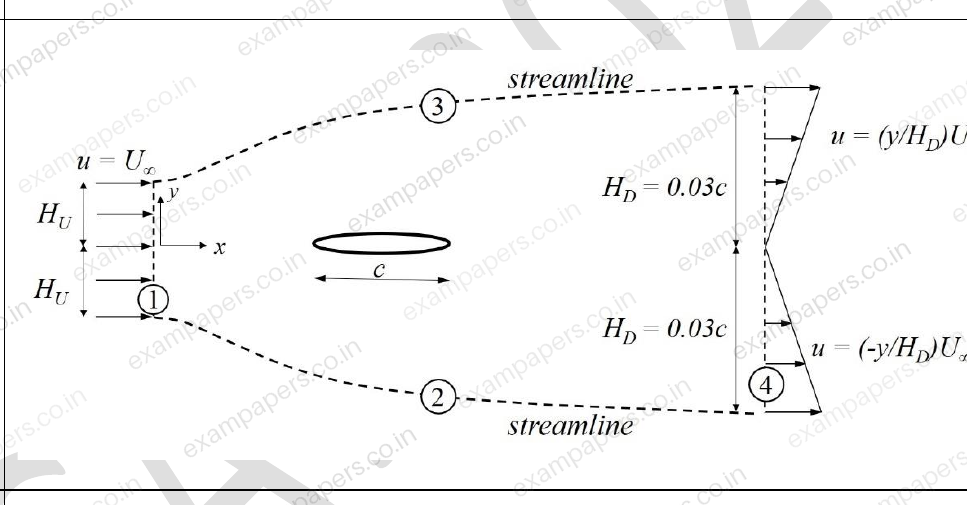
Log in to check the answer
You can attempt this question now. Sign in to view the answer key, explanations and discussion.Log in to check answerQuestion 58
Open questionAENAT2 marksNeeds review
Enstrophy is defined as the square of the magnitude of vorticity. For the three-dimensional velocity field
the enstrophy at location (1, 1, 1) is _______. (round off to two decimal places)
Log in to check the answer
You can attempt this question now. Sign in to view the answer key, explanations and discussion.Log in to check answerQuestion 16
Open questionAEMCQ1 markNeeds review
Consider steady, two-dimensional, incompressible flow over a non-porous flat plate as shown in the figure. For the control volume PQRS, the speed,
, at section PQ is uniform and the speed at section RS is given by
, where
is a positive integer. The value of
for which the flow through section PS will vanish is: 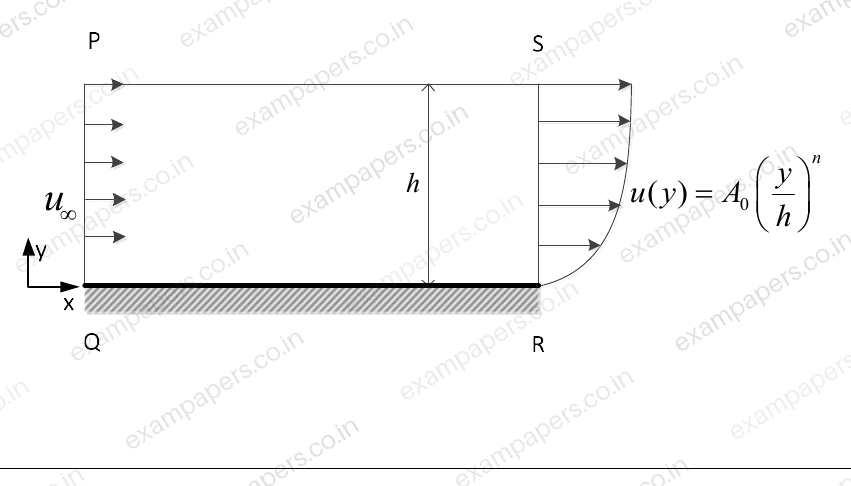
Your answerChoose one option.
Log in to check the answer
You can attempt this question now. Sign in to view the answer key, explanations and discussion.Log in to check answerQuestion 17
Open questionAEMCQ1 markNeeds review
Consider the velocity distribution,
shown in the figure. For two adjacent fluid layers L1 and L2, the viscous force exerted by L1 on L2 is 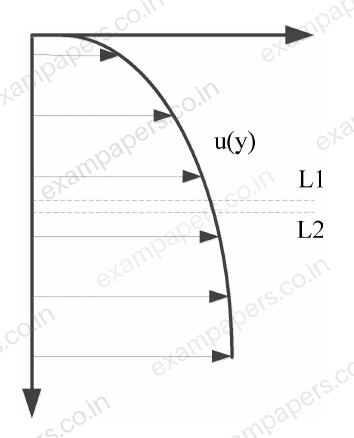
Your answerChoose one option.
Log in to check the answer
You can attempt this question now. Sign in to view the answer key, explanations and discussion.Log in to check answerQuestion 39
Open questionAEMCQ2 marksNeeds review
A cylindrical object of diameter 900 mm is designed to move axially in air at 60 m/s. Its drag is estimated on a geometrically half-scaled model in water, assuming flow similarity. Coefficients of dynamic viscosity and densities for air and water are
Pa-s, 1.2 kg/m
and
Pa-s, 1000 kg/m
respectively. Drag measured for the model is 220 N. Drag experienced by the full-scale object is ____ N (round off to the nearest integer).Your answerChoose one option.
Log in to check the answer
You can attempt this question now. Sign in to view the answer key, explanations and discussion.Log in to check answerQuestion 50
Open questionAENAT2 marksNeeds review
A rotational velocity field in an air flow is given as
, with
,
.The air density is 1.0 kg/m
and the pressure at
is 100 kPa.Neglecting gravity, the pressure at
is ____ kPa (rounded off to nearest integer).Log in to check the answer
You can attempt this question now. Sign in to view the answer key, explanations and discussion.Log in to check answerQuestion 52
Open questionAENAT2 marksNeeds review
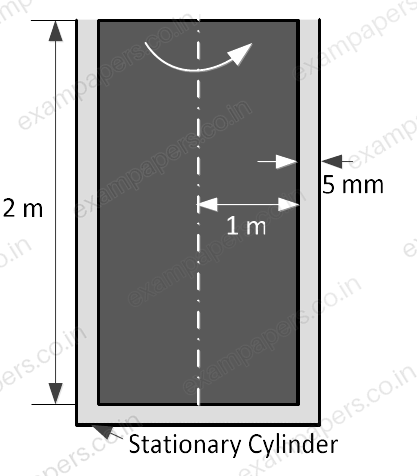
Consider a solid cylinder housed inside another cylinder as shown in the figure. Radius of the inner cylinder is 1 m and its height is 2 m. The gap between the cylinders is 5 mm and is filled with a fluid of viscosity
Pa-s.The inner cylinder is rotating at a constant angular speed of 5 rad/s while the outer cylinder is stationary. Friction at the bottom surfaces can be ignored. Velocity profile in the vertical gap between the cylinders can be assumed to be linear.
The driving moment required for the rotating motion of the inner cylinder is __________ Nm (rounded off to two decimal places).
Log in to check the answer
You can attempt this question now. Sign in to view the answer key, explanations and discussion.Log in to check answerQuestion 28
Open questionAEMCQ2 marksNeeds review
To estimate aerodynamic loads on an aircraft flying at 100 km/h at standard sea-level conditions, a one-fifth scale model is tested in a variable-density wind tunnel ensuring similarity of inertial and viscous forces. The pressure used in the wind tunnel is 10 times the atmospheric pressure. Assuming ideal gas law to hold and the same temperature conditions in model and prototype, the velocity needed in the wind tunnel test-section is ______.
Your answerChoose one option.
Log in to check the answer
You can attempt this question now. Sign in to view the answer key, explanations and discussion.Log in to check answer