
Aerospace Engineering
GATE AE Basics PYQs
Build your understanding with focused practice from past exam papers.
How to practice Basics
Attempt a question, record the concept and assumptions, then check the available answer. Rework mistakes after revising the relevant concepts. Topic tags can overlap; review the question context.
Questions 1–10 of 26. Imported answers require independent review unless marked reviewed.
Question 14
Open questionAEMCQ1 markNeeds review
Which one of the following makes an ideal air-standard Stirling cycle?
Your answerChoose one option.
Log in to check the answer
You can attempt this question now. Sign in to view the answer key, explanations and discussion.Log in to check answerQuestion 18
Open questionAEMCQ1 markNeeds review
The figure below depicts two ideal gas turbine cycles, cycle 1-2-3-4-1 and cycle 1-2-3'-4'-1, on a T-s diagram. Which one the following statements is FALSE?
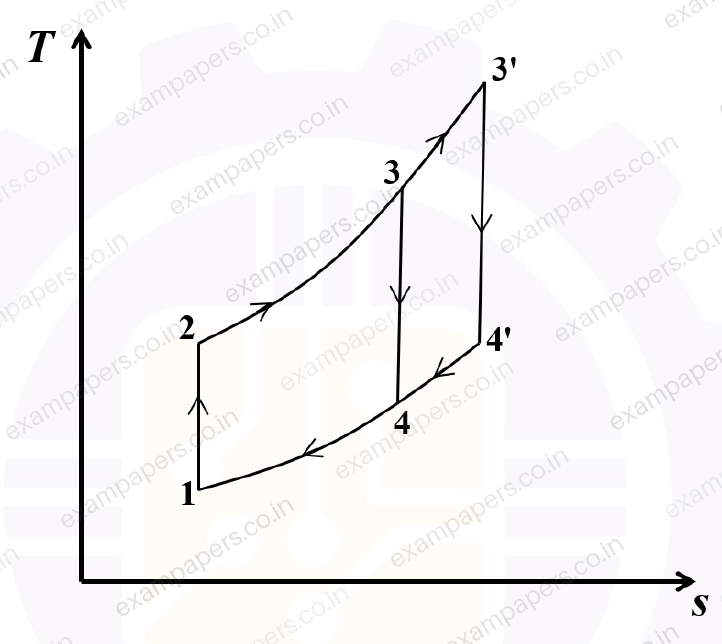
Your answerChoose one option.
Log in to check the answer
You can attempt this question now. Sign in to view the answer key, explanations and discussion.Log in to check answerQuestion 52
Open questionAENAT2 marksNeeds review
Isobutane (C₄H₁₀) is burnt completely in pure oxygen as per the reaction given below. Given that the standard heats of formation (in kcal/mole) of isobutane, carbon dioxide, and water vapour are −31.49, −94.052, and −60.150, respectively, the heat of reaction is ________ kcal (rounded off to 2 decimal places).
C₄H₁₀ + 6.5 O₂ → 4 CO₂ + 5 H₂O
Log in to check the answer
You can attempt this question now. Sign in to view the answer key, explanations and discussion.Log in to check answerQuestion 53
Open questionAENAT2 marksNeeds review
A furnace of 250 MW rating is used to melt and raise the temperature of aluminum from 25 °C to 900 °C. Aluminum has a solid-state specific heat, latent heat, and liquid-state specific heat of 0.9 kJ/kg-K, 390 kJ/kg, and 1.08 kJ/kg-K, respectively, and the furnace has 70% efficiency. The melting point of aluminum is 660 °C. The amount of aluminum that can be processed per hour is ________ kg (rounded off to 1 decimal place).
Log in to check the answer
You can attempt this question now. Sign in to view the answer key, explanations and discussion.Log in to check answerQuestion 31
Open questionAEMCQ1 markNeeds review
and
are the heat and work interactions of a system with its surroundings, and
is the change in the internal energy of the system. For an adiabatic process in a closed, constant pressure combustor, which one of the following options is correct?Your answerChoose one option.
Log in to check the answer
You can attempt this question now. Sign in to view the answer key, explanations and discussion.Log in to check answerQuestion 33
Open questionAEMCQ1 markNeeds review
A gaseous fuel mixture comprising 3 moles of methane and 2 moles of ammonia is combusted in X moles of pure oxygen in stoichiometric amount. Assuming complete combustion, with only CO
, H
O and N
in the product gases, the value of X is ____. The displayed reaction is: 3 CH
+ 2 NH
+ X O
→ Products (CO
, H
O, N
).Your answerChoose one option.
Log in to check the answer
You can attempt this question now. Sign in to view the answer key, explanations and discussion.Log in to check answerQuestion 62
Open questionAENAT2 marksNeeds review
Air at temperature 300 K is compressed isentropically from a pressure of 1 bar to 10 bar in a compressor. Eighty percent of the compressed air is supplied to a combustor. In the combustor, 0.8 MJ of heat is added per kg of air. The specific heat at constant pressure is
J/kg/K and the specific heat ratio is
. The temperature of the air leaving the combustor is ____ K (rounded off to one decimal place).Log in to check the answer
You can attempt this question now. Sign in to view the answer key, explanations and discussion.Log in to check answerQuestion 16
Open questionAEMCQ1 markNeeds review
For an ideal gas, the specific heat at constant pressure is 1147 J/kg K and the ratio of specific heats is equal to 1.33. What is the value of the gas constant for this gas in J/kg K?
Your answerChoose one option.
Log in to check the answer
You can attempt this question now. Sign in to view the answer key, explanations and discussion.Log in to check answerQuestion 17
Open questionAEMCQ1 markNeeds review
A surrogate liquid hydrocarbon fuel, approximated as
, is being burned in a land-based gas turbine combustor with dry air (79%
and 21%
by volume). How many moles of dry air are required for the stoichiometric combustion of the surrogate fuel with dry air at atmospheric temperature and pressure?Your answerChoose one option.
Log in to check the answer
You can attempt this question now. Sign in to view the answer key, explanations and discussion.Log in to check answerQuestion 18
Open questionAEMCQ1 markNeeds review
In the figure shown below, various thermodynamics processes for an ideal gas are represented. Match each curve with the process that it best represents.
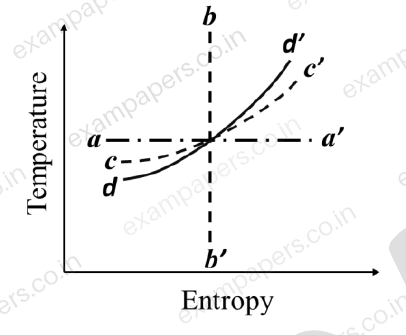
Your answerChoose one option.
Log in to check the answer
You can attempt this question now. Sign in to view the answer key, explanations and discussion.Log in to check answer