
Aerospace Engineering
GATE AE Basics PYQs
Build your understanding with focused practice from past exam papers.
Questions 11–20 of 26. Imported answers require independent review unless marked reviewed.
Question 19
Open questionAEMCQ1 markNeeds review
In an airbreathing gas turbine engine, the combustor inlet temperature is 600 K. The heating value of the fuel is 43.4 × 10⁶ J/kg. Assume Cₚ to be 1100 J/kg K for air and burned gases, and fuel-air ratio f<< 1.0. Neglect kinetic energy at the inlet and exit of the combustor and assume 100% burner efficiency. What is the fuel-air ratio required to achieve 1300 K temperature at the combustor exit?
Your answerChoose one option.
Log in to check the answer
You can attempt this question now. Sign in to view the answer key, explanations and discussion.Log in to check answerQuestion 33
Open questionAENAT1 markNeeds review
The ratio of the speed of sound in H
(molecular weight 2 kg/kmol) to that in N
(molecular weight 28 kg/kmol) at temperature 300 K and pressure 2 bar is ____. (round off to two decimal places)Log in to check the answer
You can attempt this question now. Sign in to view the answer key, explanations and discussion.Log in to check answerQuestion 61
Open questionAENAT2 marksNeeds review
A gas turbine combustor is burning methane and air at an equivalence ratio
, where
and
is the ratio of mass flow rate of fuel to the mass flow rate of air at stoichiometry. If the air flow rate is
kg/s then the mass flow rate of methane is _____ kg/s. (round off to two decimal places)Log in to check the answer
You can attempt this question now. Sign in to view the answer key, explanations and discussion.Log in to check answerQuestion 23
Open questionAEMCQ1 markNeeds review
The region of highest static temperature in a rocket engine and the region of highest heat flux are ____________, respectively.
Your answerChoose one option.
Log in to check the answer
You can attempt this question now. Sign in to view the answer key, explanations and discussion.Log in to check answerQuestion 42
Open questionAEMCQ2 marksNeeds review
Which of the following is NOT always true for a combustion process taking place in a closed system?
Your answerChoose one option.
Log in to check the answer
You can attempt this question now. Sign in to view the answer key, explanations and discussion.Log in to check answerQuestion 5
Open questionAEMCQ1 markNeeds review
The combustion process in a turbo-shaft engine during ideal operation is:
Your answerChoose one option.
Log in to check the answer
You can attempt this question now. Sign in to view the answer key, explanations and discussion.Log in to check answerQuestion 27
Open questionAEMCQ2 marksNeeds review
The figure shows three glasses P, Q and R with water and floating ice cube. Glass P has a solid ice cube, glass Q has an ice cube with a small solid steel ball embedded in it and glass R has an ice cube with an air bubble. After the ice cube melts, the level of water in glasses P, Q and R, respectively:
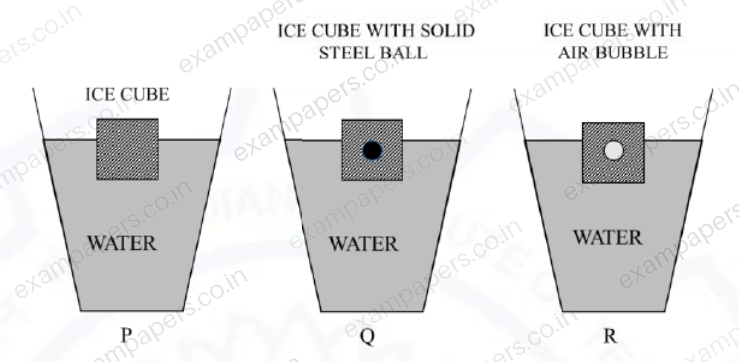
Your answerChoose one option.
Log in to check the answer
You can attempt this question now. Sign in to view the answer key, explanations and discussion.Log in to check answerQuestion 48
Open questionAENAT2 marksNeeds review
The operating conditions of an aircraft engine combustor are as follows.
The rate of total enthalpy of air entering the combustor = 28.94 MJ/s.
The rate of total enthalpy of air leaving the combustor = 115.42 MJ/s.
Mass flow rate of air = 32 kg/s.
Air to fuel mass ratio = 15.6.
Lower heating value of the fuel = 46 MJ/kg.
The efficiency of the combustor is ______% (round off to two decimal places).
Log in to check the answer
You can attempt this question now. Sign in to view the answer key, explanations and discussion.Log in to check answerQuestion 20
Open questionAENAT1 markNeeds review
For the complete combustion of 1 mole of ethanol (C
H
OH), the required number of moles of oxygen is ______.Log in to check the answer
You can attempt this question now. Sign in to view the answer key, explanations and discussion.Log in to check answerQuestion 21
Open questionAENAT1 markNeeds review
One kg of diatomic gas is heated and its temperature increases from 100 K to 600 K. The energy added at constant pressure during this process is 500 kJ. The specific heat at constant volume for the gas is ______ kJ/kgK. (round off to 2 decimal places).
Log in to check the answer
You can attempt this question now. Sign in to view the answer key, explanations and discussion.Log in to check answer