
Aerospace Engineering
GATE AE Central force motion PYQs
Build your understanding with focused practice from past exam papers.
How to practice Central force motion
Attempt a question, record the concept and assumptions, then check the available answer. Rework mistakes after revising the relevant concepts. Topic tags can overlap; review the question context.
Questions 1–10 of 17. Imported answers require independent review unless marked reviewed.
Question 53
Open questionAENAT2 marksNeeds review
F and G denote two points on a spacecraft’s orbit around a planet, as indicated in the figure. O is the center of the planet, P is the periapsis, and the angles are as indicated in the figure. If OF = 8000 km, OG = 10000 km,
deg, and
deg, the eccentricity of the spacecraft’s orbit is
(rounded off to two decimal places). 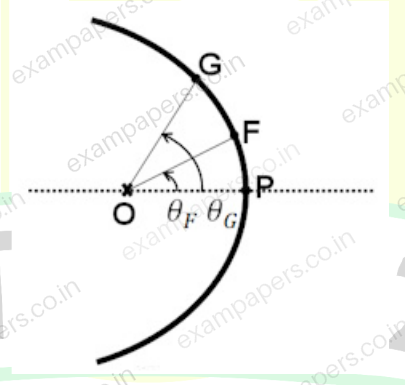
Log in to check the answer
You can attempt this question now. Sign in to view the answer key, explanations and discussion.Log in to check answerQuestion 26
Open questionAEMSQ1 markNeeds review
Which of the following statements is/are correct about a satellite moving in a geostationary orbit?
Your answerSelect all correct options. You can choose more than one.
Log in to check the answer
You can attempt this question now. Sign in to view the answer key, explanations and discussion.Log in to check answerQuestion 39
Open questionAEMCQ2 marksNeeds review
At a point in the trajectory of an unpowered space vehicle moving about the Earth, the altitude above the mean sea level is 600 km, and the speed with reference to a coordinate system fixed to the center of mass of the Earth is 9 km/s. Assume that the Earth is a sphere with a radius 6400 km and
, where G is the universal gravitational constant and
is mass of the Earth. The trajectory is:Your answerChoose one option.
Log in to check the answer
You can attempt this question now. Sign in to view the answer key, explanations and discussion.Log in to check answerQuestion 60
Open questionAENAT2 marksNeeds review
Consider an artificial satellite moving around the Moon in an elliptic orbit. The altitude of the satellite from the Moon’s surface at the perigee is 25 km and that at the apogee is 134 km. Assume the Moon to be spherical with a radius of 1737 km. The trajectory is considered with reference to a coordinate system fixed to the center of mass of the Moon. The ratio of the speed of the satellite at the perigee to that at the apogee is ________ (rounded off to 2 decimal places).
Log in to check the answer
You can attempt this question now. Sign in to view the answer key, explanations and discussion.Log in to check answerQuestion 62
Open questionAENAT2 marksNeeds review
The universal gravitational constant is
Nm
/kg
. For a planet of mass
kg and radius 3390 km, the escape velocity is _____ km/s. (round off to one decimal place).Log in to check the answer
You can attempt this question now. Sign in to view the answer key, explanations and discussion.Log in to check answerQuestion 63
Open questionAENAT2 marksNeeds review
A satellite is in a circular orbit around Earth with a time period of 90 minutes. The radius of Earth is 6370 km, mass of Earth is
kg and the universal gravitational constant is
Nm
/kg
. The altitude of the satellite above mean sea level is ___ km. (round off to the nearest integer)Log in to check the answer
You can attempt this question now. Sign in to view the answer key, explanations and discussion.Log in to check answerQuestion 46
Open questionAEMSQ2 marksNeeds review
Consider a high Earth-orbiting satellite of angular momentum per unit mass h⃗ and eccentricity e.
The mass of the Earth is M and G is the universal gravitational constant.
The distance between the satellite’s center of mass and the Earth’s center of mass is r, the true anomaly is θ, and the phase angle is zero.
Which of the following statements is/are true?
Your answerSelect all correct options. You can choose more than one.
Log in to check the answer
You can attempt this question now. Sign in to view the answer key, explanations and discussion.Log in to check answerQuestion 25
Open questionAENAT1 markNeeds review
The velocity required to launch a space shuttle from the surface of the earth to achieve a circular orbit of 250 km altitude is ______ (round off to two decimal places).
For earth,
km³/s² and surface radius
km.Log in to check the answer
You can attempt this question now. Sign in to view the answer key, explanations and discussion.Log in to check answerQuestion 11
Open questionAEMCQ1 markNeeds review
For hyperbolic trajectory of a satellite of mass
having velocity
at a distance
from the center of earth (
: gravitational constant,
: mass of earth), which one of the following relations is true?Your answerChoose one option.
Log in to check the answer
You can attempt this question now. Sign in to view the answer key, explanations and discussion.Log in to check answerQuestion 20
Open questionAENAT1 markNeeds review
Burnout velocity of a space vehicle in circular orbit at an angle 5 degrees above the local horizon around earth is 13.5 km/s. Tangential velocity of the space vehicle in the orbit is ______ km/s (round off to two decimal places).
Log in to check the answer
You can attempt this question now. Sign in to view the answer key, explanations and discussion.Log in to check answer