
Aerospace Engineering
GATE AE exam:gate PYQs
Build your understanding with focused practice from past exam papers.
Questions 141–150 of 650. Imported answers require independent review unless marked reviewed.
Question 11
Open questionAEMCQ1 markNeeds review
The following system of linear equations
has:
Your answerChoose one option.
Log in to check the answer
You can attempt this question now. Sign in to view the answer key, explanations and discussion.Log in to check answerQuestion 12
Open questionAEMCQ1 markNeeds review
The acceleration of a body traveling in a straight line is given by
where
is the velocity, and
,
are positive constants. Starting with an initial positive velocity
, the distance traveled by the body before coming to rest for the first time is:Your answerChoose one option.
Log in to check the answer
You can attempt this question now. Sign in to view the answer key, explanations and discussion.Log in to check answerQuestion 13
Open questionAEMCQ1 markNeeds review
The three-dimensional stress-strain relationship for an isotropic material is given as
where P, Q and R are the three elastic constants,
and
represent normal and shear stresses and
and
represent normal and engineering shear strains. Which one of the following options is correct?Your answerChoose one option.
Log in to check the answer
You can attempt this question now. Sign in to view the answer key, explanations and discussion.Log in to check answerQuestion 14
Open questionAEMCQ1 markNeeds review
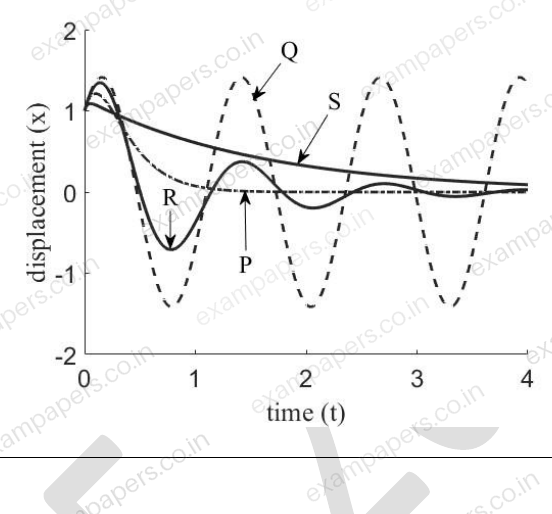
Consider the free vibration responses P, Q, R and S (shown in the figure) of a single degree of freedom spring-mass-damper system with the same initial conditions. For the different damping cases listed below, which one of the following options is correct?
Overdamped
Underdamped
Critically damped
Undamped
Your answerChoose one option.
Log in to check the answer
You can attempt this question now. Sign in to view the answer key, explanations and discussion.Log in to check answerQuestion 15
Open questionAEMCQ1 markNeeds review
For a single degree of freedom spring-mass-damper system subjected to harmonic forcing, the part of the motion (response) that decays due to damping is known as:
Your answerChoose one option.
Log in to check the answer
You can attempt this question now. Sign in to view the answer key, explanations and discussion.Log in to check answerQuestion 16
Open questionAEMCQ1 markNeeds review
For an ideal gas, the specific heat at constant pressure is 1147 J/kg K and the ratio of specific heats is equal to 1.33. What is the value of the gas constant for this gas in J/kg K?
Your answerChoose one option.
Log in to check the answer
You can attempt this question now. Sign in to view the answer key, explanations and discussion.Log in to check answerQuestion 17
Open questionAEMCQ1 markNeeds review
A surrogate liquid hydrocarbon fuel, approximated as
, is being burned in a land-based gas turbine combustor with dry air (79%
and 21%
by volume). How many moles of dry air are required for the stoichiometric combustion of the surrogate fuel with dry air at atmospheric temperature and pressure?Your answerChoose one option.
Log in to check the answer
You can attempt this question now. Sign in to view the answer key, explanations and discussion.Log in to check answerQuestion 18
Open questionAEMCQ1 markNeeds review
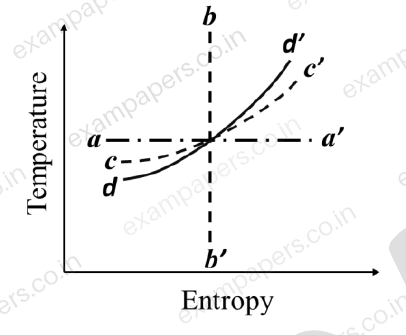
In the figure shown below, various thermodynamics processes for an ideal gas are represented. Match each curve with the process that it best represents.
Your answerChoose one option.
Log in to check the answer
You can attempt this question now. Sign in to view the answer key, explanations and discussion.Log in to check answerQuestion 19
Open questionAEMCQ1 markNeeds review
In an airbreathing gas turbine engine, the combustor inlet temperature is 600 K. The heating value of the fuel is 43.4 × 10⁶ J/kg. Assume Cₚ to be 1100 J/kg K for air and burned gases, and fuel-air ratio f<< 1.0. Neglect kinetic energy at the inlet and exit of the combustor and assume 100% burner efficiency. What is the fuel-air ratio required to achieve 1300 K temperature at the combustor exit?
Your answerChoose one option.
Log in to check the answer
You can attempt this question now. Sign in to view the answer key, explanations and discussion.Log in to check answerQuestion 20
Open questionAEMCQ1 markNeeds review
Which one of the following figures represents the drag polar of a general aviation aircraft?
Your answerChoose one option.
Log in to check the answer
You can attempt this question now. Sign in to view the answer key, explanations and discussion.Log in to check answer