
Aerospace Engineering
GATE AE kind:question PYQs
Build your understanding with focused practice from past exam papers.
Questions 501–510 of 650. Imported answers require independent review unless marked reviewed.
Question 36
Open questionAENAT2 marksNeeds review
A two-dimensional, incompressible fluid flow is described by the stream function
m
/s on the Cartesian
-
plane. If the density and dynamic viscosity of the fluid are 1 kg/m
and 0.1 kg/m-s, respectively, the magnitude of the pressure gradient in the
direction at
m and
m is ______ N/m
(round off to 1 decimal place).Log in to check the answer
You can attempt this question now. Sign in to view the answer key, explanations and discussion.Log in to check answerQuestion 37
Open questionAENAT2 marksNeeds review
The static pressure ratio across a stationary normal shock is given by
where
is the upstream Mach number. For a stationary normal shock in air (
,
J/kg-K) with upstream flow conditions given by: speed 800 m/s, static temperature 300 K and static pressure 1 atm., the static pressure downstream of the shock is ______ atm. (round off to 2 decimal places).Log in to check the answer
You can attempt this question now. Sign in to view the answer key, explanations and discussion.Log in to check answerQuestion 38
Open questionAENAT2 marksNeeds review
For a symmetric airfoil at an angle of attack of 10°, assuming thin airfoil theory, the magnitude of the pitching moment coefficient about the leading edge is ______ (round off to 2 decimal places).
Log in to check the answer
You can attempt this question now. Sign in to view the answer key, explanations and discussion.Log in to check answerQuestion 39
Open questionAENAT2 marksNeeds review
The span-wise distribution of circulation over a finite wing of span
m is
If
m
/s and the free stream density and speed are 1.2 kg/m
and 100 m/s, respectively, the total lift is ______ kN (round off to 2 decimal places).Log in to check the answer
You can attempt this question now. Sign in to view the answer key, explanations and discussion.Log in to check answerQuestion 40
Open questionAENAT2 marksNeeds review
The airplane shown in figure starts executing a symmetric pull-up maneuver from steady level altitude with a constant nose-up pitch acceleration of 20 deg/s
. The vertical load factor measured at this instant at the centre of gravity (CG) is 2. Given that the acceleration due to gravity is 9.81 m/s
, the vertical load factor measured at point P on the nose of the airplane, which is 2 m ahead of the CG, is ______ (round off to 2 decimal places). 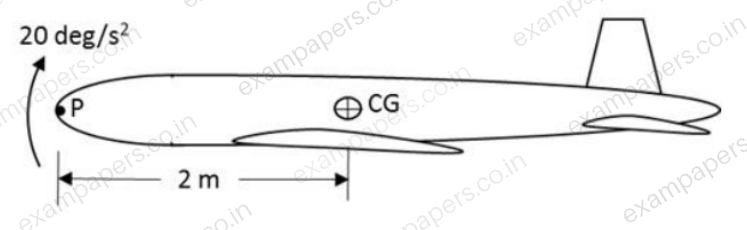
Log in to check the answer
You can attempt this question now. Sign in to view the answer key, explanations and discussion.Log in to check answerQuestion 41
Open questionAENAT2 marksNeeds review
Consider an airplane with a weight of 8000 N, wing area of 16 m
, wing zero-lift drag coefficient of 0.02, Oswald’s efficiency factor of 0.8, and wing aspect ratio of 6, in steady level flight with wing lift coefficient of 0.375. Considering the same flight speed and ambient density, the ratio of the induced drag coefficient during steady level flight to that during a 30° climb is ______ (round off to 2 decimal places).Log in to check the answer
You can attempt this question now. Sign in to view the answer key, explanations and discussion.Log in to check answerQuestion 42
Open questionAENAT2 marksNeeds review
The product of earth’s mass (
) and the universal gravitational constant (
) is
m
/s
. The radius of the earth is 6371 km. The minimum increment in the velocity to be imparted to a spacecraft flying in a circular orbit around the earth at an altitude of 400 km to make it exit earth’s gravitational field is ______ km/s (round off to 2 decimal places).Log in to check the answer
You can attempt this question now. Sign in to view the answer key, explanations and discussion.Log in to check answerQuestion 43
Open questionAENAT2 marksNeeds review
A propeller driven airplane has a gross take-off weight of 4905 N with a wing area of 6.84 m
. Assume that the wings are operating at the maximum
ratio, the propeller efficiency is 0.9 and the specific fuel consumption of the engine is 0.76 kg/kW-hr. Given that the density of air at sea level is 1.225 kg/m
and the acceleration due to gravity is 9.81 m/s
, the weight of the fuel required for an endurance of 18 hours at sea level is ______ N (round off to the nearest integer).Log in to check the answer
You can attempt this question now. Sign in to view the answer key, explanations and discussion.Log in to check answerQuestion 44
Open questionAENAT2 marksNeeds review
The design of an airplane is modified to increase the vertical tail area by 20% and decrease the moment arm from the aerodynamic centre of the vertical tail to the airplane centre of gravity by 20%. Assuming all other factors remain unchanged, the ratio of the modified to the original directional static stability (
due to tail fin) is ______ (round off to 2 decimal places).Log in to check the answer
You can attempt this question now. Sign in to view the answer key, explanations and discussion.Log in to check answerQuestion 45
Open questionAENAT2 marksNeeds review
For a rocket engine, the velocity ratio
is
, where
is the vehicle velocity and
is the exit velocity of the exhaust gases. Assume the flow to be optimally expanded through the nozzle. For
, if
is the thrust produced and
is the mass flow rate of exhaust gases, then
is ______.Log in to check the answer
You can attempt this question now. Sign in to view the answer key, explanations and discussion.Log in to check answer