
Aerospace Engineering
GATE AE topic:aerodynamics PYQs
Build your understanding with focused practice from past exam papers.
Questions 371–380 of 650. Imported answers require independent review unless marked reviewed.
Question 36
Open questionAEMSQ2 marksNeeds review
A conventional fixed-wing aircraft, with a horizontal tail and vertical fin, in steady and level flight is subjected to small perturbations. Which of the following statement(s) is/are true?
Your answerSelect all correct options. You can choose more than one.
Log in to check the answer
You can attempt this question now. Sign in to view the answer key, explanations and discussion.Log in to check answerQuestion 37
Open questionAENAT2 marksNeeds review
The ratio of the product of eigenvalues to the sum of the eigenvalues of the given matrix
is ______ (round off to nearest integer).Log in to check the answer
You can attempt this question now. Sign in to view the answer key, explanations and discussion.Log in to check answerQuestion 38
Open questionAENAT2 marksNeeds review
The definite integral
is evaluated using four equal intervals by two methods – first by the trapezoidal rule and then by the Simpson’s one-third rule. The absolute value of the difference between the two calculations is ______ (round off to two decimal places).Log in to check the answer
You can attempt this question now. Sign in to view the answer key, explanations and discussion.Log in to check answerQuestion 39
Open questionAENAT2 marksNeeds review
The deflection
of a certain beam of length
and uniform weight per unit length
, is given as
, where
is the distance from the point of support and
is a constant. The non-dimensional location
, where the deflection of the beam is maximum, is ______ (round off to two decimal places).Log in to check the answer
You can attempt this question now. Sign in to view the answer key, explanations and discussion.Log in to check answerQuestion 40
Open questionAENAT2 marksNeeds review
A large water tank is fixed on a cart with wheels and a vane (see figure). The wheels of the cart provide negligible resistance for rolling on the fixed support. The cart is tied to the fixed support with a thin horizontal rope. There is a hole of diameter 5 cm on the side of the tank through which a jet of constant velocity of 10 m/s emerges. The jet of water is deflected by the attached vane by 60° (see figure). Assume that the jet velocity remains constant at 10 m/s after emerging from the vane. Take density of water to be 1000 kg/m
. The tension in the connecting rope is ______ N (round off to one decimal place). 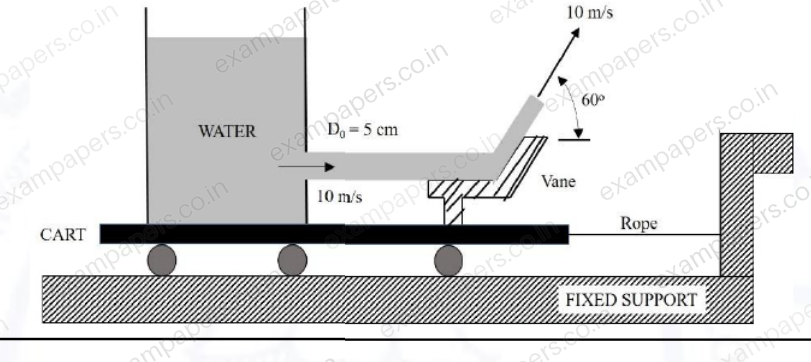
Log in to check the answer
You can attempt this question now. Sign in to view the answer key, explanations and discussion.Log in to check answerQuestion 41
Open questionAENAT2 marksNeeds review
A finite wing of elliptic planform with aspect ratio 10, whose section is a symmetric airfoil, is placed in a uniform flow at 5 degrees angle of attack. The induced drag coefficient for the wing is ______ (round off to three decimal places).
Log in to check the answer
You can attempt this question now. Sign in to view the answer key, explanations and discussion.Log in to check answerQuestion 42
Open questionAENAT2 marksNeeds review
Consider a model of a boundary layer with the following velocity profile:
The shape factor, defined as the ratio of the displacement thickness to momentum thickness, for this profile is _____ (round off to 2 decimal places).Log in to check the answer
You can attempt this question now. Sign in to view the answer key, explanations and discussion.Log in to check answerQuestion 43
Open questionAENAT2 marksNeeds review
An aircraft with a turbojet engine is flying at 270 m/s. The enthalpy of the incoming air at the intake is 260 kJ/kg and the enthalpy of the exhaust gases at the nozzle exit is 912 kJ/kg. The ratio of mass flow rates of fuel and air is equal to 0.019. The chemical energy (heating value) of fuel is 44.5 MJ/kg and the combustion process is ideal. The total loss of heat from the engine to the ambient is 25 kJ per kg of air. The velocity of the exhaust jet is __________ m/s (round off to two decimal places).
Log in to check the answer
You can attempt this question now. Sign in to view the answer key, explanations and discussion.Log in to check answerQuestion 44
Open questionAENAT2 marksNeeds review
Hot gases are generated at a temperature of 2100 K and a pressure of 14 MPa in a rocket chamber. The hot gases are expanded ideally to the ambient pressure of 0.1 MPa in a convergent-divergent nozzle having a throat area of 0.1 m². The molecular mass of the gas is 22 kg/kmol. The ratio of specific heats (γ) of the gas is 1.32. The value of the universal gas constant (R₀) is 8314 J/kmol-K. The acceleration due to gravity, g, is 9.8 m/s². The specific impulse of the rocket is ______ seconds (round off to two decimal places).
Log in to check the answer
You can attempt this question now. Sign in to view the answer key, explanations and discussion.Log in to check answerQuestion 45
Open questionAENAT2 marksNeeds review
A twin-spool turbofan engine is operated at sea level (Pₐ = 1 bar, Tₐ = 288 K). The engine has separate cold and hot nozzles. During static thrust test at sea level, the overall mass flow rate of air through the engine and the cold exhaust temperature are measured to be 100 kg/s and 288 K, respectively. The parameters for the engine are:
Fan pressure ratio = 1.6
Overall pressure ratio = 20
Bypass ratio = 3.0
Turbine entry temperature = 1800 K.
The specific heat at constant pressure (Cₚ) is 1.005 kJ/kg-K and the ratio of specific heats (γ) is 1.4 for air.
Assuming ideal fan and ideal expansion in the nozzle, the sea-level static thrust from the cold nozzle is ______________ kN (round off to two decimal places).
Log in to check the answer
You can attempt this question now. Sign in to view the answer key, explanations and discussion.Log in to check answer