
Aerospace Engineering
GATE AE topic:compressible-flows PYQs
Build your understanding with focused practice from past exam papers.
How to practice topic:compressible-flows
Attempt a question, record the concept and assumptions, then check the available answer. Rework mistakes after revising the relevant concepts. Topic tags can overlap; review the question context.
Questions 1–10 of 41. Imported answers require independent review unless marked reviewed.
Question 21
Open questionAEMCQ1 markNeeds review
In the figure shown below, the flow at the nozzle exit is _______.
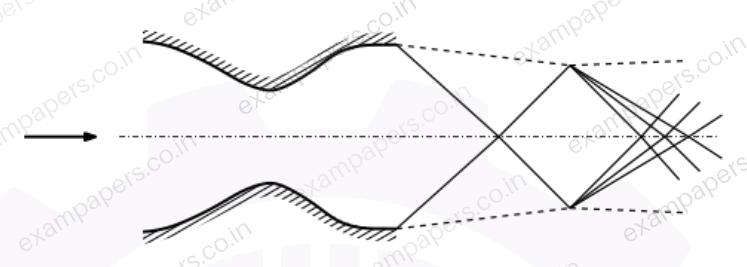
Your answerChoose one option.
Log in to check the answer
You can attempt this question now. Sign in to view the answer key, explanations and discussion.Log in to check answerQuestion 30
Open questionAEMSQ1 markNeeds review
A flow is steady, inviscid and one-dimensional, with no shaft work or body forces. Which of the following is/are possible under the given conditions?
Your answerSelect all correct options. You can choose more than one.
Log in to check the answer
You can attempt this question now. Sign in to view the answer key, explanations and discussion.Log in to check answerQuestion 64
Open questionAENAT2 marksNeeds review
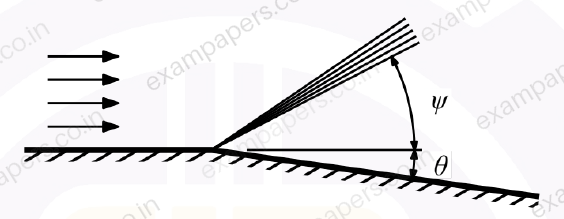
Consider a centered Prandtl-Meyer expansion fan at a
corner in a Mach 1.78 air flow, as shown in the figure below. The angle
(see figure) made by the ending wave of the fan with respect to the incoming stream is ________ degrees (rounded off to 1 decimal place).An excerpt from the table of Prandtl-Meyer function for air is provided below.
M | [deg] | M | [deg] | M | [deg] |
|---|---|---|---|---|---|
1.72 | 18.40 | 1.82 | 21.30 | 1.92 | 24.15 |
1.74 | 18.98 | 1.84 | 21.88 | 1.94 | 24.71 |
1.76 | 19.56 | 1.86 | 22.45 | 1.96 | 25.27 |
1.78 | 20.15 | 1.88 | 23.02 | 1.98 | 25.83 |
1.80 | 20.73 | 1.90 | 23.59 | 2.00 | 26.38 |
Log in to check the answer
You can attempt this question now. Sign in to view the answer key, explanations and discussion.Log in to check answerQuestion 65
Open questionAENAT2 marksNeeds review
A Mach 1.5 air flow enters a round duct of length 20 cm and diameter 3 cm. If the flow exits with Mach number 1.1, the average Fanning friction factor
of the duct is ________
(rounded off to 1 decimal place).An excerpt from the Fanno flow table for air is given below.
| 1.1 | 1.2 | 1.3 | 1.4 | 1.5 | 1.6 |
|---|---|---|---|---|---|---|
| 99.35 | 336.4 | 648.3 | 997.4 | 1361 | 1724 |
Log in to check the answer
You can attempt this question now. Sign in to view the answer key, explanations and discussion.Log in to check answerQuestion 21
Open questionAEMCQ1 markNeeds review
In a fluid flow, Mach number is an estimate of _____.
Your answerChoose one option.
Log in to check the answer
You can attempt this question now. Sign in to view the answer key, explanations and discussion.Log in to check answerQuestion 46
Open questionAENAT2 marksNeeds review
An aircraft is flying at an altitude of 4500 m above sea level, where the ambient pressure, temperature and density are 57 kPa, 259 K and 0.77 kg/m
, respectively. The speed of the aircraft (
) is 230 m/s. Gas constant
J/kg/K, and specific heat ratio
. If the stagnation pressure is
, and static pressure is
, the value of
is
(rounded off to two decimal places).Log in to check the answer
You can attempt this question now. Sign in to view the answer key, explanations and discussion.Log in to check answerQuestion 49
Open questionAENAT2 marksNeeds review
A supersonic stream of an ideal gas at Mach number
is turned by a ramp, as shown in the figure. The ramp angle is 20°. The pressure ratio is
and the specific heat ratio is
. The pressure coefficient on the ramp surface is
(rounded off to two decimal places). 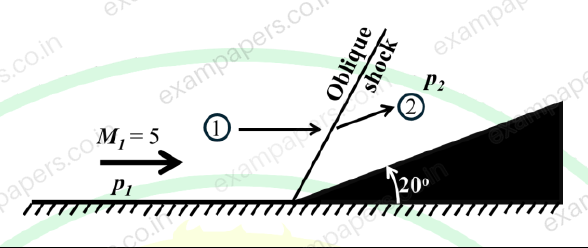
Log in to check the answer
You can attempt this question now. Sign in to view the answer key, explanations and discussion.Log in to check answerQuestion 50
Open questionAENAT2 marksNeeds review
A perfect gas flows through a frictionless constant-area duct with heat addition. The inlet conditions are as follows: pressure 100 kPa, density 1 kg/m
, and velocity 100 m/s. At a particular downstream location, the gas velocity is 200 m/s. The static pressure at the downstream location is
kPa (answer in integer).Log in to check the answer
You can attempt this question now. Sign in to view the answer key, explanations and discussion.Log in to check answerQuestion 51
Open questionAENAT2 marksNeeds review
The mass flow rate in a supersonic wind tunnel is 2 kg/s when the stagnation pressure and stagnation temperature are 1 MPa and 800 K, respectively. If the stagnation pressure and stagnation temperature are changed to 3 MPa and 200 K, the mass flow rate in the tunnel changes to
kg/s (answer in integer).Log in to check the answer
You can attempt this question now. Sign in to view the answer key, explanations and discussion.Log in to check answerQuestion 23
Open questionAEMCQ1 markNeeds review
Consider a steady, isentropic, supersonic flow (Mach number M > 1) entering a Convergent-Divergent (CD) duct as shown in the figure. Which one of the following options correctly describes the flow at the throat?
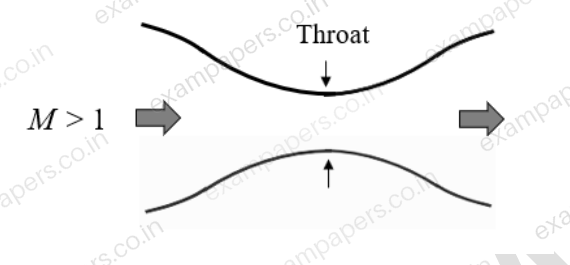
Your answerChoose one option.
Log in to check the answer
You can attempt this question now. Sign in to view the answer key, explanations and discussion.Log in to check answer