
Aerospace Engineering
GATE AE topic:compressible-flows PYQs
Build your understanding with focused practice from past exam papers.
Questions 21–30 of 41. Imported answers require independent review unless marked reviewed.
Question 53
Open questionAENAT2 marksNeeds review
In a converging duct, area and velocity at section P are 1 m
and 15 m/s, respectively. The temperature of the fluid is 300 K.Air flow through the nozzle can be assumed to be inviscid and isothermal. Characteristic gas constant is 287 J/(kg-K) and ratio of specific heats is 1.4 for air.
To ensure that the air flow remains incompressible (Mach number,
) in the duct, the minimum area required at section Q is ____ m
(rounded off to two decimal places). 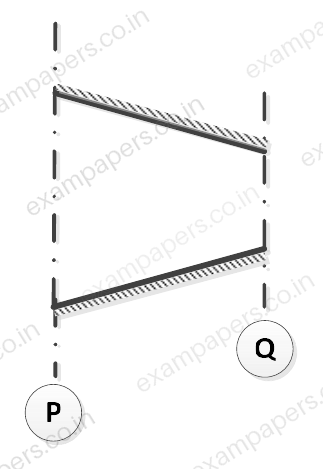
Log in to check the answer
You can attempt this question now. Sign in to view the answer key, explanations and discussion.Log in to check answerQuestion 55
Open questionAENAT2 marksNeeds review
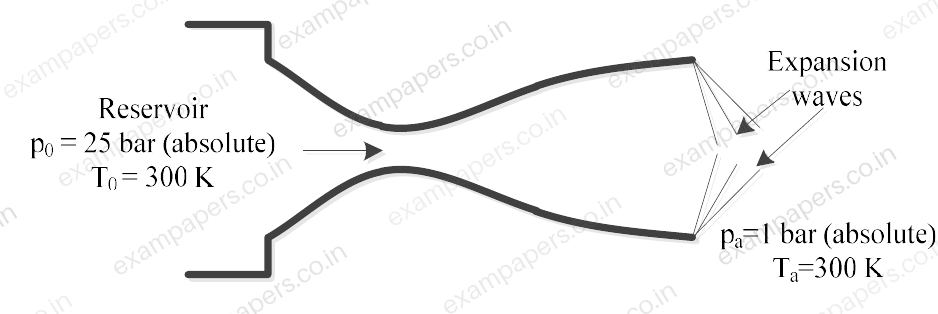
A convergent-divergent nozzle with adiabatic walls is designed for an exit Mach number of 2.3. It is discharging air to atmosphere under the conditions indicated in the figure.
Flow through the nozzle is inviscid, the characteristic gas constant for air is 287 J/(kg-K), and
.When the reservoir pressure is 25 bar (absolute), and temperature is 300 K, Prandtl-Meyer expansion waves appear at the nozzle exit as shown.
The minimum percentage change in the reservoir pressure required to eliminate the wave system at the nozzle exit under steady state is ______ %.
Log in to check the answer
You can attempt this question now. Sign in to view the answer key, explanations and discussion.Log in to check answerQuestion 4
Open questionAEMCQ1 markNeeds review
The figure shows schematics of wave patterns at the exit of nozzles A and B operating at different pressure ratios.
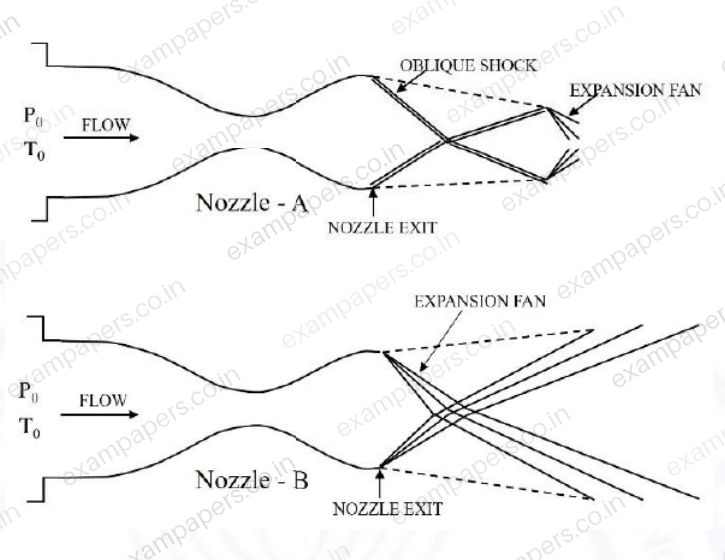
Nozzles A and B, respectively, are said to be operating in:
Your answerChoose one option.
Log in to check the answer
You can attempt this question now. Sign in to view the answer key, explanations and discussion.Log in to check answerQuestion 9
Open questionAEMCQ1 markNeeds review
The shape of a supersonic diffuser that slows down a supersonic flow to subsonic flow is
Your answerChoose one option.
Log in to check the answer
You can attempt this question now. Sign in to view the answer key, explanations and discussion.Log in to check answerQuestion 14
Open questionAEMSQ1 markNeeds review
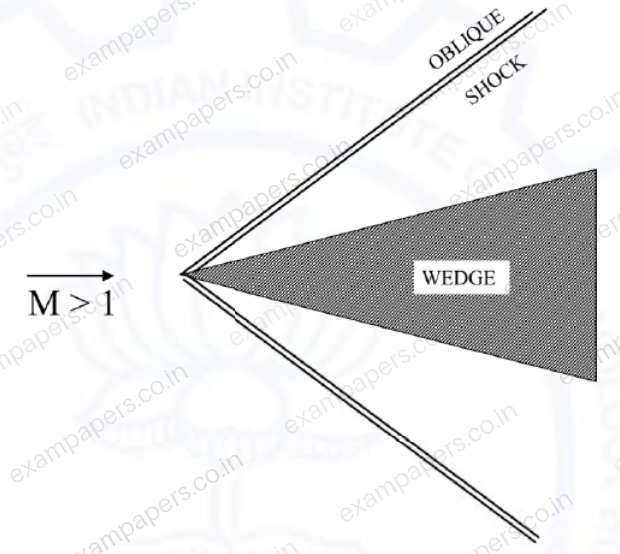
Which of the following statement(s) is/are true across an oblique shock (in adiabatic conditions) over a wedge shown below?
Your answerSelect all correct options. You can choose more than one.
Log in to check the answer
You can attempt this question now. Sign in to view the answer key, explanations and discussion.Log in to check answerQuestion 33
Open questionAEMSQ2 marksNeeds review
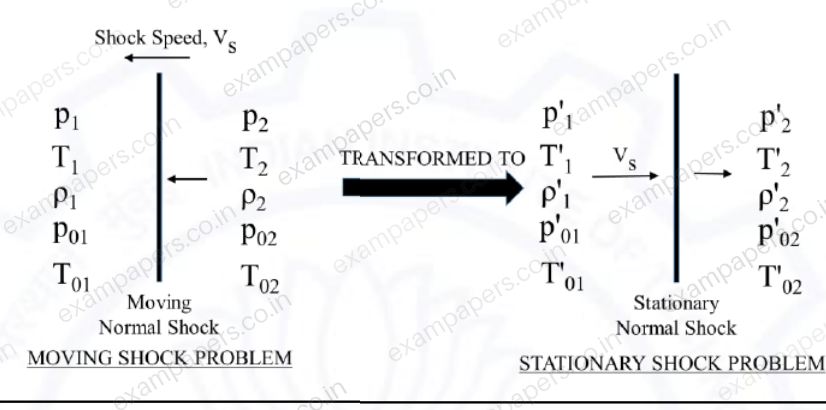
A shock moving into a stationary gas can be transformed to a stationary shock by a change in reference frame, as shown in the figure. Which of the following is/are true relating the flow properties in the two reference frames?
Your answerSelect all correct options. You can choose more than one.
Log in to check the answer
You can attempt this question now. Sign in to view the answer key, explanations and discussion.Log in to check answerQuestion 8
Open questionAEMCQ1 markNeeds review
Which of the following options can result in an increase in the Mach number of a supersonic flow in a duct?
Your answerChoose one option.
Log in to check the answer
You can attempt this question now. Sign in to view the answer key, explanations and discussion.Log in to check answerQuestion 27
Open questionAEMCQ2 marksNeeds review
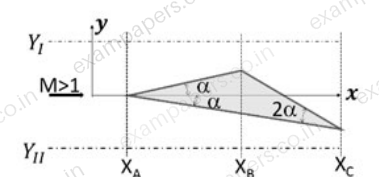
A wedge shaped airfoil is placed in a supersonic flow as shown in the figure (not to scale). The corners of the wedge are at
,
,
, respectively. Which one of the following represents the correct static pressure profiles along
and
? 
Your answerChoose one option.
Log in to check the answer
You can attempt this question now. Sign in to view the answer key, explanations and discussion.Log in to check answerQuestion 39
Open questionAENAT2 marksNeeds review
An oblique shock is inclined at an angle of 35 degrees to the upstream flow of velocity 517.56 m/s. The deflection of the flow due to this shock is 5.75 degrees and the temperature downstream is 182.46 K. Assume the gas constant
J/(kg K), specific heat ratio
, and specific heat at constant pressure
J/(kg K). Using conservation relations, the Mach number of the upstream flow can be obtained as ______ (round off to one decimal place).Log in to check the answer
You can attempt this question now. Sign in to view the answer key, explanations and discussion.Log in to check answerQuestion 6
Open questionAEMCQ1 markNeeds review
For a quasi-one-dimensional isentropic supersonic flow through a diverging duct, which of the following is true in the direction of the flow?
Your answerChoose one option.
Log in to check the answer
You can attempt this question now. Sign in to view the answer key, explanations and discussion.Log in to check answer