
Aerospace Engineering
GATE AE year:2025 PYQs
Build your understanding with focused practice from past exam papers.
Questions 41–50 of 65. Imported answers require independent review unless marked reviewed.
Question 41
Open questionAENAT2 marksNeeds review
(answer in integer).Log in to check the answer
You can attempt this question now. Sign in to view the answer key, explanations and discussion.Log in to check answerQuestion 42
Open questionAENAT2 marksNeeds review
The equation of a closed curve in two-dimensional polar coordinates is given by
. The area enclosed by the curve is
(answer in integer).Log in to check the answer
You can attempt this question now. Sign in to view the answer key, explanations and discussion.Log in to check answerQuestion 43
Open questionAENAT2 marksNeeds review
Consider the ordinary differential equation:
. If
at
, then the value of
at
is
(rounded off to the nearest integer).Log in to check the answer
You can attempt this question now. Sign in to view the answer key, explanations and discussion.Log in to check answerQuestion 44
Open questionAENAT2 marksNeeds review
An approximate solution of the equation
is to be obtained using the Newton-Raphson method. If the initial guess is
, the value at the end of the first iteration is
(rounded off to two decimal places).Log in to check the answer
You can attempt this question now. Sign in to view the answer key, explanations and discussion.Log in to check answerQuestion 45
Open questionAENAT2 marksNeeds review
and
denote unit vectors in the
and
directions, respectively. The outward flux of the two-dimensional vector field
over the unit circle centered at the origin is
(rounded off to two decimal places).Log in to check the answer
You can attempt this question now. Sign in to view the answer key, explanations and discussion.Log in to check answerQuestion 46
Open questionAENAT2 marksNeeds review
An aircraft is flying at an altitude of 4500 m above sea level, where the ambient pressure, temperature and density are 57 kPa, 259 K and 0.77 kg/m
, respectively. The speed of the aircraft (
) is 230 m/s. Gas constant
J/kg/K, and specific heat ratio
. If the stagnation pressure is
, and static pressure is
, the value of
is
(rounded off to two decimal places).Log in to check the answer
You can attempt this question now. Sign in to view the answer key, explanations and discussion.Log in to check answerQuestion 47
Open questionAENAT2 marksNeeds review
A rectangular wing of 1.2 m chord length and aspect ratio 5 is tested in a wind tunnel at an air speed of 60 m/s. The density and the dynamic viscosity of air are 1.3 kg/m
and
kg/m-s, respectively. A second rectangular wing of the same span, but with an aspect ratio of 6, is to be tested in the same tunnel at the same Reynolds number. The air speed at which the second test should be performed is
m/s (answer in integer).Log in to check the answer
You can attempt this question now. Sign in to view the answer key, explanations and discussion.Log in to check answerQuestion 48
Open questionAENAT2 marksNeeds review
In a low-speed airplane, a venturimeter with 1.3:1 area ratio is used for airspeed measurement. The airplane’s maximum speed at sea level is 90 m/s. If the density of air at sea level is 1.225 kg/m
, the maximum pressure difference between the inlet and the throat of the venturimeter is
kPa (rounded off to two decimal places).Log in to check the answer
You can attempt this question now. Sign in to view the answer key, explanations and discussion.Log in to check answerQuestion 49
Open questionAENAT2 marksNeeds review
A supersonic stream of an ideal gas at Mach number
is turned by a ramp, as shown in the figure. The ramp angle is 20°. The pressure ratio is
and the specific heat ratio is
. The pressure coefficient on the ramp surface is
(rounded off to two decimal places). 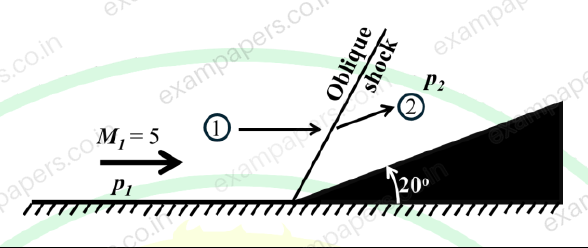
Log in to check the answer
You can attempt this question now. Sign in to view the answer key, explanations and discussion.Log in to check answerQuestion 50
Open questionAENAT2 marksNeeds review
A perfect gas flows through a frictionless constant-area duct with heat addition. The inlet conditions are as follows: pressure 100 kPa, density 1 kg/m
, and velocity 100 m/s. At a particular downstream location, the gas velocity is 200 m/s. The static pressure at the downstream location is
kPa (answer in integer).Log in to check the answer
You can attempt this question now. Sign in to view the answer key, explanations and discussion.Log in to check answer