
Architecture and Planning
GATE AR exam:gate PYQs
Build your understanding with focused practice from past exam papers.
Questions 71–80 of 730. Imported answers require independent review unless marked reviewed.
Question 71
Open questionAR-B2NAT1 markNeeds review
Based on Greenshield’s model, a speed-density relationship is developed on the data of a traffic stream. This relationship is represented as v = 75 − 0.03k, where v (in km/hr) is the mean speed at density k (in vehicle/km). The jam density (in vehicle/km) of this traffic stream is ____________ (in integer).
Log in to check the answer
You can attempt this question now. Sign in to view the answer key, explanations and discussion.Log in to check answerQuestion 72
Open questionAR-B2NAT1 markNeeds review
In a particular year, the status of Consolidated Funds of India is shown in the table below. For the given data, the fiscal deficit of that year (Rupees in crores) is ____________ (in integer).
Consolidated Funds of India | | | |
|---|---|---|---|
Receipt | Amount (Rupees in Crores) | Expenditure | Amount (Rupees in Crores) |
Revenue | 2,65,279 | Revenue | 3,75,582 |
Non-debt capital receipt | 3,646 | Capital | 31,295 |
Recovery of loans and advances | 20,733 | Disbursement of loans and advances | 38,614 |
Public debt | 4,36,689 | Public debt repayment | 3,21,725 |
Log in to check the answer
You can attempt this question now. Sign in to view the answer key, explanations and discussion.Log in to check answerQuestion 73
Open questionAR-B2MCQ2 marksNeeds review
Match the following zoning in Group–I with their characteristics in Group–II.
Group–I | | Group–II | |
|---|---|---|---|
P | Form based zoning | 1 | Strictly segregates different land uses |
Q | Euclidean zoning | 2 | Provides for urban poor or economically weaker sections in land use planning |
R | Inclusionary zoning | 3 | Regulates the development by assessing the impacts of land use |
S | Performance zoning | 4 | Encourages developers to build community amenities in lieu of surplus F.A.R. |
| | 5 | Creates a public realm by guiding the building envelope, considering the community’s unique characteristics |
Your answerChoose one option.
Log in to check the answer
You can attempt this question now. Sign in to view the answer key, explanations and discussion.Log in to check answerQuestion 74
Open questionAR-B2MCQ2 marksNeeds review
Match the following strategies in Group–I with their corresponding descriptions in Group–II.
Group–I | | Group–II | |
|---|---|---|---|
P | Transfer of Development Rights | 1 | Financial support by the Government for Public-Private-Partnership projects |
Q | Betterment Levy | 2 | Tax imposed on unused or underdeveloped plots |
R | Viability Gap Funding | 3 | Award of additional F.A.R. in different locations in exchange of land for public purpose |
S | Vacant Land Tax | 4 | One-time fee to recover investment for enhanced public infrastructure |
| | 5 | Fee for land use change from agriculture to non-agriculture |
Your answerChoose one option.
Log in to check the answer
You can attempt this question now. Sign in to view the answer key, explanations and discussion.Log in to check answerQuestion 75
Open questionAR-B2MCQ2 marksNeeds review
Match the following types of plans in Group–I with their corresponding scope in Group–II, in accordance with the URDPFI Guidelines, 2015.
Group–I | | Group–II | |
|---|---|---|---|
P | Perspective Plan | 1 | To identify resources for development and plan for settlements, prepared and regulated by District Plan Committee |
Q | Regional Plan | 2 | To detail sub-city land use plan and integrate with urban infrastructure |
R | Development Plan | 3 | To develop vision and provide policy framework for urban and regional development |
S | Local Area Plan | 4 | To prepare special area plan for towns with special development needs |
| | 5 | To prepare plan for urban areas and peri-urban areas under the control of Metropolitan Planning Committee |
Your answerChoose one option.
Log in to check the answer
You can attempt this question now. Sign in to view the answer key, explanations and discussion.Log in to check answerQuestion 76
Open questionAR-B2MSQ2 marksNeeds review
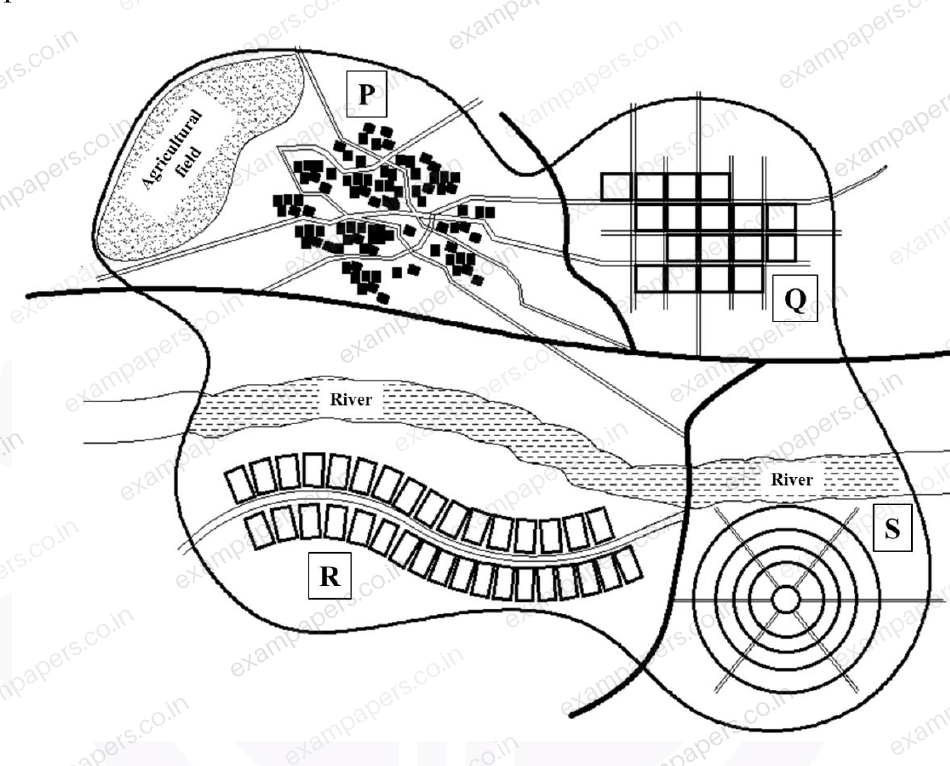
Which of the following is/are correct labeling of P, Q, R, S with respect to the urban patterns shown below?
Your answerSelect all correct options. You can choose more than one.
Log in to check the answer
You can attempt this question now. Sign in to view the answer key, explanations and discussion.Log in to check answerQuestion 77
Open questionAR-B2MSQ2 marksNeeds review
Which of the following is/ are passive remote sensing technique(s)?
Your answerSelect all correct options. You can choose more than one.
Log in to check the answer
You can attempt this question now. Sign in to view the answer key, explanations and discussion.Log in to check answerQuestion 78
Open questionAR-B2NAT2 marksNeeds review
A capital investment of Rs. 60,000 has been made at present, expecting an annual return of Rs. 20,000 at the end of each year for a period of 5 years. If the annual discount rate is 5%, then the Net Present Value (in Rs.) is __________ (rounded off to the nearest integer).
Log in to check the answer
You can attempt this question now. Sign in to view the answer key, explanations and discussion.Log in to check answerQuestion 79
Open questionAR-B2NAT2 marksNeeds review
The demand function of a light rail transit system (LRTS) of a city is represented as Q = 4300 – 85P, where Q is the ridership/day and P is the fare/ride. If the existing fare of Rs. 30 per ride is reduced to Rs. 25 per ride, then the consequent increase in ridership of the LRTS (in percentage) is __________ (rounded off to two decimal places).
Log in to check the answer
You can attempt this question now. Sign in to view the answer key, explanations and discussion.Log in to check answerQuestion 80
Open questionAR-B2NAT2 marksNeeds review
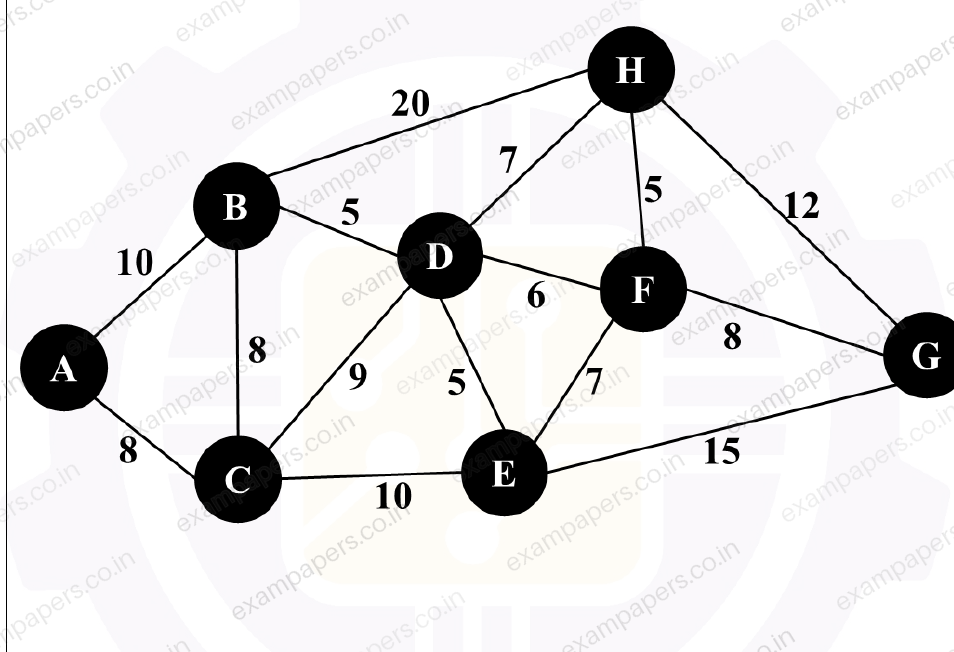
In a transport network, all the nodes (represented by A, B, C, D, E, F, G, H) and their connecting links are shown in the figure below. The values mentioned alongside the links represent the travel time (in minutes) between nodes. Following the shortest path, the minimum time required to commute from node A to node G (in minutes) is __________ (in integer).
Log in to check the answer
You can attempt this question now. Sign in to view the answer key, explanations and discussion.Log in to check answer