
Architecture and Planning
GATE AR purpose:exam-prep PYQs
Build your understanding with focused practice from past exam papers.
Questions 511–520 of 730. Imported answers require independent review unless marked reviewed.
Question 31
Open questionARMCQ2 marksNeeds review
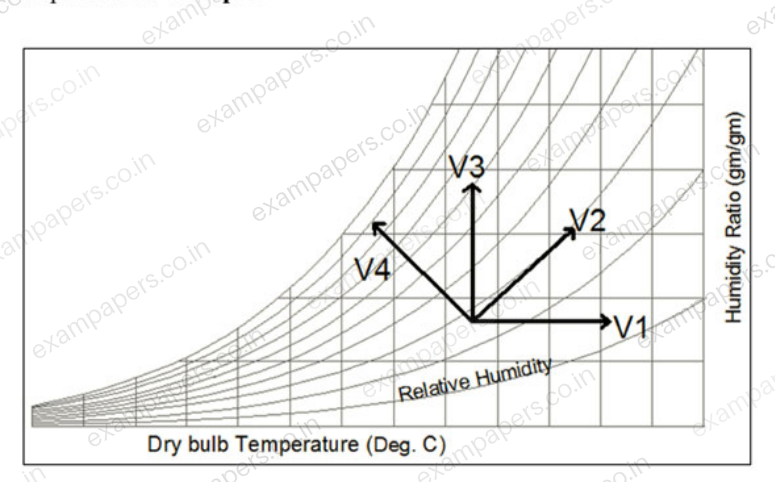
Based on the psychometric chart given below, match the vector in Group I with the respective process in Group II.
Group I: (P) V1; (Q) V2; (R) V3; (S) V4.
Group II: (1) Heating and humidification; (2) Cooling and humidification; (3) Heating and dehumidification; (4) Sensible heating; (5) Humidification.
Your answerChoose one option.
Log in to check the answer
You can attempt this question now. Sign in to view the answer key, explanations and discussion.Log in to check answerQuestion 32
Open questionARMCQ2 marksNeeds review
Match the software tools in Group I with their primary applications in Group II.
Group I: (P) ETabs; (Q) Carto; (R) eQuest; (S) SPSS.
Group II: (1) Acoustic analysis; (2) Structural analysis; (3) Statistical analysis; (4) Energy simulation; (5) Geo-spatial analysis.
Your answerChoose one option.
Log in to check the answer
You can attempt this question now. Sign in to view the answer key, explanations and discussion.Log in to check answerQuestion 33
Open questionARMCQ2 marksNeeds review
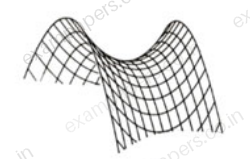
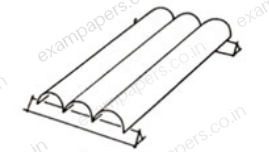
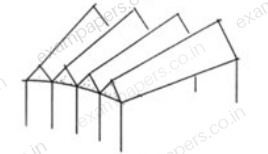
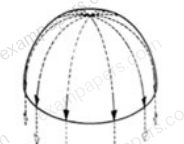
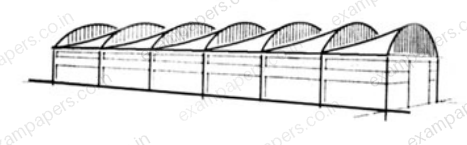
Match the structural form in Group I with their corresponding illustration in Group II.
Group I
(P) Cylindrical shell; (Q) Dome; (R) Conoid; (S) Hyperbolic paraboloid.
Group II
(1)
(2)
(3)
(4)
(5)
Your answerChoose one option.
Log in to check the answer
You can attempt this question now. Sign in to view the answer key, explanations and discussion.Log in to check answerQuestion 34
Open questionARMCQ2 marksNeeds review
Match the books in Group I with the corresponding authors in Group II.
Group I: (P) The Autobiography of an Idea; (Q) Letters to a Young Architect; (R) A Pattern Language; (S) Architecture: Forms, Space and Order.
Group II: (1) Christopher Charles Benninger; (2) Sunil Khilnani; (3) Francis D. K. Ching; (4) Louis H. Sullivan; (5) Christopher Alexander.
Your answerChoose one option.
Log in to check the answer
You can attempt this question now. Sign in to view the answer key, explanations and discussion.Log in to check answerQuestion 35
Open questionARMCQ2 marksNeeds review
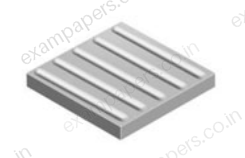
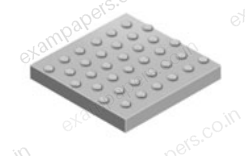
Match the names of tactile paving in Group I with their patterns in Group II.
Group I: (P) Lozenge; (Q) Offset blister; (R) Corduroy; (S) Directional.
Group II: (1)
(2)
(3)
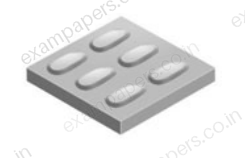
(4)
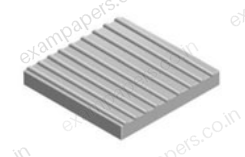
(5)
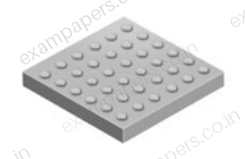
Your answerChoose one option.
Log in to check the answer
You can attempt this question now. Sign in to view the answer key, explanations and discussion.Log in to check answerQuestion 36
Open questionARMCQ2 marksNeeds review
Match the name of architects in Group I with the buildings designed by them in Group II.
Group I: (P) Brinda Somaya; (Q) Sheila Sai Prakash; (R) Revathy Kamath; (S) Marina Tabassum.
Group II: (1) Museum of Tribal Heritage, Bhopal; (2) St. Thomas Cathedral, Mumbai; (3) Bait-ur-Rauf Mosque, Dhaka; (4) Indian Naval Academy, Kerala; (5) Cholamandalam Artists’ Village, Chennai
Your answerChoose one option.
Log in to check the answer
You can attempt this question now. Sign in to view the answer key, explanations and discussion.Log in to check answerQuestion 37
Open questionARMCQ2 marksNeeds review
Match the terms in Group I with the parameters in Group II.
Group I: (P) Frontal Area Density; (Q) Sky View Factor; (R) Drift Index; (S) Biotope Factor.
Group II: (1) Active Green Area; (2) Urban Density in Third Dimension; (3) Built Density in Two Dimension; (4) Lateral Stiffness; (5) Cross Sectional Property of Urban Canyon
Your answerChoose one option.
Log in to check the answer
You can attempt this question now. Sign in to view the answer key, explanations and discussion.Log in to check answerQuestion 38
Open questionARMCQ2 marksNeeds review
Match the structural system in Group I with their potential causes of failure in Group II.
Group I: (P) Flat Slab; (Q) Long Column; (R) Arch; (S) Tensile Fabric.
Group II: (1) Thrust; (2) Flutter; (3) Punching Shear; (4) Buckling; (5) Moment
Your answerChoose one option.
Log in to check the answer
You can attempt this question now. Sign in to view the answer key, explanations and discussion.Log in to check answerQuestion 39
Open questionARMCQ2 marksNeeds review
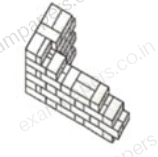
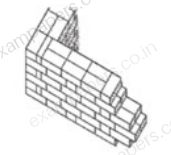
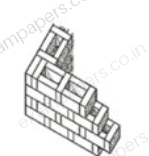
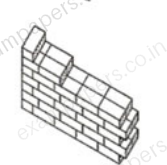
Match the brick masonry bond type in Group I with the corresponding illustration in Group II.
Group I
(P) Rat Trap
(Q) English
(R) Flemish
(S) Stretcher
Group II
(1)
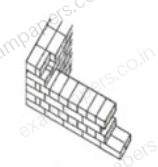
(2)
(3)
(4)
(5)
Your answerChoose one option.
Log in to check the answer
You can attempt this question now. Sign in to view the answer key, explanations and discussion.Log in to check answerQuestion 40
Open questionARMCQ2 marksNeeds review
Match the characteristics in Group I with the type of settlements in Group II as given in URDPFI Guidelines 2015, Government of India.
Group I: (P) Zones of transition from rural to urban land uses located between the outer limits of urban and regional centres and rural environment; (Q) Towns having potential for investment and development; identified on the basis of their inter-aerial relationship with the regional nodal centre; (R) Settlements that are growing sub-nodal centres but located out of the direct functionally linked areas of the growth node / nodal centre in the region; (S) Located near or within reasonable distance, well connected by transportation route of the growth node or metropolitan city and dependent on growth node largely for employment.
Group II: (1) Counter-Magnets; (2) Satellite Towns; (3) Peri-Urban Areas; (4) Priority Towns; (5) Statutory Towns
Your answerChoose one option.
Log in to check the answer
You can attempt this question now. Sign in to view the answer key, explanations and discussion.Log in to check answer