
Architecture and Planning
GATE AR Quantitative Aptitude PYQs
Build your understanding with focused practice from past exam papers.
Questions 21–30 of 49. Imported answers require independent review unless marked reviewed.
Question 3
Open questionGAMCQ1 markNeeds review
A person travelled 80 km in 6 hours. If the person travelled the first part with a uniform speed of 10 kph and the remaining part with a uniform speed of 18 kph.
What percentage of the total distance is traveled at a uniform speed of 10 kph?
Your answerChoose one option.
Log in to check the answer
You can attempt this question now. Sign in to view the answer key, explanations and discussion.Log in to check answerQuestion 7
Open questionGAMCQ2 marksNeeds review
A rhombus is formed by joining the midpoints of the sides of a unit square.
What is the diameter of the largest circle that can be inscribed within the rhombus?
Your answerChoose one option.
Log in to check the answer
You can attempt this question now. Sign in to view the answer key, explanations and discussion.Log in to check answerQuestion 8
Open questionGAMCQ2 marksNeeds review
An equilateral triangle, a square and a circle have equal areas.
What is the ratio of the perimeters of the equilateral triangle to square to circle?
Your answerChoose one option.
Log in to check the answer
You can attempt this question now. Sign in to view the answer key, explanations and discussion.Log in to check answerQuestion 10
Open questionGAMCQ2 marksNeeds review
In a 12-hour clock that runs correctly, how many times do the second, minute, and hour hands of the clock coincide, in 12-hour duration from 3 PM in a day to 3 AM the next day?
Your answerChoose one option.
Log in to check the answer
You can attempt this question now. Sign in to view the answer key, explanations and discussion.Log in to check answerQuestion 3
Open questionGAMCQ1 markNeeds review
Two identical cube shaped dice each with faces numbered 1 to 6 are rolled simultaneously. The probability that an even number is rolled out on each dice is:
Your answerChoose one option.
Log in to check the answer
You can attempt this question now. Sign in to view the answer key, explanations and discussion.Log in to check answerQuestion 4
Open questionGAMCQ1 markNeeds review
and
are two operators on numbers
and
such that
, and
.
Then,
Your answerChoose one option.
Log in to check the answer
You can attempt this question now. Sign in to view the answer key, explanations and discussion.Log in to check answerQuestion 6
Open questionGAMCQ2 marksNeeds review
On a planar field, you travelled 3 units East from a point O. Next you travelled 4 units South to arrive at point P. Then you travelled from P in the North-East direction such that you arrive at a point that is 6 units East of point O. Next, you travelled in the North-West direction, so that you arrive at point Q that is 8 units North of point P.
The distance of point Q to point O, in the same units, should be _____
Your answerChoose one option.
Log in to check the answer
You can attempt this question now. Sign in to view the answer key, explanations and discussion.Log in to check answerQuestion 9
Open questionGAMCQ2 marksNeeds review
In the figure shown above, PQRS is a square. The shaded portion is formed by the intersection of sectors of circles with radius equal to the side of the square and centers at S and Q.
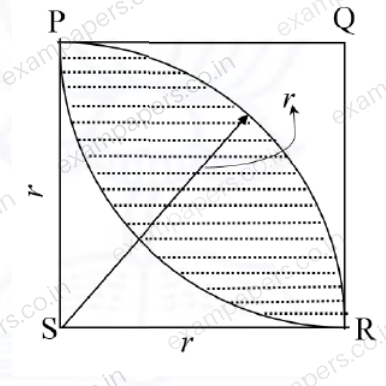
The probability that any point picked randomly within the square falls in the shaded area is ______
Your answerChoose one option.
Log in to check the answer
You can attempt this question now. Sign in to view the answer key, explanations and discussion.Log in to check answerQuestion 10
Open questionGAMCQ2 marksNeeds review
In an equilateral triangle PQR, side PQ is divided into four equal parts, side QR is divided into six equal parts and side PR is divided into eight equal parts. The length of each subdivided part in cm is an integer.
The minimum area of the triangle PQR possible, in cm
, isYour answerChoose one option.
Log in to check the answer
You can attempt this question now. Sign in to view the answer key, explanations and discussion.Log in to check answerQuestion 5
Open questionGAMCQ1 markNeeds review
The difference between the sum of the first
natural numbers and the sum of the first
odd natural numbers is _____.Your answerChoose one option.
Log in to check the answer
You can attempt this question now. Sign in to view the answer key, explanations and discussion.Log in to check answer