
Architecture and Planning
GATE AR Section B.1: History and Contemporary Architecture PYQs
Build your understanding with focused practice from past exam papers.
How to practice Section B.1: History and Contemporary Architecture
Attempt a question, record the concept and assumptions, then check the available answer. Rework mistakes after revising the relevant concepts. Topic tags can overlap; review the question context.
Questions 1–6 of 6. Imported answers require independent review unless marked reviewed.
Question 19
Open questionARMCQ1 markNeeds review
Read the following statements and select the correct option.
P: Strong axial layout, symmetry, proportion and infinite perspective of the 17th Century French Gardens reflects the wealth, power and rigid social structure of France.
Q: Italian gardens of early renaissance period were designed as intellectual retreats where scholars and artists could work and debate.
Your answerChoose one option.
Log in to check the answer
You can attempt this question now. Sign in to view the answer key, explanations and discussion.Log in to check answerQuestion 24
Open questionARMCQ1 markNeeds review
Which one of the following buildings features an Onion dome?
Your answerChoose one option.
Log in to check the answer
You can attempt this question now. Sign in to view the answer key, explanations and discussion.Log in to check answerQuestion 50
Open questionAR-B1MCQ1 markNeeds review
With reference to Squinch adopted in dome construction, choose the correct option related to statements P and Q.
P: Squinch is a structural element used to support the base of a circular or octagonal dome that surmounts a square hall.
Q: Squinch is a double layered dome comprising of an inner and an outer layer of masonry.
Your answerChoose one option.
Log in to check the answer
You can attempt this question now. Sign in to view the answer key, explanations and discussion.Log in to check answerQuestion 54
Open questionAR-B1MCQ1 markNeeds review
A typical Clasical Greek temple with Doric order columns is illustrated in the figure. Identify the correct terms corresponding to P, Q and R marked in the figure.
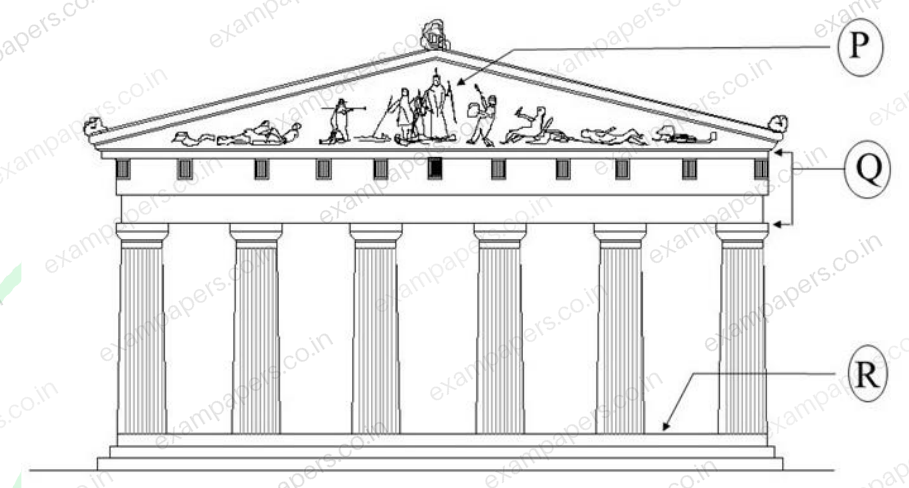
Your answerChoose one option.
Log in to check the answer
You can attempt this question now. Sign in to view the answer key, explanations and discussion.Log in to check answerQuestion 58
Open questionAR-B1MCQ2 marksNeeds review
Match the statements in Group-I with the corresponding names of architects in Group-II.
Group-I: (P) Form Follows Function; (Q) Less is More; (R) Architecture should speak of its time and place, but yearn for timelessness; (S) There are no straight lines or sharp corners in nature.
Group-II: (1) Ludwig Mies van der Rohe; (2) Louis H. Sullivan; (3) Antoni Gaudi; (4) Frank O. Gehry; (5) Adolf Loos
Your answerChoose one option.
Log in to check the answer
You can attempt this question now. Sign in to view the answer key, explanations and discussion.Log in to check answerQuestion 60
Open questionAR-B1MCQ2 marksNeeds review
Match the following Indian Temples in Group-I with their relevant descriptions in Group-II.
Group-I: (P) Kailasa Temple, Ellora; (Q) Shore Temple, Mamallapuram; (R) Mahabodhi Temple, Bodh Gaya; (S) Brihadisvara Temple, Thanjavur.
Group-II: (1) Temple from Chandela culture; (2) Temple from late Gupta period entirely built in brick; (3) Pallava temple constructed of dressed stone; (4) Brahmanical rock-cut architecture, constructed by excavating out of the hill site; (5) One of the largest Chola temples
Your answerChoose one option.
Log in to check the answer
You can attempt this question now. Sign in to view the answer key, explanations and discussion.Log in to check answer