
Architecture and Planning
GATE AR topic:regional-settlement-planning PYQs
Build your understanding with focused practice from past exam papers.
Questions 21–30 of 38. Imported answers require independent review unless marked reviewed.
Question 32
Open questionARMCQ2 marksNeeds review
Match the examples in Group I with their corresponding typologies in Group II.
Group I: (P) Navi Mumbai; (Q) Hissar; (R) Greater Mumbai; (S) Delhi-Mumbai Industrial Corridor.
Group II: (1) Counter Magnet; (2) Urban Agglomeration; (3) Satellite Town; (4) University Town; (5) Investment Region.
Your answerChoose one option.
Log in to check the answer
You can attempt this question now. Sign in to view the answer key, explanations and discussion.Log in to check answerQuestion 74
Open questionARMCQ2 marksNeeds review
Match the proponents in Group I with the corresponding theories in Group II.
Group I | Group II |
|---|---|
(P) James Q Wilson and George K. Kelling | (1) Creative Class |
(Q) Sherry Arnstein | (2) Right to City |
(R) Henry Lefebvre | (3) Drive-in Culture |
(S) Richard Florida | (4) Ladder of Citizen Participation |
| (5) Broken Window |
Your answerChoose one option.
Log in to check the answer
You can attempt this question now. Sign in to view the answer key, explanations and discussion.Log in to check answerQuestion 75
Open questionARMCQ2 marksNeeds review
Match the Artists/Scientists in Group I with their corresponding contributions in Group II.
Group I | Group II |
|---|---|
(P) Robert Park and Louis Wirth | (1) Poverty Map |
(Q) Jacob August Riis | (2) Cholera Map |
(R) Charles Booth | (3) Tenement Shelter Photography |
(S) John Snow | (4) Urban Ethnography |
| (5) Underground Sewer Systems |
Your answerChoose one option.
Log in to check the answer
You can attempt this question now. Sign in to view the answer key, explanations and discussion.Log in to check answerQuestion 76
Open questionARMCQ2 marksNeeds review
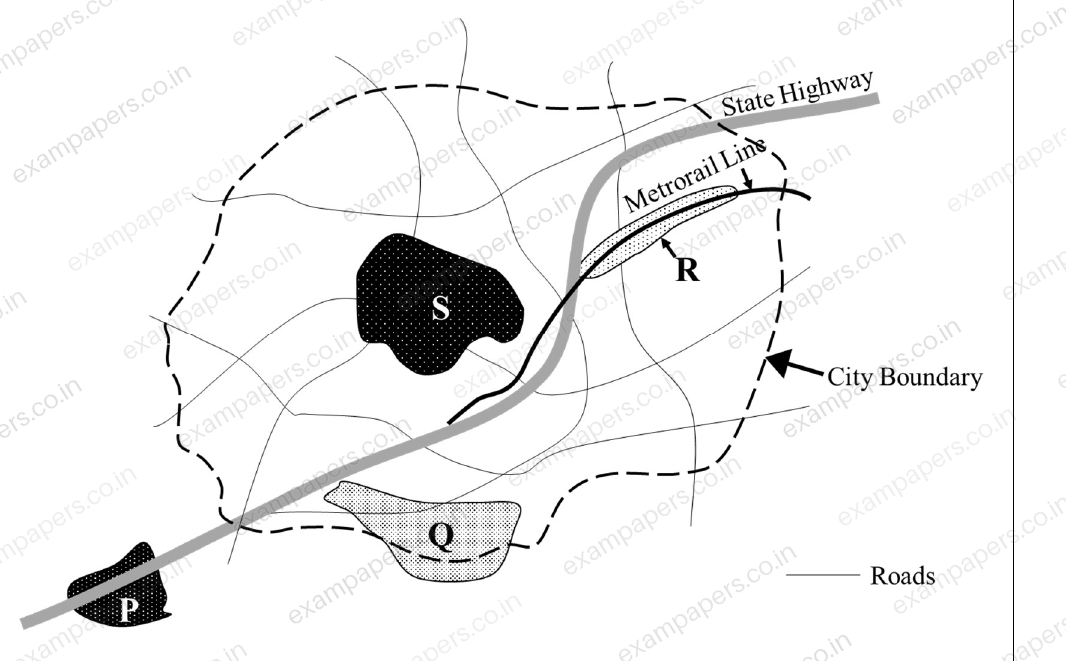
In the conceptual diagram of the city given below, P, Q, R, and S refer to urban patterns. Among the choices given below, the correct association is
Your answerChoose one option.
Log in to check the answer
You can attempt this question now. Sign in to view the answer key, explanations and discussion.Log in to check answerQuestion 16
Open questionARMCQ1 markNeeds review
The law of Primate City was first proposed by
Your answerChoose one option.
Log in to check the answer
You can attempt this question now. Sign in to view the answer key, explanations and discussion.Log in to check answerQuestion 17
Open questionARMCQ1 markNeeds review
In the European Union which constitutes the cities namely, London, Paris, Brussels, Amsterdam, Cologne, Frankfurt, Munich and Milan, lie within a linear megalopolitan zone known as
Your answerChoose one option.
Log in to check the answer
You can attempt this question now. Sign in to view the answer key, explanations and discussion.Log in to check answerQuestion 5
Open questionARMCQ1 markNeeds review
As per URDPFI Guidelines 2015, Government of India, choose the correct hierarchy of plans from higher to lower order.
Your answerChoose one option.
Log in to check the answer
You can attempt this question now. Sign in to view the answer key, explanations and discussion.Log in to check answerQuestion 19
Open questionARMCQ1 markNeeds review
‘Formulation of GIS based master plan’ is a sub-scheme of
Your answerChoose one option.
Log in to check the answer
You can attempt this question now. Sign in to view the answer key, explanations and discussion.Log in to check answerQuestion 40
Open questionARMCQ2 marksNeeds review
Match the characteristics in Group I with the type of settlements in Group II as given in URDPFI Guidelines 2015, Government of India.
Group I: (P) Zones of transition from rural to urban land uses located between the outer limits of urban and regional centres and rural environment; (Q) Towns having potential for investment and development; identified on the basis of their inter-aerial relationship with the regional nodal centre; (R) Settlements that are growing sub-nodal centres but located out of the direct functionally linked areas of the growth node / nodal centre in the region; (S) Located near or within reasonable distance, well connected by transportation route of the growth node or metropolitan city and dependent on growth node largely for employment.
Group II: (1) Counter-Magnets; (2) Satellite Towns; (3) Peri-Urban Areas; (4) Priority Towns; (5) Statutory Towns
Your answerChoose one option.
Log in to check the answer
You can attempt this question now. Sign in to view the answer key, explanations and discussion.Log in to check answerQuestion 11
Open questionARMCQ1 markNeeds review
The term ‘Necropolis’ refers to
Your answerChoose one option.
Log in to check the answer
You can attempt this question now. Sign in to view the answer key, explanations and discussion.Log in to check answer