
Biotechnology
GATE BT exam:gate PYQs
Build your understanding with focused practice from past exam papers.
Questions 31–40 of 650. Imported answers require independent review unless marked reviewed.
Question 31
Open questionBTNAT1 markNeeds review
The mean of the following series is _____. (rounded off to three decimal places)
0.01, 0.02, 0.03, ⋯ ⋯ ⋯, 1
Log in to check the answer
You can attempt this question now. Sign in to view the answer key, explanations and discussion.Log in to check answerQuestion 32
Open questionBTNAT1 markNeeds review
You are characterizing a new enzyme isolated and purified in the laboratory. If the maximum velocity of the enzyme is 1800 μmoles L⁻¹ min⁻¹ and the total concentration of the enzyme in the reaction mixture is 1.5 μM, then the turnover number of the enzyme is _____ s⁻¹. (answer in integer)
Log in to check the answer
You can attempt this question now. Sign in to view the answer key, explanations and discussion.Log in to check answerQuestion 33
Open questionBTNAT1 markNeeds review
To determine the viable cell count of a bacterial culture, you have plated 50 μL of a 100-fold diluted sample of the culture on a nutrient agar plate and obtained 20 colonies after overnight incubation. The viable cell count of the culture is _____ CFU mL⁻¹. (answer in integer)
Log in to check the answer
You can attempt this question now. Sign in to view the answer key, explanations and discussion.Log in to check answerQuestion 34
Open questionBTNAT1 markNeeds review
Given below is the Gibbs free energy change (ΔG) in kilo Joules per electron equivalent (kJ e⁻eq⁻¹) at pH 7.0, of organic and inorganic half reactions.
Acetate synthesis:
ΔG=27.4 kJ e⁻eq⁻¹Reduction reaction:
ΔG = -78.72 kJ e⁻eq⁻¹The free energy change of acetate oxidation to CO₂, H₂O and HCO₃⁻ is _____ kJ e⁻eq⁻¹. (rounded off to two decimal places)
Log in to check the answer
You can attempt this question now. Sign in to view the answer key, explanations and discussion.Log in to check answerQuestion 35
Open questionBTNAT1 markNeeds review
You have purified an enzyme using a series of chromatographic methods. It was observed that a 10 μg mL⁻¹ of this purified enzyme converted 10 mM substrate per hour at 25°C and pH 7. Its specific activity is _____ IU μg⁻¹. (rounded off to three decimal places)
Log in to check the answer
You can attempt this question now. Sign in to view the answer key, explanations and discussion.Log in to check answerQuestion 36
Open questionBTMCQ2 marksNeeds review
In the open-loop process shown in the figure, the input
, the transfer function
and the output
are given in the Laplace domain in terms of the Laplace variable s. For this process, which of the following is true?(where
,
,
, are the magnitude of the input, the characteristic time and the gain for the process, respectively)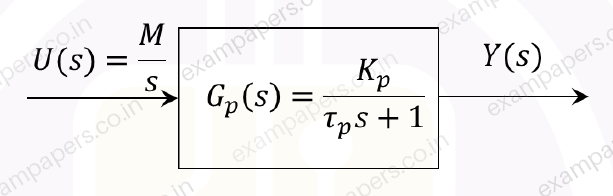
Your answerChoose one option.
Log in to check the answer
You can attempt this question now. Sign in to view the answer key, explanations and discussion.Log in to check answerQuestion 37
Open questionBTMCQ2 marksNeeds review
Match the immunological terms in Column I with their function/description in the Column II
Column I: P. J gene; Q. Cyclosporin; R. Epitope; S. Hapten
Column II: 1. Suppresses immune system by blocking calcineurin; 2. Antibody binding site on a large molecule; 3. Small foreign molecule which elicits an immune response only when combined with a carrier molecule; 4. Contributes to antibody diversity
Your answerChoose one option.
Log in to check the answer
You can attempt this question now. Sign in to view the answer key, explanations and discussion.Log in to check answerQuestion 38
Open questionBTMCQ2 marksNeeds review
Match the genetic disorders in Column I to the corresponding underlying cause in Column II
Column I: P. Klinefelter Syndrome; Q. Turner syndrome; R. Bloom syndrome; S. Xeroderma pigmentosum
Column II: 1. X-chromosome insufficiency; 2. DNA helicase mutations; 3. Nucleotide excision repair defects; 4. Extra X chromosome(s) in a male
Your answerChoose one option.
Log in to check the answer
You can attempt this question now. Sign in to view the answer key, explanations and discussion.Log in to check answerQuestion 39
Open questionBTMCQ2 marksNeeds review
Match the biomolecules in Column I with their function given in Column II
Column I: P. Lectins; Q. P-glycoprotein; R. Digitoxigenin; S. Mannose 6-phosphate
Column II: 1. Acts as ATP dependent pump to efflux out small molecules; 2. Targets lysosomal enzymes to their destination; 3. Specific carbohydrate binding proteins; 4. Inhibits Na⁺-K⁺ pump
Your answerChoose one option.
Log in to check the answer
You can attempt this question now. Sign in to view the answer key, explanations and discussion.Log in to check answerQuestion 40
Open questionBTMCQ2 marksNeeds review
By elemental analysis of a biomass sample, it was found that the cells in the given sample are composed of (by weight) C=50%, H=8%, O=20%, N=10% and ash content=12%. Which of the following is the correct empirical formula of the ash-free cells, normalized with respect to Nitrogen?
Your answerChoose one option.
Log in to check the answer
You can attempt this question now. Sign in to view the answer key, explanations and discussion.Log in to check answer