
Biotechnology
GATE BT format:mcq PYQs
Build your understanding with focused practice from past exam papers.
Questions 361–370 of 389. Imported answers require independent review unless marked reviewed.
Question 23
Open questionBTMCQ1 markNeeds review
The transcription factor X binds a 10 base pair DNA stretch. In the DNA of an organism, X was found to bind at 20 distinct sites. An analysis of these 20 binding sites showed the following distribution:
Base | 1 | 2 | 3 | 4 | 5 | 6 | 7 | 8 | 9 | 10 |
|---|---|---|---|---|---|---|---|---|---|---|
A | 11 | 0 | 0 | 0 | 16 | 2 | 4 | 0 | 4 | 3 |
T | 3 | 0 | 19 | 0 | 1 | 3 | 4 | 20 | 2 | 4 |
G | 4 | 20 | 0 | 0 | 2 | 4 | 6 | 0 | 12 | 2 |
C | 2 | 0 | 1 | 20 | 1 | 11 | 6 | 0 | 2 | 11 |
What is the consensus sequence for the binding site of X?
Your answerChoose one option.
Log in to check the answer
You can attempt this question now. Sign in to view the answer key, explanations and discussion.Log in to check answerQuestion 26
Open questionBTMCQ2 marksNeeds review
Which one of the following graphs represents the kinetics of protein precipitation by addition of ammonium sulphate? On the Y-axis, [Protein] represents the concentration of free protein in solution.
Your answerChoose one option.
Log in to check the answer
You can attempt this question now. Sign in to view the answer key, explanations and discussion.Log in to check answerQuestion 27
Open questionBTMCQ2 marksNeeds review
The distribution of marks scored by a large class in an exam can be represented as a normal distribution with mean μ and standard deviation σ. In a follow-up exam in the same class, everyone scored 5 marks more than their respective score in the earlier exam. For this follow-up exam, the distribution of marks can be represented as a normal distribution with mean μ₂ and standard deviation σ₂. Which one of the following is correct?
Your answerChoose one option.
Log in to check the answer
You can attempt this question now. Sign in to view the answer key, explanations and discussion.Log in to check answerQuestion 29
Open questionBTMCQ2 marksNeeds review
Match the proteins in Group I with cellular processes in Group II.
Group I: P. p53; Q. Lysozyme; R. Tubulins; S. Histones
Group II: 1. DNA packaging; 2. Apoptosis; 3. Hydrolysis of polysaccharides; 4. Chromosome segregation
Your answerChoose one option.
Log in to check the answer
You can attempt this question now. Sign in to view the answer key, explanations and discussion.Log in to check answerQuestion 30
Open questionBTMCQ2 marksNeeds review
The circular dichroism spectra of three proteins P, Q, and R are given below:
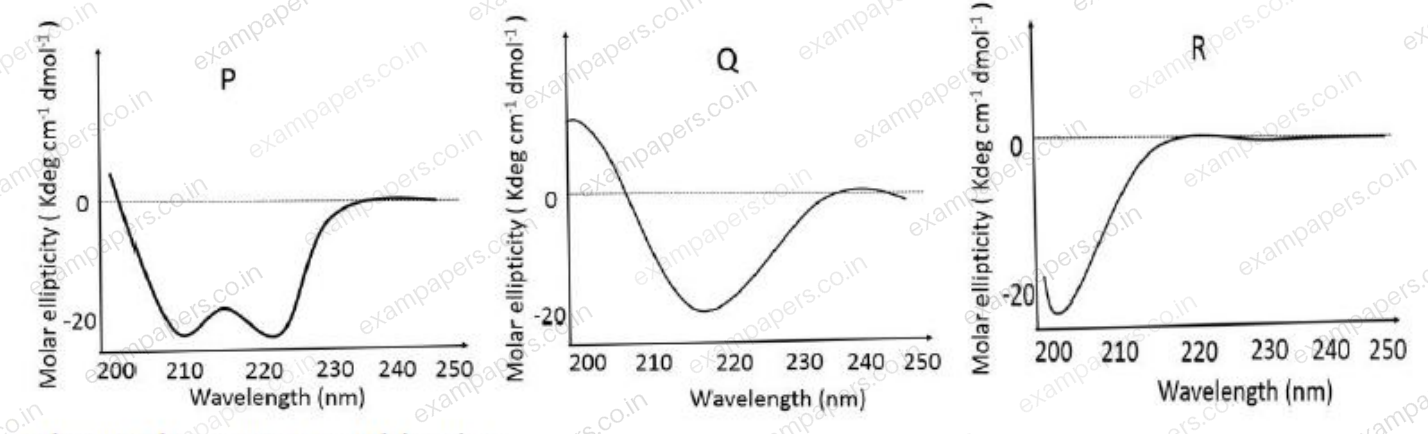
Choose the correct combination.
Your answerChoose one option.
Log in to check the answer
You can attempt this question now. Sign in to view the answer key, explanations and discussion.Log in to check answerQuestion 31
Open questionBTMCQ2 marksNeeds review
Match the organisms in Column I with the characteristics in Column II.
Column I | Column II |
|---|---|
P. Methanococcus | 1. Halophile |
Q. Dunaliella | 2. Acidophile |
R. Sulfolobus | 3. Mesophile |
S. Escherichia | 4. Barophile |
Your answerChoose one option.
Log in to check the answer
You can attempt this question now. Sign in to view the answer key, explanations and discussion.Log in to check answerQuestion 32
Open questionBTMCQ2 marksNeeds review
Which one of the following amino acids has three ionizable groups?
Your answerChoose one option.
Log in to check the answer
You can attempt this question now. Sign in to view the answer key, explanations and discussion.Log in to check answerQuestion 36
Open questionBTMCQ2 marksNeeds review
Which one of the following organisms is responsible for crown gall disease in plants?
Your answerChoose one option.
Log in to check the answer
You can attempt this question now. Sign in to view the answer key, explanations and discussion.Log in to check answerQuestion 38
Open questionBTMCQ2 marksNeeds review
Match the plant hormones in Column I with functions in Column II.
Column I:
P. Gibberellic acid
Q. Zeatin
R. Ethylene
S. Abscisic acid
Column II:
Seed and bud dormancy
Fruit ripening
Delaying leaf senescence
Regulation of plant height
Your answerChoose one option.
Log in to check the answer
You can attempt this question now. Sign in to view the answer key, explanations and discussion.Log in to check answerQuestion 40
Open questionBTMCQ2 marksNeeds review
An immunocompetent person becomes infected with a pathogenic strain of bacteria. Which one of the following graphs correctly depicts bacterial load in this person over time?
Your answerChoose one option.
Log in to check the answer
You can attempt this question now. Sign in to view the answer key, explanations and discussion.Log in to check answer