
Biotechnology
GATE BT topic:biotechnology PYQs
Build your understanding with focused practice from past exam papers.
Questions 631–640 of 650. Imported answers require independent review unless marked reviewed.
Question 46
Open questionBTNAT2 marksNeeds review
If the chemical composition of proteins in an organism is CH₁.₅O₀.₃N₀.₃S₀.₀₀₄, the mass percentage of carbon in the proteins is ________.
Given data: Atomic weights (Da) of C = 12, H = 1, O = 16, N = 14, and S = 32.
Log in to check the answer
You can attempt this question now. Sign in to view the answer key, explanations and discussion.Log in to check answerQuestion 47
Open questionBTNAT2 marksNeeds review
For the probability density
, the integral
________.Log in to check the answer
You can attempt this question now. Sign in to view the answer key, explanations and discussion.Log in to check answerQuestion 48
Open questionBTMCQ2 marksNeeds review
Growth of a microbe in a test tube is modeled as
, where, X is the biomass, r is the growth rate, and K is the carrying capacity of the environment (
;
). If the value of starting biomass is
, which one of the following graphs qualitatively represents the growth dynamics?Your answerChoose one option.
Log in to check the answer
You can attempt this question now. Sign in to view the answer key, explanations and discussion.Log in to check answerQuestion 49
Open questionBTNAT2 marksNeeds review
A zero-order liquid phase reaction A
B is being carried out in a batch reactor with
mol/min. If the starting concentration of A is 0.1 moles/liter, the time (in minutes) taken by the system before A is exhausted in a 100 liter reactor is ________.Log in to check the answer
You can attempt this question now. Sign in to view the answer key, explanations and discussion.Log in to check answerQuestion 50
Open questionBTMCQ2 marksNeeds review
The interaction energy E between two spherical particles is plotted as a function of the distance (r) between them. When
, where
is a constant, the net force between the spherical particles is repulsive. When
, they attract via van der Waals attraction. Which one of the following plots correctly represents the interaction energy between the above two particles?Your answerChoose one option.
Log in to check the answer
You can attempt this question now. Sign in to view the answer key, explanations and discussion.Log in to check answerQuestion 51
Open questionBTMCQ2 marksNeeds review
EcoRI restriction sites on a 10kb DNA fragment are shown below.
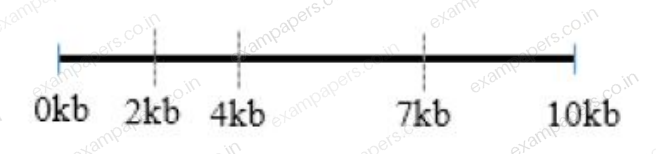
Upon partial digestion, what are the lengths (in kb) of all the possible DNA fragments obtained?
Your answerChoose one option.
Log in to check the answer
You can attempt this question now. Sign in to view the answer key, explanations and discussion.Log in to check answerQuestion 52
Open questionBTNAT2 marksNeeds review
A DNA strand of length 25 nm wraps diametrically around the circumference of a spherical histone-octamer once. The radius (nm) of the histone-octamer is ________. Given data:
Log in to check the answer
You can attempt this question now. Sign in to view the answer key, explanations and discussion.Log in to check answerQuestion 53
Open questionBTNAT2 marksNeeds review
One hundred E. coli cells are each infected by a single
phage particle. The ratio of the number of phage particles committing to lysogeny to those committing to lysis is 4:1. Assuming that the average burst size is 80, the number of free phage particles released after one round of infection is ________.Log in to check the answer
You can attempt this question now. Sign in to view the answer key, explanations and discussion.Log in to check answerQuestion 54
Open questionBTNAT2 marksNeeds review
During anaerobic growth, an organism converts glucose (P) into biomass (Q), ethanol (R), acetaldehyde (S), and glycerol (T). Every mole of carbon present in glucose gets distributed among the products as follows:
1 (C-mole P)
0.14 (C-mole Q) + 0.25 (C-mole R) + 0.3 (C-mole S) + 0.31 (C-mole T)From 1800 grams of glucose fed to the organism, the ethanol produced (in grams) is ________. Given data: Atomic weights (Da) of C = 12, H = 1, O = 16, and N = 14
Log in to check the answer
You can attempt this question now. Sign in to view the answer key, explanations and discussion.Log in to check answerQuestion 55
Open questionBTMCQ2 marksNeeds review
Which of the following conditions promote the development of human autoimmune disorders?
P. Inability to eliminate self-reactive lymphocytes
Q. Generation of auto-antibodies
R. Ability to eliminate self-reactive T-cells
S. Induction of regulatory T-cells in the thymus
Your answerChoose one option.
Log in to check the answer
You can attempt this question now. Sign in to view the answer key, explanations and discussion.Log in to check answer