
Biotechnology
GATE BT topic:classical-thermodynamics-bioenergetics PYQs
Build your understanding with focused practice from past exam papers.
Questions 11–19 of 19. Imported answers require independent review unless marked reviewed.
Question 61
Open questionBTNAT2 marksNeeds review
Consider a piston-cylinder assembly shown in the figure below. The walls of the cylinder are insulated. The cylinder contains 1 mole of an ideal gas at 300 K and the piston is held initially at the position
using a stopper. After the stopper is removed, the piston suddenly rises against atmospheric pressure (
Pa) to the new position
where it is held by another stopper.The heat capacity (
) of the gas is 12.5 J mol
K
. The cross-sectional area of the cylinder is
m
. Assume the piston is weightless and frictionless.If
m, the final temperature of the gas (rounded off to nearest integer) is __________ K. 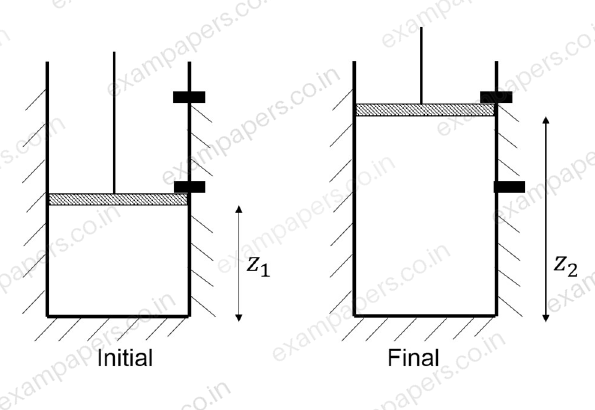
Log in to check the answer
You can attempt this question now. Sign in to view the answer key, explanations and discussion.Log in to check answerQuestion 10
Open questionBTMCQ1 markNeeds review
Under standard temperature (
) and pressure (
) conditions, 128 g of an ideal gas molecule
occupies a volume of 1 L. The gas molecule
obeys the relationship
.
and
are universal gas constant and ideal gas volume, respectively. The molecule
isYour answerChoose one option.
Log in to check the answer
You can attempt this question now. Sign in to view the answer key, explanations and discussion.Log in to check answerQuestion 24
Open questionBTNAT1 markNeeds review
A system consists of two reactors, connected by a valve. The first reactor (
) contains an ideal gas
of volume
and the second reactor (
) has an ideal gas
of volume
. Initially, the valve is closed and pressure
in
and
are
and
, respectively. Later, when the valve is open, the system reaches equilibrium. If the temperature
of both the reactors is maintained constant, the final equilibrium pressure in
of the system is ________.Log in to check the answer
You can attempt this question now. Sign in to view the answer key, explanations and discussion.Log in to check answerQuestion 20
Open questionBTNAT1 markNeeds review
Solvents A and B are completely immiscible. Solute S is soluble in both these solvents. 100 g of S was added to a container which has 2 kg each of A and B. The solute is 1.5 times more soluble in solvent A than in solvent B. The mixture was agitated thoroughly and allowed to reach equilibrium. Assuming that the solute has completely dissolved, the amount of solute in solvent A phase is ____________ g.
Log in to check the answer
You can attempt this question now. Sign in to view the answer key, explanations and discussion.Log in to check answerQuestion 26
Open questionBTMCQ2 marksNeeds review
A block of ice at 0 °C is supplied heat at a constant rate to convert ice to superheated steam. Which one of the following trajectories correctly represents the trend of the temperature of the system with time? Assume that the specific heat of H₂O is not a function of temperature.
Your answerChoose one option.
Log in to check the answer
You can attempt this question now. Sign in to view the answer key, explanations and discussion.Log in to check answerQuestion 53
Open questionBTNAT2 marksNeeds review
The concentrations of ATP, ADP and inorganic phosphate in a cell are 2.59, 0.73 and 2.72 mM, respectively. Under these conditions, free energy change for the synthesis of ATP at 37 °C is __________ kJ/mol (round off to 2 decimal places).
Given: free energy change for ATP hydrolysis under standard conditions is -30.5 kJ/mol and R = 8.315 kJ/mol.K
Log in to check the answer
You can attempt this question now. Sign in to view the answer key, explanations and discussion.Log in to check answerQuestion 55
Open questionBTNAT2 marksNeeds review
The mitochondrial electron transfer chain oxidizes NADH with oxygen being the terminal electron acceptor. The redox potentials for the two half-reactions are given below:
The free energy change associated with the transfer of electrons from NADH to O₂ is __________ kJ/mol (round off to 2 decimal places).
Given: F = 9650 C/mol.
Log in to check the answer
You can attempt this question now. Sign in to view the answer key, explanations and discussion.Log in to check answerQuestion 46
Open questionBTNAT2 marksNeeds review
The difference in concentrations of an uncharged solute between two compartments is 1.6-fold. The energy required for active transport of the solute across the membrane separating the two compartments is ______ cal mol⁻¹ (rounded off to the nearest integer). (R = 1.987 cal mol⁻¹ K⁻¹, T = 37 °C)
Log in to check the answer
You can attempt this question now. Sign in to view the answer key, explanations and discussion.Log in to check answerQuestion 50
Open questionBTMCQ2 marksNeeds review
The interaction energy E between two spherical particles is plotted as a function of the distance (r) between them. When
, where
is a constant, the net force between the spherical particles is repulsive. When
, they attract via van der Waals attraction. Which one of the following plots correctly represents the interaction energy between the above two particles?Your answerChoose one option.
Log in to check the answer
You can attempt this question now. Sign in to view the answer key, explanations and discussion.Log in to check answer