
Biotechnology
GATE BT topic:transport-processes PYQs
Build your understanding with focused practice from past exam papers.
Questions 21–24 of 24. Imported answers require independent review unless marked reviewed.
Question 22
Open questionBTNAT1 markNeeds review
To facilitate mass transfer from a gas to a liquid phase, a gas bubble of radius
is introduced into the liquid. The gas bubble then breaks into 8 bubbles of equal radius. Upon this change, the ratio of the interfacial surface area to the gas phase volume for the system changes from
to
. The value of
is ____________.Log in to check the answer
You can attempt this question now. Sign in to view the answer key, explanations and discussion.Log in to check answerQuestion 16
Open questionBTMCQ1 markNeeds review
Which one of the following is the unit of heat transfer coefficient?
Your answerChoose one option.
Log in to check the answer
You can attempt this question now. Sign in to view the answer key, explanations and discussion.Log in to check answerQuestion 36
Open questionBTMCQ2 marksNeeds review
Shear stress versus shear rate behavior of four different types of fluids (I, II, III and IV) are shown in the figure below.
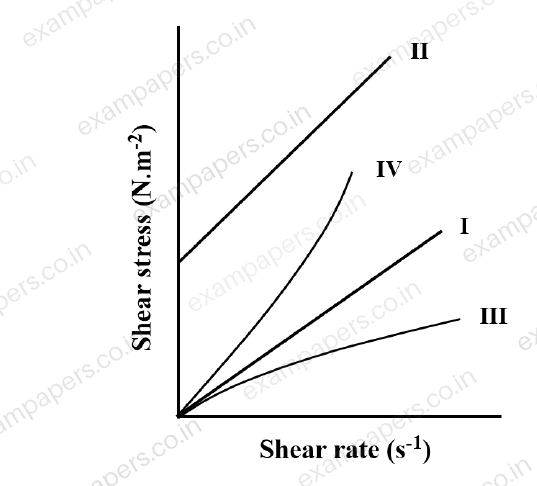
Which one of the following options is correct?
Your answerChoose one option.
Log in to check the answer
You can attempt this question now. Sign in to view the answer key, explanations and discussion.Log in to check answerQuestion 46
Open questionBTNAT2 marksNeeds review
A microbial strain is cultured in a 100 L stirred fermenter for secondary metabolite production. If the specific rate of oxygen uptake is 0.4 h⁻¹ and the oxygen solubility in the broth is 8 mg/L, then the volumetric mass transfer coefficient (
) (in s⁻¹) of oxygen required to achieve a maximum cell concentration of 12 g/L is (up to two decimal places)
Log in to check the answer
You can attempt this question now. Sign in to view the answer key, explanations and discussion.Log in to check answer