
Civil Engineering
GATE CE branch:ce PYQs
Build your understanding with focused practice from past exam papers.
Questions 511–520 of 1300. Imported answers require independent review unless marked reviewed.
Question 61
Open questionceNAT2 marksNeeds review
In Horton’s equation fitted to the infiltration data for a soil, the initial infiltration capacity is 10 mm/h; final infiltration capacity is 5 mm/h; and the exponential decay constant is 0.5 /h. Assuming that the infiltration takes place at capacity rates, the total infiltration depth (in mm) from a uniform storm of duration 12 h is ________. (round off to one decimal place)
Log in to check the answer
You can attempt this question now. Sign in to view the answer key, explanations and discussion.Log in to check answerQuestion 61
Open questionCE-2NAT2 marksNeeds review
A consolidated drained (CD) triaxial test was carried out on a sand sample with the known effective shear strength parameters,
and
. In the test, prior to the failure, when the sample was undergoing axial compression under constant cell pressure, the drainage valve was accidentally closed. At the failure, 360 kPa deviator stress was recorded along with 70 kPa pore water pressure. If the test is repeated without such error, and no back pressure is applied in either of the tests, what is the deviator stress (in kPa, in integer) at the failure? ________________Log in to check the answer
You can attempt this question now. Sign in to view the answer key, explanations and discussion.Log in to check answerQuestion 62
Open questionCENAT2 marksNeeds review
The composition and energy content of a representative solid waste sample are given in the table. If the moisture content for the waste is 26%, the energy content of the solid waste on dry-weight basis is __________________ MJ/kg (round off to one decimal place).
Component | Percent by mass | Energy content as-discarded basis (MJ/kg) |
|---|---|---|
Food waste | 20 | 4.5 |
Paper | 45 | 16.0 |
Cardboard | 5 | 14.0 |
Plastics | 10 | 32.0 |
Others | 20 | 8.0 |
Log in to check the answer
You can attempt this question now. Sign in to view the answer key, explanations and discussion.Log in to check answerQuestion 62
Open questionCE-2NAT2 marksNeeds review
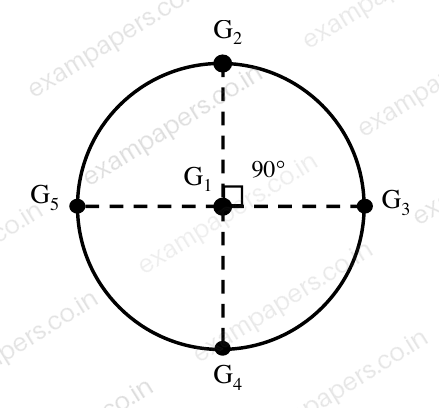
A catchment may be idealized as a circle of radius 30 km. There are five rain gauges, one at the center of the catchment and four on the boundary (equi-spaced), as shown in the figure (not to scale).
The annual rainfall recorded at these gauges in a particular year are given below.
Gauge | G | G | G | G | G |
|---|---|---|---|---|---|
Rainfall (mm) | 910 | 930 | 925 | 895 | 905 |
Using the Thiessen polygon method, what is the average rainfall (in mm, rounded off to two decimal places) over the catchment in that year?
Log in to check the answer
You can attempt this question now. Sign in to view the answer key, explanations and discussion.Log in to check answerQuestion 63
Open questionCENAT2 marksNeeds review
A flocculator tank has a volume of 280 m³. The temperature of water in the tank is 15°C, and the average velocity gradient maintained in the tank is 100/s. The temperature of water is reduced to 5°C, but all other operating conditions including the power input are maintained as the same. The decrease in the average velocity gradient (in %) due to the reduction in water temperature is ______________ (round off to nearest integer).
[Consider dynamic viscosity of water at 15°C and 5°C as 1.139×10⁻³ N-s/m² and 1.518×10⁻³ N-s/m², respectively]
Log in to check the answer
You can attempt this question now. Sign in to view the answer key, explanations and discussion.Log in to check answerQuestion 63
Open questionCE-2NAT2 marksNeeds review
The cross-section of a small river is sub-divided into seven segments of width 1.5 m each. The average depth and velocity at different depths were measured during a field campaign at the middle of each segment width. The discharge computed by the velocity area method for the given data is __________ m
/s (round off to one decimal place).Segment | Average depth (D) (m) | 0.2D | 0.6D | 0.8D |
|---|---|---|---|---|
1 | 0.40 | -- | 0.40 | -- |
2 | 0.70 | 0.76 | -- | 0.70 |
3 | 1.20 | 1.19 | -- | 1.13 |
4 | 1.40 | 1.25 | -- | 1.10 |
5 | 1.10 | 1.13 | -- | 1.09 |
6 | 0.80 | 0.69 | -- | 0.65 |
7 | 0.45 | -- | 0.42 | -- |
Log in to check the answer
You can attempt this question now. Sign in to view the answer key, explanations and discussion.Log in to check answerQuestion 64
Open questionCENAT2 marksNeeds review
The wastewater inflow to an activated sludge plant is 0.5 m³/s, and the plant is to be operated with a food to microorganism ratio of 0.2 mg/mg-d. The concentration of influent biodegradable organic matter to the plant (after primary settling) is 150 mg/L, and the mixed liquor volatile suspended solids concentration to be maintained in the plant is 200 mg/L. Assuming that complete removal of biodegradable organic matter in the tank, the volume of aeration tank (in m³, in integer) required for the plant is ________________.
Log in to check the answer
You can attempt this question now. Sign in to view the answer key, explanations and discussion.Log in to check answerQuestion 64
Open questionCE-2NAT2 marksNeeds review
The theoretical aerobic oxidation of biomass (C
H
O
N) is given below:C
H
O
N + 5O
→ 5CO
+ NH
+ 2H
OThe biochemical oxidation of biomass is assumed as a first-order reaction with a rate constant of 0.23/d at 20°C (logarithm to base e). Neglecting the second-stage oxygen demand from its biochemical oxidation, the ratio of BOD
at 20°C to total organic carbon (TOC) of biomass is __________ (round off to two decimal places).[Consider the atomic weights of C, H, O and N as 12 g/mol, 1 g/mol, 16 g/mol and 14 g/mol, respectively]
Log in to check the answer
You can attempt this question now. Sign in to view the answer key, explanations and discussion.Log in to check answerQuestion 65
Open questionCENAT2 marksNeeds review
Trigonometric levelling was carried out from two stations P and Q to find the reduced level (R. L.) of the top of hillock, as shown in the table. The distance between Stations P and Q is 55 m. Assume Stations P and Q, and the hillock are in the same vertical plane. The R. L. of the top of the hillock (in m) is ________________________ (round off to three decimal places).
Station | Vertical angle of the top of hillock | Staff reading on benchmark | R. L. of benchmark |
|---|---|---|---|
P | 18°45′ | 2.340 m | 100.000 m |
Q | 12°45′ | 1.660 m | |
Log in to check the answer
You can attempt this question now. Sign in to view the answer key, explanations and discussion.Log in to check answerQuestion 65
Open questionCE-2NAT2 marksNeeds review
A system of seven river segments is shown in the schematic diagram. The R
’s, Q
’s, and C
’s (i = 1 to 7) are the river segments, their corresponding flow rates, and concentrations of a conservative pollutant, respectively. Assume complete mixing at the intersections, no additional water loss or gain in the system, and steady state condition. Given: Q
= 5 m
/s ; Q
= 15 m
/s ; Q
= 3 m
/s ; Q
= 8 m
/s ; C
= 8 kg/m
; C
= 12 kg/m
; C
= 10 kg/m
. What is the steady state concentration (in kg/m
, rounded off to two decimal place) of the pollutant in the river segment 7? 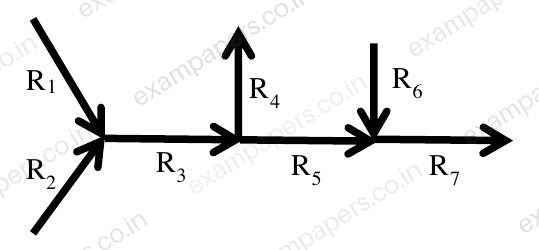
Log in to check the answer
You can attempt this question now. Sign in to view the answer key, explanations and discussion.Log in to check answer