
Civil Engineering
GATE CE exam:gate PYQs
Build your understanding with focused practice from past exam papers.
Questions 771–780 of 1300. Imported answers require independent review unless marked reviewed.
Question 51
Open questionCENAT2 marksNeeds review
A baghouse filter has to treat 12 m³/s of waste gas continuously. The baghouse is to be divided into 5 sections of equal cloth area such that one section can be shut down for cleaning and/or repair, while the other 4 sections continue to operate. An air-to-cloth ratio of 6.0 m³/min-m² cloth will provide sufficient treatment to the gas. The individual bags are of 32 cm in diameter and 5 m in length. The total number of bags (in integer) required in the baghouse is ________.
Log in to check the answer
You can attempt this question now. Sign in to view the answer key, explanations and discussion.Log in to check answerQuestion 51
Open questionCENAT2 marksNeeds review
An activated sludge process (ASP) is designed for secondary treatment of 750 m³/day of municipal wastewater. After primary clarifier, the ultimate BOD of the influent, which enters into ASP reactor is 200 mg/L. Treated effluent after secondary clarifier is required to have an ultimate BOD of 20 mg/L. Mix liquor volatile suspended solids (MLVSS) concentration in the reactor and the underflow is maintained as 3000 mg/L and 12000 mg/L, respectively. The hydraulic retention time and mean cell residence time are 0.2 day and 10 days, respectively. A representative flow diagram of the ASP is shown below. The underflow volume (in m³/day, round off to one decimal place) of sludge wastage is ________.
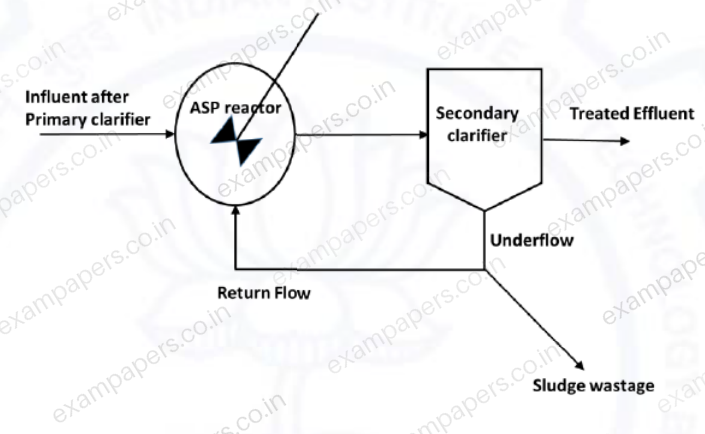
Log in to check the answer
You can attempt this question now. Sign in to view the answer key, explanations and discussion.Log in to check answerQuestion 52
Open questionCENAT2 marksNeeds review
A secondary clarifier handles a total flow of 9600 m³/d from the aeration tank of a conventional activated-sludge treatment system. The concentration of solids in the flow from the aeration tank is 3000 mg/L. The clarifier is required to thicken the solids to 1200 mg/L, and hence it is to be designed for a solid flux of 3.2 kg/m².h. The surface area of the designed clarifier for thickening (in m², in integer) is ________.
Log in to check the answer
You can attempt this question now. Sign in to view the answer key, explanations and discussion.Log in to check answerQuestion 52
Open questionCENAT2 marksNeeds review
A grit chamber of rectangular cross-section is to be designed to remove particles with diameter of 0.25 mm and specific gravity of 2.70. The terminal settling velocity of the particles is estimated as 2.5 cm/s. The chamber is having a width of 0.50 m and has to carry a peak wastewater flow of 9720 m³/d giving the depth of flow as 0.75 m. If a flow-through velocity of 0.3 m/s has to be maintained using a proportional weir at the outlet end of the chamber, the minimum length of the chamber (in m, in integer) to remove 0.25 mm particles completely is ________.
Log in to check the answer
You can attempt this question now. Sign in to view the answer key, explanations and discussion.Log in to check answerQuestion 53
Open questionCENAT2 marksNeeds review
Spot speeds of vehicles observed at a point on a highway are 40, 55, 60, 65 and 80 km/h. The space-mean speed (in km/h, round off to two decimal places) of the observed vehicles is ________.
Log in to check the answer
You can attempt this question now. Sign in to view the answer key, explanations and discussion.Log in to check answerQuestion 53
Open questionCENAT2 marksNeeds review
In an aggregate mix, the proportions of coarse aggregate, fine aggregate and mineral filler are 55%, 40% and 5%, respectively. The values of bulk specific gravity of the coarse aggregate, fine aggregate and mineral filler are 2.55, 2.65 and 2.70, respectively. The bulk specific gravity of the aggregate mix (round off to two decimal places) is ________.
Log in to check the answer
You can attempt this question now. Sign in to view the answer key, explanations and discussion.Log in to check answerQuestion 54
Open questionCENAT2 marksNeeds review
The longitudinal section of a runway provides the following data:
End-to-end runway (m) | Gradient (%) |
|---|---|
0 to 300 | + 1.2 |
300 to 600 | − 0.7 |
600 to 1100 | + 0.6 |
1100 to 1400 | − 0.8 |
1400 to 1700 | − 1.0 |
The effective gradient of the runway (in %, round off to two decimal places) is ________.
Log in to check the answer
You can attempt this question now. Sign in to view the answer key, explanations and discussion.Log in to check answerQuestion 54
Open questionCENAT2 marksNeeds review
The stopping sight distance (SSD) for a level highway is 140 m for the design speed of 90 km/h. The acceleration due to gravity and deceleration rate are 9.81 m/s² and 3.5 m/s², respectively. The perception/reaction time (in s, round off to two decimal places) used in the SSD calculation is ________.
Log in to check the answer
You can attempt this question now. Sign in to view the answer key, explanations and discussion.Log in to check answerQuestion 55
Open questionCENAT2 marksNeeds review
Traversing is carried out for a closed traverse PQRS. The internal angles at vertices P, Q, R and S are measured as 92°, 68°, 123°, and 77°, respectively. If fore bearing of line PQ is 27°, fore bearing of line RS (in degrees, in integer) is ________.
Log in to check the answer
You can attempt this question now. Sign in to view the answer key, explanations and discussion.Log in to check answerQuestion 55
Open questionCENAT2 marksNeeds review
For a 2° curve on a high speed Broad Gauge (BG) rail section, the maximum sanctioned speed is 100 km/h and the equilibrium speed is 80 km/h. Consider dynamic gauge of BG rail as 1750 mm. The degree of curve is defined as the angle subtended at its center by a 30.5 m arc. The cant deficiency for the curve (in mm, round off to integer) is ________.
Log in to check the answer
You can attempt this question now. Sign in to view the answer key, explanations and discussion.Log in to check answer