
Civil Engineering
GATE CE exam:gate PYQs
Build your understanding with focused practice from past exam papers.
Questions 851–860 of 1300. Imported answers require independent review unless marked reviewed.
Question 26
Open questionCEMCQ2 marksNeeds review
For the Ordinary Differential Equation
, with initial conditions
and
, the solution isYour answerChoose one option.
Log in to check the answer
You can attempt this question now. Sign in to view the answer key, explanations and discussion.Log in to check answerQuestion 26
Open questionCEMCQ2 marksNeeds review
An ordinary differential equation is given below
The general solution of the above equation (with constants
and
), isYour answerChoose one option.
Log in to check the answer
You can attempt this question now. Sign in to view the answer key, explanations and discussion.Log in to check answerQuestion 27
Open questionCEMCQ2 marksNeeds review
A continuous function
is defined. If the third derivative at
is to be computed by using the fourth order central finite-difference scheme (with step length = h), the correct formula isYour answerChoose one option.
Log in to check the answer
You can attempt this question now. Sign in to view the answer key, explanations and discussion.Log in to check answerQuestion 27
Open questionCEMCQ2 marksNeeds review
A 4×4 matrix
is given below
The eigenvalues of
areYour answerChoose one option.
Log in to check the answer
You can attempt this question now. Sign in to view the answer key, explanations and discussion.Log in to check answerQuestion 28
Open questionCEMCQ2 marksNeeds review
Distributed load(s) of 50 kN/m may occupy any position(s) (either continuously or in patches) on the girder PQRST as shown in the figure (not drawn to the scale). The maximum negative (hogging) bending moment (in kN.m) that occurs at point R, is
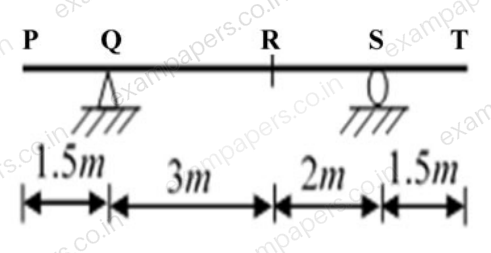
Your answerChoose one option.
Log in to check the answer
You can attempt this question now. Sign in to view the answer key, explanations and discussion.Log in to check answerQuestion 28
Open questionCEMCQ2 marksNeeds review
A prismatic linearly elastic bar of length
, cross-sectional area
, and made up of a material with Young’s modulus
, is subjected to axial tensile force as shown in the figures 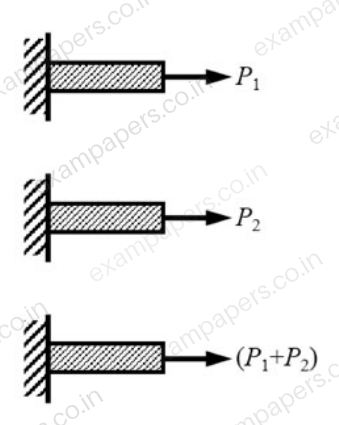
. When the bar is subjected to axial tensile forces
and
, the strain energies stored in the bar are
and
, respectively.If
is the strain energy stored in the same bar when subjected to an axial tensile force
, the correct relationship isYour answerChoose one option.
Log in to check the answer
You can attempt this question now. Sign in to view the answer key, explanations and discussion.Log in to check answerQuestion 29
Open questionCEMCQ2 marksNeeds review
A rigid weightless platform PQR shown in the figure (not drawn to the scale) can slide freely in the vertical direction. The platform is held in position by the weightless member OJ and four weightless, frictionless rollers. Points O and J are pin connections. A block of 90 kN rests on the platform as shown in the figure. The magnitude of horizontal component of the reaction (in kN) at pin O, is
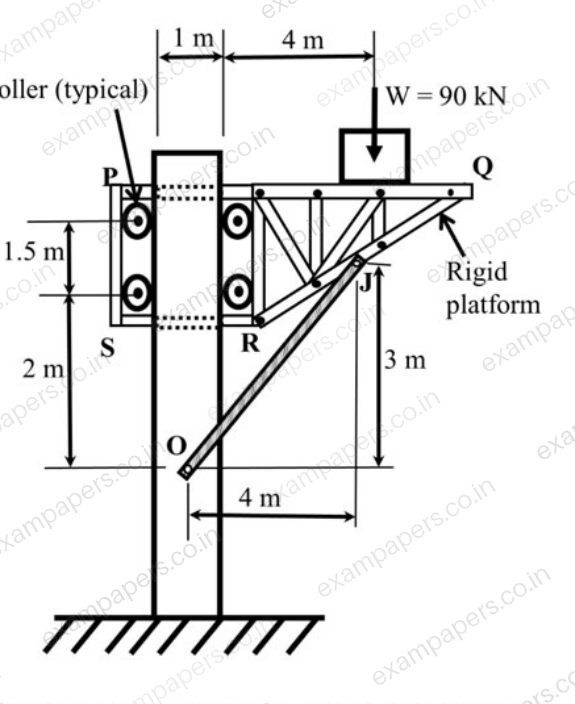
Your answerChoose one option.
Log in to check the answer
You can attempt this question now. Sign in to view the answer key, explanations and discussion.Log in to check answerQuestion 29
Open questionCEMCQ2 marksNeeds review
The planar structure RST shown in the figure
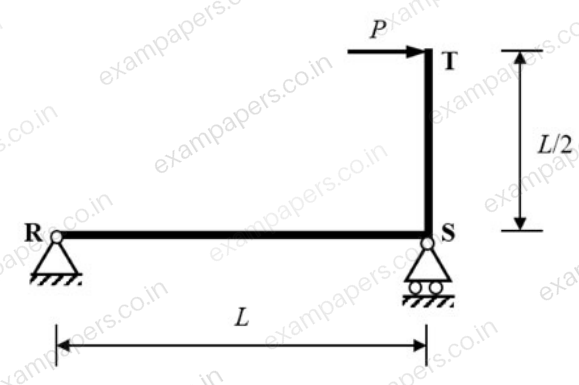
is roller-supported at S and pin-supported at R. Members RS and ST have uniform flexural rigidity
and S is a rigid joint. Consider only bending deformation and neglect effects of self-weight and axial stiffness.When the structure is subjected to a concentrated horizontal load
at the end T, the magnitude of rotation at the support R, isYour answerChoose one option.
Log in to check the answer
You can attempt this question now. Sign in to view the answer key, explanations and discussion.Log in to check answerQuestion 30
Open questionCEMCQ2 marksNeeds review
A cantilever beam PQ of uniform flexural rigidity (EI) is subjected to a concentrated moment M at R as shown in the figure. The deflection at the free end Q is
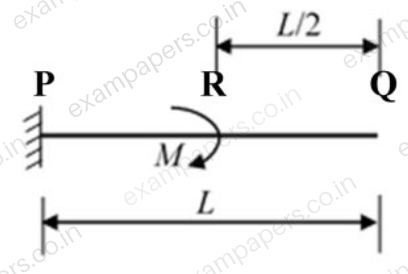
Your answerChoose one option.
Log in to check the answer
You can attempt this question now. Sign in to view the answer key, explanations and discussion.Log in to check answerQuestion 30
Open questionCEMCQ2 marksNeeds review
Joints I, J, K, L, Q and M of the frame shown in the figure
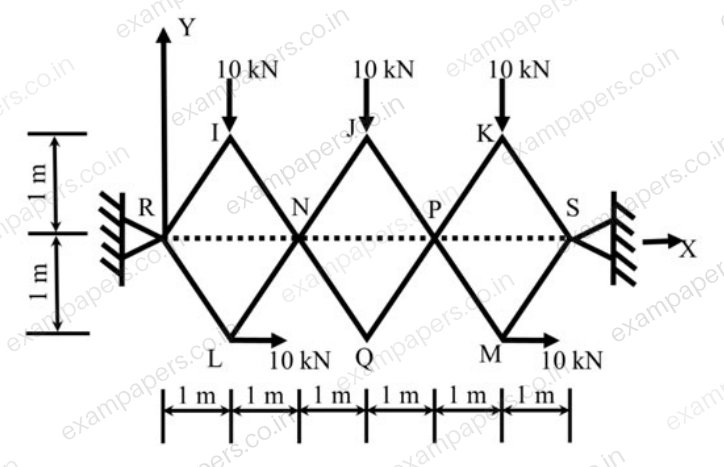
(not drawn to the scale) are pins. Continuous members IQ and LJ are connected through a pin at N. Continuous members JM and KQ are connected through a pin at P. The frame has hinge supports at joints R and S. The loads acting at joints I, J and K are along the negative Y direction and the loads acting at joints L and M are along the positive X direction.
The magnitude of the horizontal component of reaction (in kN) at S, is
Your answerChoose one option.
Log in to check the answer
You can attempt this question now. Sign in to view the answer key, explanations and discussion.Log in to check answer