
Civil Engineering
GATE CE Fluid Mechanics PYQs
Build your understanding with focused practice from past exam papers.
Questions 41–49 of 49. Imported answers require independent review unless marked reviewed.
Question 17
Open questionCENAT1 markNeeds review
A flow field is given by
,
,
. Value of the z-component of the angular velocity (in radians per unit time, up to two decimal places) at the point (0, −1, 1) is ______Log in to check the answer
You can attempt this question now. Sign in to view the answer key, explanations and discussion.Log in to check answerQuestion 32
Open questionCEMCQ2 marksNeeds review
A closed tank contains 0.5 m thick layer of mercury (specific gravity = 13.6) at the bottom. A 2.0 m thick layer of water lies above the mercury layer. A 3.0 m thick layer of oil (specific gravity = 0.6) lies above the water layer. The space above the oil layer contains air under pressure. The gauge pressure at the bottom of the tank is 196.2 kN/m
. The density of water is 1000 kg/m
and the acceleration due to gravity is 9.81 m/s
. The value of pressure in the air space isYour answerChoose one option.
Log in to check the answer
You can attempt this question now. Sign in to view the answer key, explanations and discussion.Log in to check answerQuestion 46
Open questionCENAT2 marksNeeds review
A three-fluid system (immiscible) is connected to a vacuum pump. The specific gravity values of the fluids (S₁, S₂) are given in the figure.
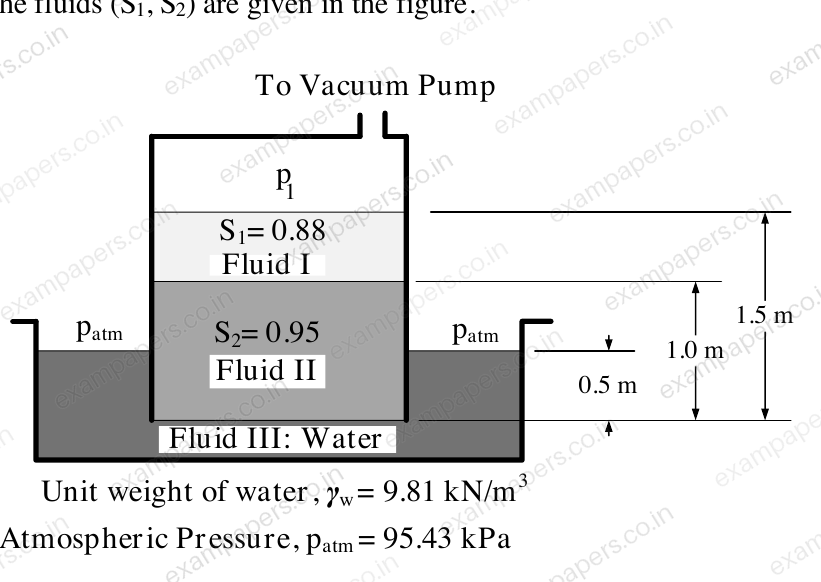
The gauge pressure value (in kN/m², up to two decimal places) of p₁ is ______
Log in to check the answer
You can attempt this question now. Sign in to view the answer key, explanations and discussion.Log in to check answerQuestion 48
Open questionCENAT2 marksNeeds review
A rough pipe of 0.5 m diameter, 300 m length and roughness height of 0.25 mm carries water (kinematic viscosity = 0.9×10⁻⁶ m²/s) with velocity of 3 m/s. Friction factor (f) for laminar flow is given by f = 64/Re, and for turbulent flow it is given by
, where, Re = Reynolds number, r = radius of pipe, k = roughness height and g = 9.81 m/s². The head loss (in m, up to three decimal places) in the pipe due to friction is ______Log in to check the answer
You can attempt this question now. Sign in to view the answer key, explanations and discussion.Log in to check answerQuestion 12
Open questionCEMCQ1 markNeeds review
For a steady incompressible laminar flow between two infinite parallel stationary plates, the shear stress variation is
Your answerChoose one option.
Log in to check the answer
You can attempt this question now. Sign in to view the answer key, explanations and discussion.Log in to check answerQuestion 23
Open questionCENAT1 markNeeds review
A triangular pipe network is shown in the figure.
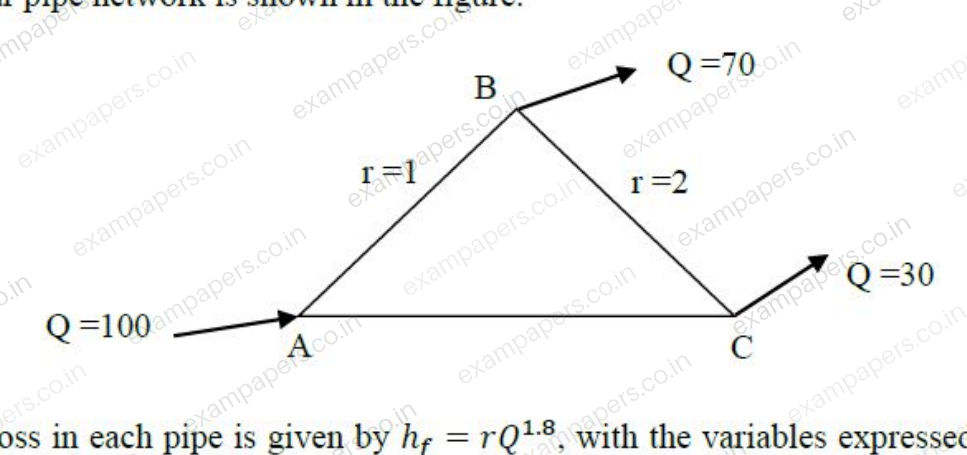
The head loss in each pipe is given by
, with the variables expressed in a consistent set of units. The value of
for the pipe
is 1 and for the pipe
is 2. If the discharge supplied at the point
(i.e., 100) is equally divided between the pipes
and
, the value of
(up to two decimal places) for the pipe
should be ____________Log in to check the answer
You can attempt this question now. Sign in to view the answer key, explanations and discussion.Log in to check answerQuestion 45
Open questionCE-2NAT2 marksNeeds review
The figure shows a U-tube having a 5 mm × 5 mm square cross-section filled with mercury (specific gravity = 13.6) up to a height of 20 cm in each limb (open to the atmosphere).
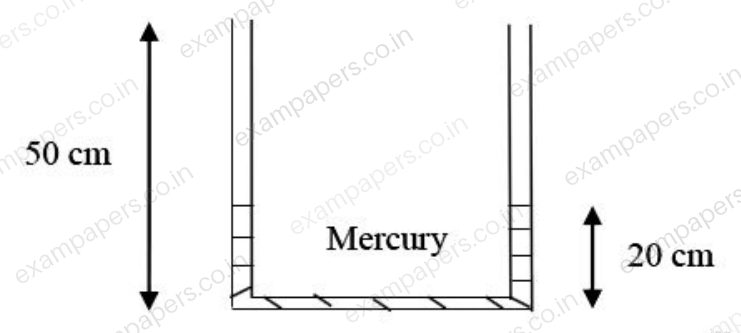
If 5 cm
of water is added to the right limb, the new height (in cm, up to two decimal places) of mercury in the LEFT limb will beLog in to check the answer
You can attempt this question now. Sign in to view the answer key, explanations and discussion.Log in to check answerQuestion 49
Open questionCENAT2 marksNeeds review
Water flows through a 90° bend in a horizontal plane as depicted in the figure.
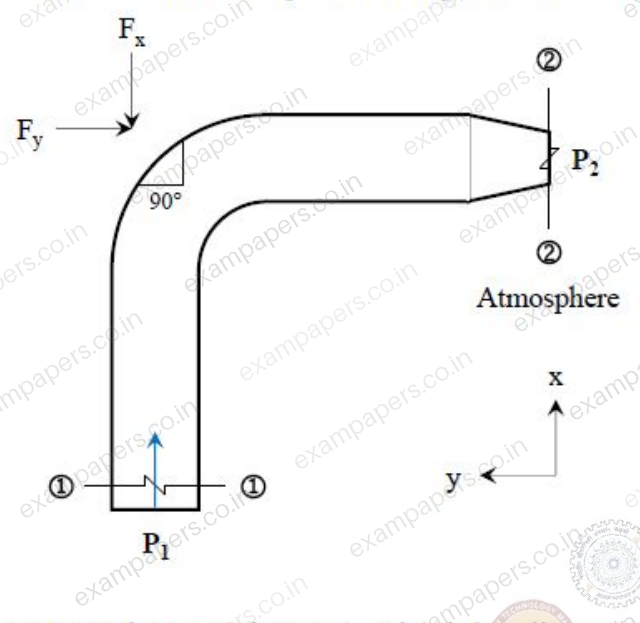
A pressure of 140 kPa is measured at Section 1-1. The inlet diameter marked at Section 1-1 is
cm, while the nozzle diameter marked at Section 2-2 is
cm. Assume the following:
(i) Acceleration due to gravity = 10 m/s
.
(ii) Weights of both the bent pipe segment as well as water are negligible.
(iii) Friction across the bend is negligible.The magnitude of the force (in kN, up to two decimal places) that would be required to hold the pipe section is
Log in to check the answer
You can attempt this question now. Sign in to view the answer key, explanations and discussion.Log in to check answerQuestion 49
Open questionCE-2NAT2 marksNeeds review
Water is pumped at a steady uniform flow rate of 0.01 m
/s through a horizontal smooth circular pipe of 100 mm diameter. Given that the Reynolds number is 800 and
is 9.81 m/s
, the head loss (in meters, up to one decimal place) per km length due to friction would beLog in to check the answer
You can attempt this question now. Sign in to view the answer key, explanations and discussion.Log in to check answer