
Civil Engineering
GATE CE format:nat PYQs
Build your understanding with focused practice from past exam papers.
Questions 81–90 of 495. Imported answers require independent review unless marked reviewed.
Question 57
Open questionCENAT2 marksNeeds review
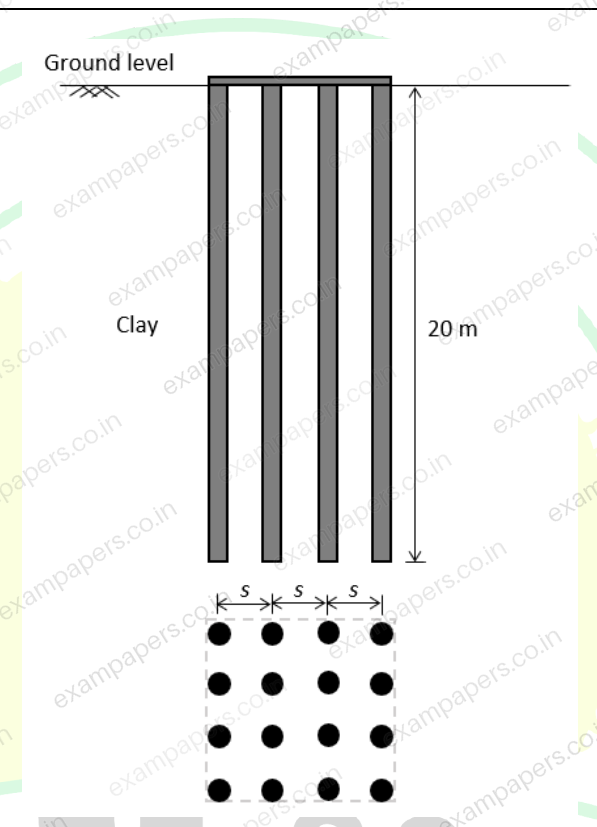
A 4 × 4 group pile, with each pile 20 m long and 500 mm in diameter, is installed in a square pattern in a clay soil, as shown in the figure. The average unconfined compressive strength of the soil is 100 kN/m², and the adhesion factor is 0.8. Neglect the bearing at the tip of the piles. For a group efficiency factor of 1.0, the centre to centre spacing (s) of the piles (in m) would be _____ (round off to two decimal places).
Log in to check the answer
You can attempt this question now. Sign in to view the answer key, explanations and discussion.Log in to check answerQuestion 58
Open questionCENAT2 marksNeeds review
A single pile with 450 mm diameter has been driven into a homogeneous clay layer, which has an undrained cohesion (cᵤ) of 20 kPa and unit weight of 18 kN/m³. The ground water table is found to be at the surface of the clay layer. The adhesion factor (α) of the soil is 0.95 and bearing capacity factor (N꜀) is 9. The pile is supporting a column load of 144 kN with a factor of safety of 3.0 against ultimate axial pile capacity in compression.
The required embedment depth of the pile (in m) is _________________ (rounded off to the nearest integer).
Log in to check the answer
You can attempt this question now. Sign in to view the answer key, explanations and discussion.Log in to check answerQuestion 58
Open questionCENAT2 marksNeeds review
A 60 cm diameter well completely penetrates a confined aquifer of permeability 5 × 10⁻⁴ m/s. The length of the strainer (spanning the entire thickness of the aquifer) is 10 m. The drawdown at the well under steady state pumping is 1.0 m. Assume that the radius of influence for this pumping is 300 m.
The discharge from the well (in litres per minute) is _____ (round off to the nearest integer).
Log in to check the answer
You can attempt this question now. Sign in to view the answer key, explanations and discussion.Log in to check answerQuestion 59
Open questionCENAT2 marksNeeds review
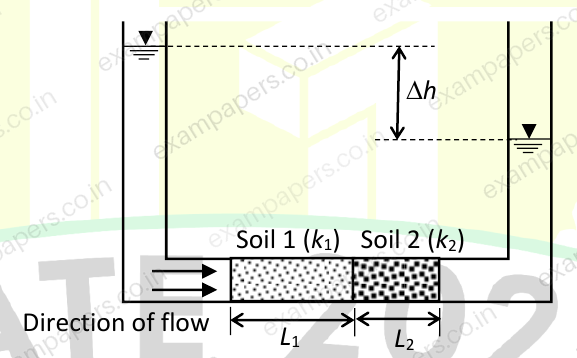
Two soils of permeabilities k₁ and k₂ are placed in a horizontal flow apparatus, as shown in the figure. For Soil 1, L₁ = 50 cm, and k₁ = 0.055 cm/s; for Soil 2, L₂ = 30 cm, and k₂ = 0.035 cm/s. The cross sectional area of the horizontal pipe is 100 cm², and the head difference (Δh) is 150 cm. The discharge (in cm³/s) through the soils is __________ (rounded off to 2 decimal places).
Log in to check the answer
You can attempt this question now. Sign in to view the answer key, explanations and discussion.Log in to check answerQuestion 59
Open questionCENAT2 marksNeeds review
The peak of flood hydrograph due to a 3-hour duration storm in a catchment is 180 m
/s. The total rainfall depth is 6.6 cm. It can be assumed that the average infiltration loss is 0.2 cm/h. There are no other losses. The base flow is constant at a value of 30 m
/s.The peak value of the 3-hour unit hydrograph for this catchment (in m
/s) is ______ (round off to the nearest integer).Log in to check the answer
You can attempt this question now. Sign in to view the answer key, explanations and discussion.Log in to check answerQuestion 60
Open questionCENAT2 marksNeeds review
A hydraulic jump is formed in a 5 m wide rectangular channel, which has a horizontal bed and is carrying a discharge of 15 m³/s. The depth of water upstream of the jump is 0.5 m. The power dissipated by the jump (in kW) is __________ (rounded off to the nearest integer).
Note:
Acceleration due to gravity = 9.81 m/s²
Density of water = 1000 kg/m³
Kinetic energy correction factor = 1.0
Log in to check the answer
You can attempt this question now. Sign in to view the answer key, explanations and discussion.Log in to check answerQuestion 60
Open questionCENAT2 marksNeeds review
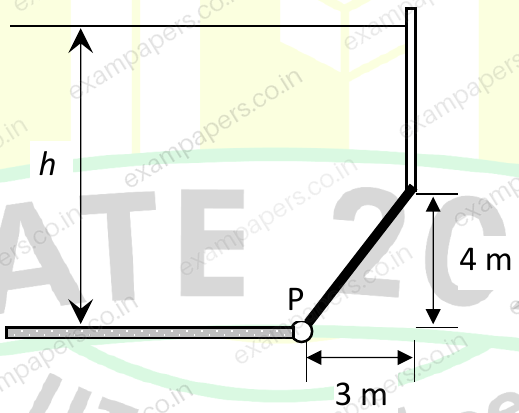
The shaft of a 6 m wide gate in the figure will fail at a moment of 3924 kN.m about the hinge P. The maximum value of water depth h (in m) that the gate can hold is ______________ (round off to the nearest integer).
Note:
Density of water = 1000 kg/m
Acceleration due to gravity = 9.81 m/s
Log in to check the answer
You can attempt this question now. Sign in to view the answer key, explanations and discussion.Log in to check answerQuestion 61
Open questionCENAT2 marksNeeds review
A symmetrical trapezoidal canal is 100 km long. The bottom width is 10 m and the side slope is 1 Horizontal : 1 Vertical. The average flow depth in the canal is 2.5 m throughout the month of April. The measurement from a Class-A evaporimeter in the vicinity of the canal indicated an average evaporation rate of 0.5 cm/day in April.
The volume of water evaporated from the canal (in m³) in the month of April is close to __________ ×10³ (rounded off to 1 decimal place).
Log in to check the answer
You can attempt this question now. Sign in to view the answer key, explanations and discussion.Log in to check answerQuestion 61
Open questionCENAT2 marksNeeds review
The analyses results of a water sample are given below. The non-carbonate hardness of the water (in mg/L) as CaCO
is ______ (in integer).Ca
= 150 mg/L as CaCO
Mg
= 40 mg/L as CaCO
Fe
= 10 mg/L as CaCO
Na
= 50 mg/L as CaCO
K
= 10 mg/L as CaCO
CO
= 120 mg/L as CaCO
HCO
= 30 mg/L as CaCO
Cl
= 50 mg/L as CaCO
; Other anions were not analysed.Log in to check the answer
You can attempt this question now. Sign in to view the answer key, explanations and discussion.Log in to check answerQuestion 62
Open questionCENAT2 marksNeeds review
A 5.0 m wide rectangular channel carries a discharge of 10 m³/s at a depth of 1.5 m under uniform flow. To produce critical flow conditions without affecting the upstream conditions, the channel bottom elevation should be raised (in m) by __________ (rounded off to 2 decimal places).
Assume that there is no loss of head at the raise, kinetic energy correction factor is 1.0, and acceleration due to gravity is 9.81 m/s².
Log in to check the answer
You can attempt this question now. Sign in to view the answer key, explanations and discussion.Log in to check answer