
Civil Engineering
GATE CE Foundation Engineering PYQs
Build your understanding with focused practice from past exam papers.
Questions 51–60 of 78. Imported answers require independent review unless marked reviewed.
Question 46
Open questionCENAT2 marksNeeds review
A vertical retaining wall of 5 m height has to support soil having unit weight of 18 kN/m
, effective cohesion of 12 kN/m
and effective friction angle of 30°. As per Rankine’s earth pressure theory and assuming that a tension crack has occurred, the lateral active thrust on the wall per meter length (in kN/m, round off to two decimal places), is _____.Log in to check the answer
You can attempt this question now. Sign in to view the answer key, explanations and discussion.Log in to check answerQuestion 46
Open questionCENAT2 marksNeeds review
A footing of size 2 m × 2 m transferring a pressure of 200 kN/m², is placed at a depth of 1.5 m below the ground as shown in the figure (not drawn to scale). The clay stratum is normally consolidated. The clay has specific gravity of 2.65 and compression index of 0.3.
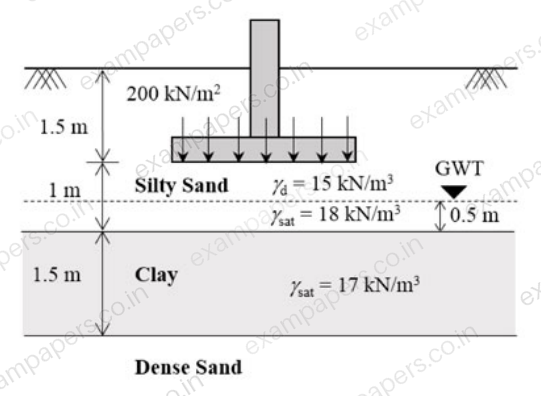
Considering 2:1 (vertical to horizontal) method of load distribution and γw = 10 kN/m³, the primary consolidation settlement (in mm, round off to two decimal places) of the clay layer is _____.
Log in to check the answer
You can attempt this question now. Sign in to view the answer key, explanations and discussion.Log in to check answerQuestion 48
Open questionCENAT2 marksNeeds review
A 5 m high vertical wall has a saturated clay backfill. The saturated unit weight and cohesion of clay are 18 kN/m³ and 20 kPa, respectively. The angle of internal friction of clay is zero. In order to prevent development of tension zone, the height of the wall is required to be increased. Dry sand is used as backfill above the clay for the increased portion of the wall. The unit weight and angle of internal friction of sand are 16 kN/m³ and 30°, respectively. Assume that the back of the wall is smooth and top of the backfill is horizontal. To prevent the development of tension zone, the minimum height (in m, round off to one decimal place) by which the wall has to be raised, is _____.
Log in to check the answer
You can attempt this question now. Sign in to view the answer key, explanations and discussion.Log in to check answerQuestion 51
Open questionCENAT2 marksNeeds review
A concrete dam holds 10 m of static water as shown in the figure (not drawn to the scale). The uplift is assumed to vary linearly from full hydrostatic head at the heel, to zero at the toe of dam. The coefficient of friction between the dam and foundation soil is 0.45. Specific weights of concrete and water are 24 kN/m³ and 9.81 kN/m³, respectively. For NO sliding condition, the required minimum base width B (in m, round off to two decimal places) is ________.
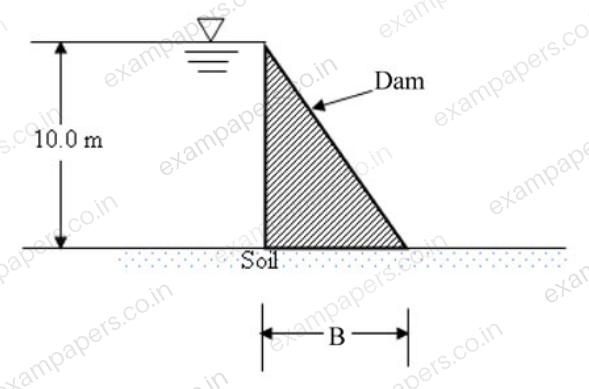
Log in to check the answer
You can attempt this question now. Sign in to view the answer key, explanations and discussion.Log in to check answerQuestion 15
Open questionCEMCQ1 markNeeds review
An earthen dam of height
is made of cohesive soil whose cohesion and unit weight are
and
, respectively. If the factor of safety against cohesion is
, the Taylor’s stability number (
) isYour answerChoose one option.
Log in to check the answer
You can attempt this question now. Sign in to view the answer key, explanations and discussion.Log in to check answerQuestion 16
Open questionCEMCQ1 markNeeds review
A retaining wall of height
with smooth vertical backface supports a backfill inclined at an angle
with the horizontal. The backfill consists of cohesionless soil having angle of internal friction
. If the active lateral thrust acting on the wall is
, which one of the following statements is TRUE?Your answerChoose one option.
Log in to check the answer
You can attempt this question now. Sign in to view the answer key, explanations and discussion.Log in to check answerQuestion 25
Open questionCENAT1 markNeeds review
A concentrated load of 500
is applied on an elastic half space. The ratio of the increase in vertical normal stress at depths of 2
and 4
along the point of the loading, as per Boussinesq’s theory, would be ________.Log in to check the answer
You can attempt this question now. Sign in to view the answer key, explanations and discussion.Log in to check answerQuestion 29
Open questionCEMCQ2 marksNeeds review
For the following statements:
P – The lateral stress in the soil while being tested in an oedometer is always at-rest.
Q – For a perfectly rigid strip footing at deeper depths in a sand deposit, the vertical normal contact stress at the footing edge is greater than that at its centre.
R – The corrections for overburden pressure and dilatancy are not applied to measured SPT-N values in case of clay deposits.
The correct combination of the statements is
Your answerChoose one option.
Log in to check the answer
You can attempt this question now. Sign in to view the answer key, explanations and discussion.Log in to check answerQuestion 52
Open questionCENAT2 marksNeeds review
A reinforced concrete circular pile of 12
length and 0.6
diameter is embedded in stiff clay which has an undrained unit cohesion of 110
. The adhesion factor is 0.5. The Net Ultimate Pullout (uplift) Load for the pile (in
, round off to 1 decimal place) is ________.Log in to check the answer
You can attempt this question now. Sign in to view the answer key, explanations and discussion.Log in to check answerQuestion 52
Open questionCENAT2 marksNeeds review
A 2 m × 4 m rectangular footing has to carry a uniformly distributed load of 120 kPa. As per the 2:1 dispersion method of stress distribution, the increment in vertical stress (in kPa) at a depth of 2 m below the footing is ________
Log in to check the answer
You can attempt this question now. Sign in to view the answer key, explanations and discussion.Log in to check answer