
Civil Engineering
GATE CE Hydrology PYQs
Build your understanding with focused practice from past exam papers.
Questions 11–20 of 49. Imported answers require independent review unless marked reviewed.
Question 58
Open questionCENAT2 marksNeeds review
A 60 cm diameter well completely penetrates a confined aquifer of permeability 5 × 10⁻⁴ m/s. The length of the strainer (spanning the entire thickness of the aquifer) is 10 m. The drawdown at the well under steady state pumping is 1.0 m. Assume that the radius of influence for this pumping is 300 m.
The discharge from the well (in litres per minute) is _____ (round off to the nearest integer).
Log in to check the answer
You can attempt this question now. Sign in to view the answer key, explanations and discussion.Log in to check answerQuestion 59
Open questionCENAT2 marksNeeds review
The peak of flood hydrograph due to a 3-hour duration storm in a catchment is 180 m
/s. The total rainfall depth is 6.6 cm. It can be assumed that the average infiltration loss is 0.2 cm/h. There are no other losses. The base flow is constant at a value of 30 m
/s.The peak value of the 3-hour unit hydrograph for this catchment (in m
/s) is ______ (round off to the nearest integer).Log in to check the answer
You can attempt this question now. Sign in to view the answer key, explanations and discussion.Log in to check answerQuestion 35
Open questionce-1NAT1 markNeeds review
A 30 cm diameter well fully penetrates an unconfined aquifer of saturated thickness 20 m with hydraulic conductivity of 10 m/day. Under the steady pumping rate for a long time, the drawdowns in two observation wells located at 10 m and 100 m from the pumping well are 5 m and 1 m, respectively. The corresponding pumping rate (in m
/day) from the well is ____________ (rounded off to 2 decimal places).Log in to check the answer
You can attempt this question now. Sign in to view the answer key, explanations and discussion.Log in to check answerQuestion 56
Open questionce-1NAT2 marksNeeds review
The ordinates of a 1-hour unit hydrograph (UH) are given below.
Time (hours) | 0 | 1 | 2 | 3 | 4 | 5 |
|---|---|---|---|---|---|---|
Ordinates of 1-hour UH (m /s) | 0 | 13 | 50 | 80 | 95 | 85 |
Time (hours) | 6 | 7 | 8 | 9 | 10 | 11 |
|---|---|---|---|---|---|---|
Ordinates of 1-hour UH (m /s) | 55 | 35 | 15 | 10 | 3 | 0 |
These ordinates are used to derive a 3-hour UH. The peak discharge (in m
/s) for the derived 3-hour UH is ______________ (rounded off to the nearest integer).Log in to check the answer
You can attempt this question now. Sign in to view the answer key, explanations and discussion.Log in to check answerQuestion 56
Open questionCE2NAT2 marksNeeds review
A storm with a recorded precipitation of 11.0 cm, as shown in the table, produced a direct run-off of 6.0 cm.
Time from start (hours) | 1 | 2 | 3 | 4 | 5 | 6 | 7 | 8 |
|---|---|---|---|---|---|---|---|---|
Recorded cumulative precipitation (cm) | 0.5 | 1.5 | 3.1 | 5.5 | 7.3 | 8.9 | 10.2 | 11.0 |
The
-index of this storm is __________ cm/hr (rounded off to 2 decimal places).Log in to check the answer
You can attempt this question now. Sign in to view the answer key, explanations and discussion.Log in to check answerQuestion 21
Open questionCE-2MCQ1 markNeeds review
Which one of the following options provides the correct match of the terms listed in Column-1 and Column-2?
Column-1 | Column-2 |
|---|---|
P: Horton equation | I: Precipitation |
Q: Muskingum method | II: Flood frequency |
R: Penman method | III: Evapotranspiration |
| IV: Infiltration |
| V: Channel routing |
Your answerChoose one option.
Log in to check the answer
You can attempt this question now. Sign in to view the answer key, explanations and discussion.Log in to check answerQuestion 34
Open questionCENAT1 markNeeds review
The ordinates of a one-hour unit hydrograph for a catchment are given below:
| t (hour) | 0 | 1 | 2 | 3 | 4 | 5 | 6 | 7 |
| Q (m³/s) | 0 | 9 | 21 | 18 | 12 | 5 | 2 | 0 |
Use the principle of superposition, a D-hour unit hydrograph for the catchment was derived from this one-hour unit hydrograph. The ordinates of the D-hour unit hydrograph were obtained as 3 m³/s at t = 1 hour and 10 m³/s at t = 2 hour. The value of D (in integer) is _________________________.
Log in to check the answer
You can attempt this question now. Sign in to view the answer key, explanations and discussion.Log in to check answerQuestion 34
Open questionCE-2NAT1 markNeeds review
For the elevation and temperature data given in the table, the existing lapse rate in the environment is ____ °C/100 m (round off to two decimal places).
Elevation from ground level (m) | Temperature (°C) |
|---|---|
5 | 14.2 |
325 | 16.9 |
Log in to check the answer
You can attempt this question now. Sign in to view the answer key, explanations and discussion.Log in to check answerQuestion 59
Open questionceNAT2 marksNeeds review
A 12-hour storm occurs over a catchment and results in a direct runoff depth of 100 mm. The time-distribution of the rainfall intensity is shown in the figure (not to scale). The
-index of the storm is (in mm, rounded off to two decimal places) ____________________.
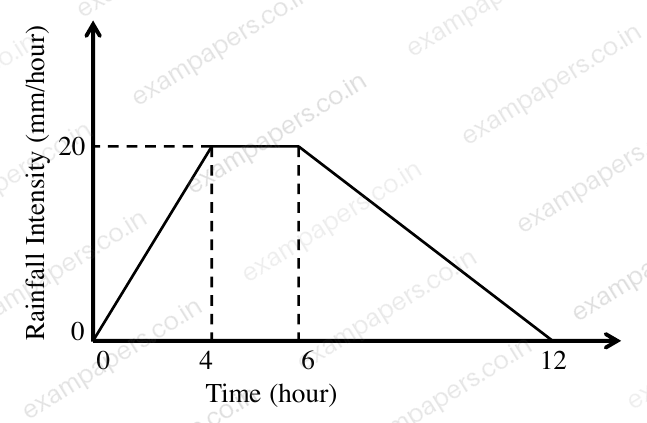
Log in to check the answer
You can attempt this question now. Sign in to view the answer key, explanations and discussion.Log in to check answerQuestion 61
Open questionceNAT2 marksNeeds review
In Horton’s equation fitted to the infiltration data for a soil, the initial infiltration capacity is 10 mm/h; final infiltration capacity is 5 mm/h; and the exponential decay constant is 0.5 /h. Assuming that the infiltration takes place at capacity rates, the total infiltration depth (in mm) from a uniform storm of duration 12 h is ________. (round off to one decimal place)
Log in to check the answer
You can attempt this question now. Sign in to view the answer key, explanations and discussion.Log in to check answer