
Civil Engineering
GATE CE Hydrology PYQs
Build your understanding with focused practice from past exam papers.
Questions 21–30 of 49. Imported answers require independent review unless marked reviewed.
Question 62
Open questionCE-2NAT2 marksNeeds review
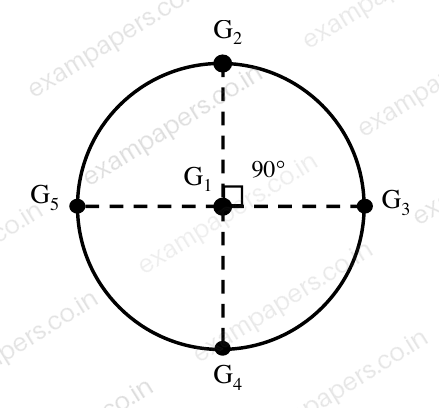
A catchment may be idealized as a circle of radius 30 km. There are five rain gauges, one at the center of the catchment and four on the boundary (equi-spaced), as shown in the figure (not to scale).
The annual rainfall recorded at these gauges in a particular year are given below.
Gauge | G | G | G | G | G |
|---|---|---|---|---|---|
Rainfall (mm) | 910 | 930 | 925 | 895 | 905 |
Using the Thiessen polygon method, what is the average rainfall (in mm, rounded off to two decimal places) over the catchment in that year?
Log in to check the answer
You can attempt this question now. Sign in to view the answer key, explanations and discussion.Log in to check answerQuestion 63
Open questionCE-2NAT2 marksNeeds review
The cross-section of a small river is sub-divided into seven segments of width 1.5 m each. The average depth and velocity at different depths were measured during a field campaign at the middle of each segment width. The discharge computed by the velocity area method for the given data is __________ m
/s (round off to one decimal place).Segment | Average depth (D) (m) | 0.2D | 0.6D | 0.8D |
|---|---|---|---|---|
1 | 0.40 | -- | 0.40 | -- |
2 | 0.70 | 0.76 | -- | 0.70 |
3 | 1.20 | 1.19 | -- | 1.13 |
4 | 1.40 | 1.25 | -- | 1.10 |
5 | 1.10 | 1.13 | -- | 1.09 |
6 | 0.80 | 0.69 | -- | 0.65 |
7 | 0.45 | -- | 0.42 | -- |
Log in to check the answer
You can attempt this question now. Sign in to view the answer key, explanations and discussion.Log in to check answerQuestion 65
Open questionCE-2NAT2 marksNeeds review
A system of seven river segments is shown in the schematic diagram. The R
’s, Q
’s, and C
’s (i = 1 to 7) are the river segments, their corresponding flow rates, and concentrations of a conservative pollutant, respectively. Assume complete mixing at the intersections, no additional water loss or gain in the system, and steady state condition. Given: Q
= 5 m
/s ; Q
= 15 m
/s ; Q
= 3 m
/s ; Q
= 8 m
/s ; C
= 8 kg/m
; C
= 12 kg/m
; C
= 10 kg/m
. What is the steady state concentration (in kg/m
, rounded off to two decimal place) of the pollutant in the river segment 7? 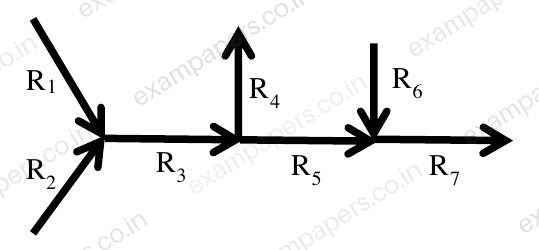
Log in to check the answer
You can attempt this question now. Sign in to view the answer key, explanations and discussion.Log in to check answerQuestion 19
Open questionCEMCQ1 markNeeds review
Match Column X with Column Y:
Column X | Column Y |
|---|---|
(P) Horton equation | (I) Design of alluvial channel |
(Q) Penman method | (II) Maximum flood discharge |
(R) Chez’s formula | (III) Evapotranspiration |
(S) Lacey’s theory | (IV) Infiltration |
(T) Dicken’s formula | (V) Flow velocity |
Which one of the following combinations is correct?
Your answerChoose one option.
Log in to check the answer
You can attempt this question now. Sign in to view the answer key, explanations and discussion.Log in to check answerQuestion 34
Open questionCENAT1 markNeeds review
A flood control structure having an expected life of
years is designed by considering a flood of return period
years. When
, and
, the structure’s hydrologic risk of failure in percentage is ______.
(round off to one decimal place)Log in to check the answer
You can attempt this question now. Sign in to view the answer key, explanations and discussion.Log in to check answerQuestion 56
Open questionCENAT2 marksNeeds review
A two-hour duration storm event with uniform excess rainfall of 3 cm occurred on a watershed. The ordinates of streamflow hydrograph resulting from this event are given in the table.
Time (hours) | 0 | 1 | 2 | 3 | 4 | 5 | 6 | 7 |
|---|---|---|---|---|---|---|---|---|
Streamflow (m³/s) | 10 | 16 | 34 | 40 | 31 | 25 | 16 | 10 |
Considering a constant baseflow of 10 m³/s, the peak flow ordinate (in m³/s) of one-hour unit hydrograph for the watershed is ________ . (in integer)
Log in to check the answer
You can attempt this question now. Sign in to view the answer key, explanations and discussion.Log in to check answerQuestion 22
Open questionCENAT1 markNeeds review
A 12-hour unit hydrograph (of 1 cm excess rainfall) of a catchment is of a triangular shape with a base width of 144 hour and a peak discharge of 23 m
/s. The area of the catchment (in km
, round off to the nearest integer) isLog in to check the answer
You can attempt this question now. Sign in to view the answer key, explanations and discussion.Log in to check answerQuestion 48
Open questionCENAT2 marksNeeds review
The hyetograph in the figure corresponds to a rainfall event of 3 cm.
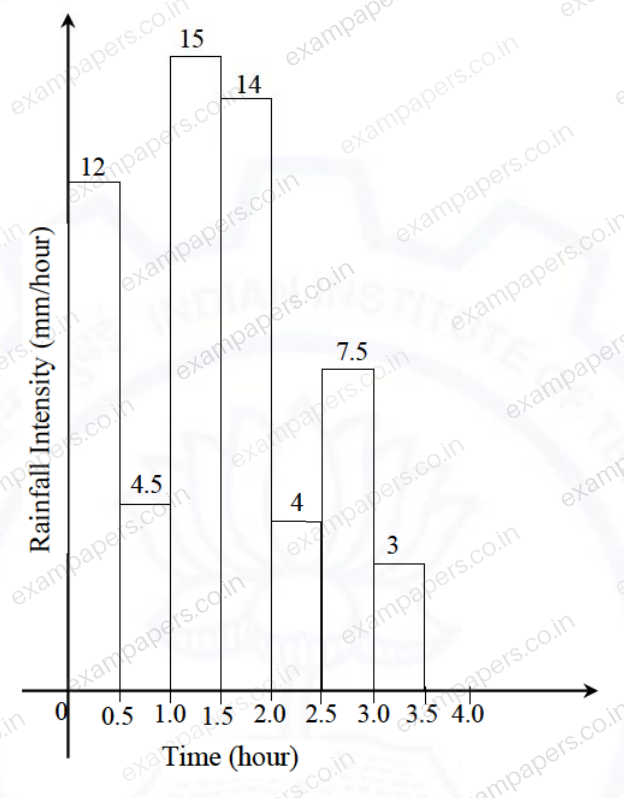
If the rainfall event has produced a direct runoff of 1.6 cm, the
-index of the event (in mm/hour, round off to one decimal place) would beLog in to check the answer
You can attempt this question now. Sign in to view the answer key, explanations and discussion.Log in to check answerQuestion 12
Open questionCEMCQ1 markNeeds review
Muskingum method is used in
Your answerChoose one option.
Log in to check the answer
You can attempt this question now. Sign in to view the answer key, explanations and discussion.Log in to check answerQuestion 14
Open questionCEMCQ1 markNeeds review
A triangular direct runoff hydrograph due to a storm has a time base of 90 hours. The peak flow of 60 m
/s occurs at 20 hours from the start of the storm. The area of catchment is 300 km
. The rainfall excess of the storm (in cm), isYour answerChoose one option.
Log in to check the answer
You can attempt this question now. Sign in to view the answer key, explanations and discussion.Log in to check answer