
Civil Engineering
GATE CE Hydrology PYQs
Build your understanding with focused practice from past exam papers.
Questions 31–40 of 49. Imported answers require independent review unless marked reviewed.
Question 18
Open questionCENAT1 markNeeds review
The probability that a 50 year flood may NOT occur at all during 25 years life of a project (round off to two decimal places), is ________.
Log in to check the answer
You can attempt this question now. Sign in to view the answer key, explanations and discussion.Log in to check answerQuestion 50
Open questionCENAT2 marksNeeds review
In a homogeneous unconfined aquifer of area 3.00 km
, the water table was at an elevation of 102.0 m. After a natural recharge of volume 0.90 million cubic meter (Mm
), the water table rose to 103.20 m. After this recharge, ground water pumping took place and the water table dropped down to 101.20 m. The volume of ground water pumped after the natural recharge, expressed (in Mm
and round off to two decimal places), is _____.Log in to check the answer
You can attempt this question now. Sign in to view the answer key, explanations and discussion.Log in to check answerQuestion 14
Open questionCEMCQ1 markNeeds review
An inflow hydrograph is routed through a reservoir to produce an outflow hydrograph. The peak flow of the inflow hydrograph is
and the time of occurrence of the peak is
. The peak flow of the outflow hydrograph is
and the time of occurrence of the peak is
. Which one of the following statements is correct?Your answerChoose one option.
Log in to check the answer
You can attempt this question now. Sign in to view the answer key, explanations and discussion.Log in to check answerQuestion 15
Open questionCEMCQ1 markNeeds review
A catchment may be idealised as a rectangle. There are three rain gauges located inside the catchment at arbitrary locations. The average precipitation over the catchment is estimated by two methods: (i) Arithmetic mean (
), and (ii) Thiessen polygon (
). Which one of the following statements is correct?Your answerChoose one option.
Log in to check the answer
You can attempt this question now. Sign in to view the answer key, explanations and discussion.Log in to check answerQuestion 23
Open questionCENAT1 markNeeds review
The probability that the annual maximum flood discharge will exceed 2500
, at least once in next 5 years is found to be 0.25. The return period of this flood event (in years, round off to 1 decimal place) is ________.Log in to check the answer
You can attempt this question now. Sign in to view the answer key, explanations and discussion.Log in to check answerQuestion 47
Open questionCENAT2 marksNeeds review
A confined aquifer of 15 m constant thickness is sandwiched between two aquicludes as shown in the figure (not drawn to scale).
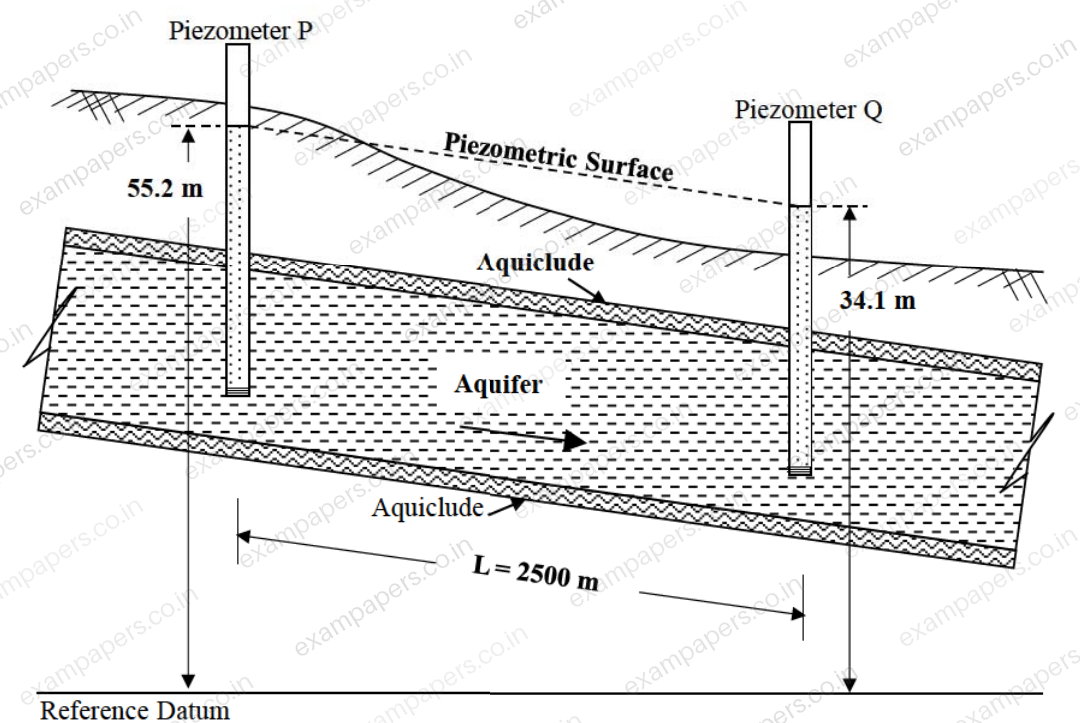
The heads indicated by two piezometers P and Q are 55.2 m and 34.1 m, respectively. The aquifer has a hydraulic conductivity of 80 m/day and its effective porosity is 0.25. If the distance between the piezometers is 2500 m, the time taken by the water to travel through the aquifer from piezometer location P to Q (in days, round off to 1 decimal place) is ________
Log in to check the answer
You can attempt this question now. Sign in to view the answer key, explanations and discussion.Log in to check answerQuestion 49
Open questionCENAT2 marksNeeds review
The hyetograph of a storm event of duration 140 minutes is shown in the figure.
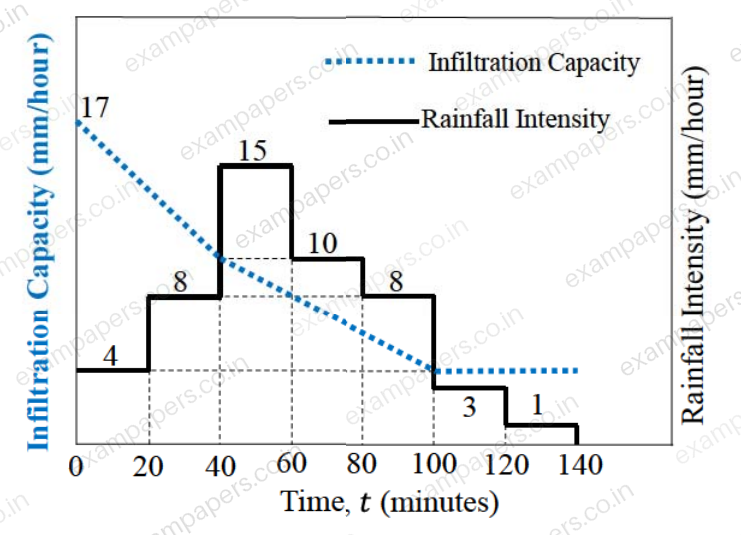
The infiltration capacity at the start of this event (
) is 17
, which linearly decreases to 10
after 40 minutes duration. As the event progresses, the infiltration rate further drops down linearly to attain a value of 4
at
minutes and remains constant thereafter till the end of the storm event. The value of the infiltration index,
(in
, round off to 2 decimal places), is ________.Log in to check the answer
You can attempt this question now. Sign in to view the answer key, explanations and discussion.Log in to check answerQuestion 50
Open questionCENAT2 marksNeeds review
The ordinates,
, of a 2-hour unit hydrograph (i.e., for 1 cm of effective rain), for a catchment are shown in the table. (hour) | 0 | 1 | 2 | 3 | 4 | 5 | 6 | 7 | 8 | 9 | 10 | 11 | 12 |
|---|---|---|---|---|---|---|---|---|---|---|---|---|---|
( ) | 0 | 2 | 8 | 18 | 32 | 45 | 30 | 19 | 12 | 7 | 3 | 1 | 0 |
A 6-hour storm occurs over the catchment such that the effective rainfall intensity is 1 cm/hour for the first two hours, zero for the next two hours, and 0.5 cm/hour for the last two hours. If the base flow is constant at 5
, the peak flow due to this storm (in
, round off to 1 decimal place) will be ________Log in to check the answer
You can attempt this question now. Sign in to view the answer key, explanations and discussion.Log in to check answerQuestion 12
Open questionCEMCQ1 markNeeds review
Dupit’s assumptions are valid for
Your answerChoose one option.
Log in to check the answer
You can attempt this question now. Sign in to view the answer key, explanations and discussion.Log in to check answerQuestion 24
Open questionCENAT1 markNeeds review
For routing of flood in a given channel using the Muskingum method, two of the routing coefficients are estimated as C
= −0.25 and C
= 0.55. The value of the third coefficient C
would be ______Log in to check the answer
You can attempt this question now. Sign in to view the answer key, explanations and discussion.Log in to check answer