
Civil Engineering
GATE CE purpose:exam-prep PYQs
Build your understanding with focused practice from past exam papers.
Questions 1231–1240 of 1300. Imported answers require independent review unless marked reviewed.
Question 31
Open questionCEMCQ2 marksNeeds review
A 1 m wide rectangular channel has a bed slope of 0.0016 and the Manning’s roughness coefficient is 0.04. Uniform flow takes place in the channel at a flow depth of 0.5 m. At a particular section, gradually varied flow (GVF) is observed and the flow depth is measured as 0.6 m. The GVF profile at that section is classified as
Your answerChoose one option.
Log in to check the answer
You can attempt this question now. Sign in to view the answer key, explanations and discussion.Log in to check answerQuestion 31
Open questionCE-2MCQ2 marksNeeds review
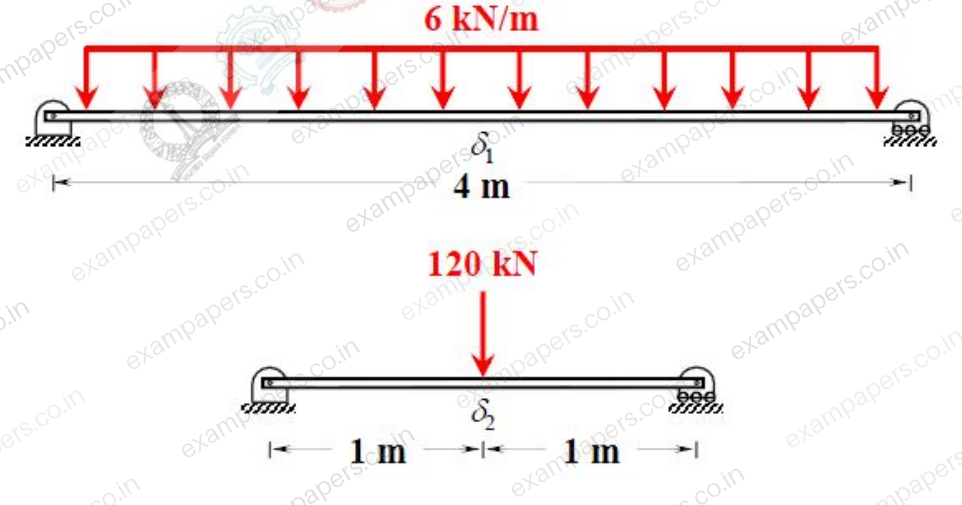
Two prismatic beams having the same flexural rigidity of 1000 kN-m² are shown in the figures.
If the mid-span deflections of these beams are denoted by δ₁ and δ₂ (as indicated in the figures), the correct option is
Your answerChoose one option.
Log in to check the answer
You can attempt this question now. Sign in to view the answer key, explanations and discussion.Log in to check answerQuestion 32
Open questionCEMCQ2 marksNeeds review
The following observations are made while testing aggregate for its suitability in pavement construction:
i. Mass of oven-dry aggregate in air = 1000 g
ii. Mass of saturated surface-dry aggregate in air = 1025 g
iii. Mass of saturated surface-dry aggregate under water = 625 g
Based on the above observations, the correct statement is
Your answerChoose one option.
Log in to check the answer
You can attempt this question now. Sign in to view the answer key, explanations and discussion.Log in to check answerQuestion 32
Open questionCE-2MCQ2 marksNeeds review
Consider the three prismatic beams with the clamped supports P, Q, and R as shown in the figures.

Given that the modulus of elasticity, E is 2.5×10⁴ MPa; and the moment of inertia, I is 8×10⁸ mm⁴, the correct comparison of the magnitudes of the shear force S and the bending moment M developed at the supports is
Your answerChoose one option.
Log in to check the answer
You can attempt this question now. Sign in to view the answer key, explanations and discussion.Log in to check answerQuestion 33
Open questionCEMCQ2 marksNeeds review
The queue length (in number of vehicles) versus time (in seconds) plot for an approach to a signalized intersection with the cycle length of 96 seconds is shown in the figure (not drawn to scale).
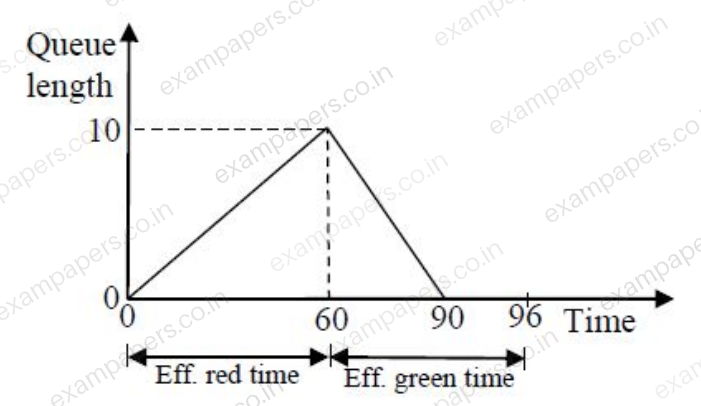
At time
, the light has just turned red. The effective green time is 36 seconds, during which vehicles discharge at the saturation flow rate,
(in vph). Vehicles arrive at a uniform rate,
(in vph), throughout the cycle. Which one of the following statements is TRUE?Your answerChoose one option.
Log in to check the answer
You can attempt this question now. Sign in to view the answer key, explanations and discussion.Log in to check answerQuestion 33
Open questionCE-2MCQ2 marksNeeds review
Consider the following statements:
P. Walls of one brick thick are measured in square meters.
Q. Walls of one brick thick are measured in cubic meters.
R. No deduction in the brickwork quantity is made for openings in walls up to 0.1 m² area.
S. For the measurement of excavation from the borrow pit in a fairly uniform ground, deadmen are left at suitable intervals.
For the above statements, the correct option is
Your answerChoose one option.
Log in to check the answer
You can attempt this question now. Sign in to view the answer key, explanations and discussion.Log in to check answerQuestion 34
Open questionCEMCQ2 marksNeeds review
The radius of a horizontal circular curve on a highway is 120 m. The design speed is 60 km/hour, and the design coefficient of lateral friction between the tyre and the road surface is 0.15. The estimated value of superelevation required (if full lateral friction is assumed to develop), and the value of coefficient of friction needed (if no superelevation is provided) will, respectively, be
Your answerChoose one option.
Log in to check the answer
You can attempt this question now. Sign in to view the answer key, explanations and discussion.Log in to check answerQuestion 34
Open questionCE-2MCQ2 marksNeeds review
Two identical concrete piles having the plan dimensions 50 cm × 50 cm are driven into a homogeneous sand layer as shown in the figures. Consider the bearing capacity factor N_q for φ = 30° as 24.
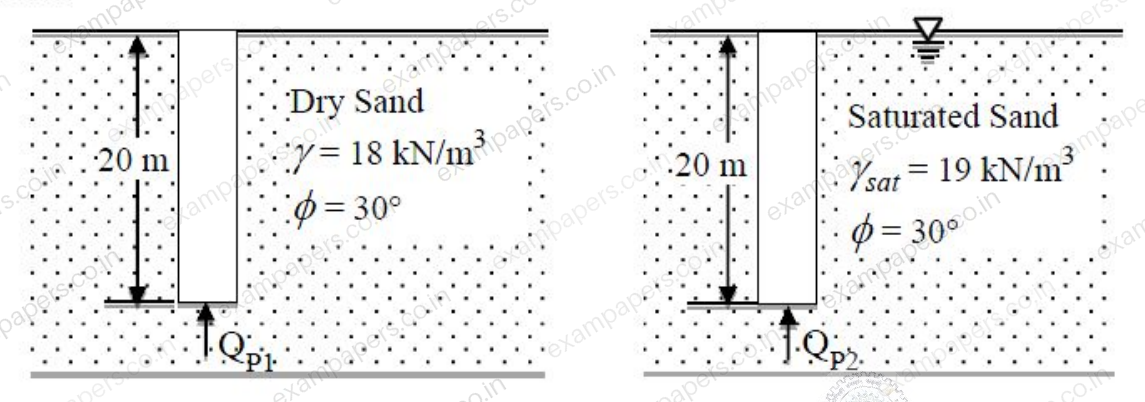
If Q_p1 and Q_p2 represent the ultimate point bearing resistances of the piles under dry and submerged conditions, respectively, which one of the following statements is correct?
Your answerChoose one option.
Log in to check the answer
You can attempt this question now. Sign in to view the answer key, explanations and discussion.Log in to check answerQuestion 35
Open questionCEMCQ2 marksNeeds review
The observed bearings of a traverse are given below:
Line | Bearing
PQ | 46°15′
QR | 108°15′
RS | 201°30′
ST | 321°45′
Line | Bearing
QP | 226°15′
RQ | 286°15′
SR | 20°30′
TS | 141°45′
The station(s) most likely to be affected by the local attraction is/are
Your answerChoose one option.
Log in to check the answer
You can attempt this question now. Sign in to view the answer key, explanations and discussion.Log in to check answerQuestion 35
Open questionCE-2MCQ2 marksNeeds review
Following are the statements related to the stress paths in a triaxial testing of soils:
P. If σ₁ = σ₃, the stress point lies at the origin of the p-q plot.
Q. If σ₁ = σ₃, the stress point lies on the p-axis of the p-q plot.
R. If σ₁ > σ₃, both the stress points p and q are positive.
For the above statements, the correct combination is
Your answerChoose one option.
Log in to check the answer
You can attempt this question now. Sign in to view the answer key, explanations and discussion.Log in to check answer