
Civil Engineering
GATE CE purpose:exam-prep PYQs
Build your understanding with focused practice from past exam papers.
Questions 1261–1270 of 1300. Imported answers require independent review unless marked reviewed.
Question 46
Open questionCENAT2 marksNeeds review
It is proposed to drive H-piles up to a depth of 7 m at a construction site. The average surface area of the H-pile is 3 m
per meter length. The soil at the site is homogeneous sand, having an effective friction angle of 32°. The ground water table (GWT) is at a depth of 2 m below the ground surface. The unit weights of the soil above and below the GWT are 16 kN/m
and 19 kN/m
, respectively. Assume the earth pressure coefficient,
, and the angle of wall friction,
. The total axial frictional resistance (in kN, up to one decimal place) mobilized on the pile against the driving isLog in to check the answer
You can attempt this question now. Sign in to view the answer key, explanations and discussion.Log in to check answerQuestion 46
Open questionCE-2NAT2 marksNeeds review
A 1 m wide rectangular channel carries a discharge of 2 m
/s. The specific energy-depth diagram is prepared for the channel. It is observed in this diagram that corresponding to a particular specific energy, the subcritical depth is twice the supercritical depth. The subcritical depth (in meters, up to two decimal places) is equal toLog in to check the answer
You can attempt this question now. Sign in to view the answer key, explanations and discussion.Log in to check answerQuestion 47
Open questionCENAT2 marksNeeds review
The infinite sand slope shown in the figure is on the verge of sliding failure. The ground water table coincides with the ground surface. Unit weight of water
kN/m
. 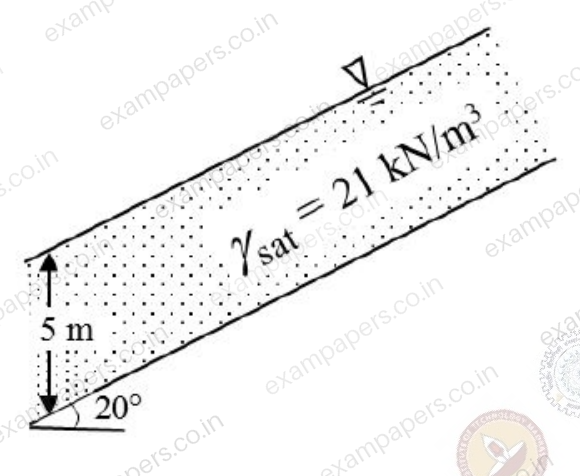
The value of the effective angle of internal friction (in degrees, up to one decimal place) of the sand is
Log in to check the answer
You can attempt this question now. Sign in to view the answer key, explanations and discussion.Log in to check answerQuestion 47
Open questionCE-2NAT2 marksNeeds review
A catchment is idealized as a 25 km × 25 km square. It has five rain gauges, one at each corner and one at the center, as shown in the figure.
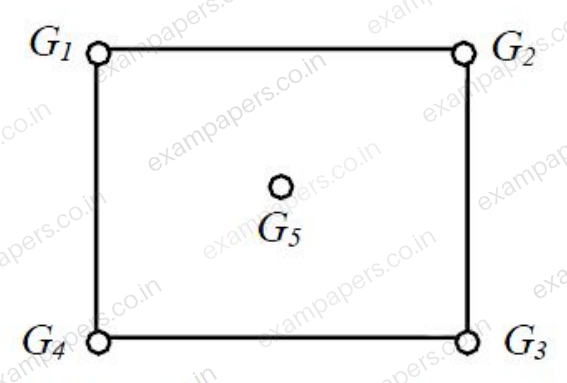
During a month, the precipitation at these gauges is measured as
mm,
mm,
mm,
mm and
mm. The average precipitation (in mm, up to one decimal place) over the catchment during this month by using the Thiessen polygon method isLog in to check the answer
You can attempt this question now. Sign in to view the answer key, explanations and discussion.Log in to check answerQuestion 48
Open questionCENAT2 marksNeeds review
A sluice gate used to control the flow in a horizontal channel of unit width is shown in the figure.
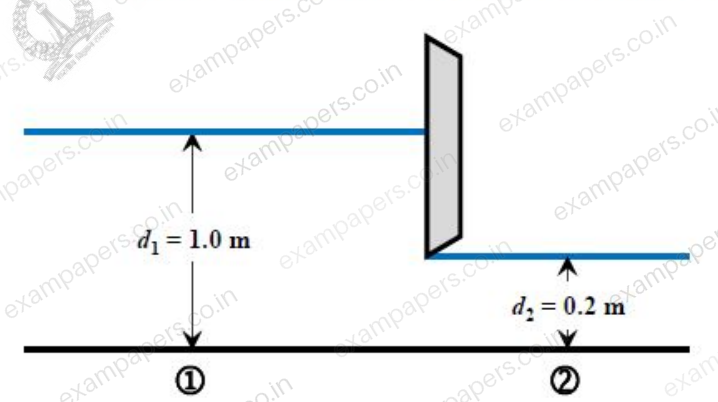
It is observed that the depth of flow is 1.0 m upstream of the gate, while the depth is 0.2 m downstream of the gate. Assuming a smooth flow transition across the sluice gate, i.e., without any energy loss, and the acceleration due to gravity as 10 m/s
, the discharge (in m
/s, up to two decimal places) passing under the sluice gate isLog in to check the answer
You can attempt this question now. Sign in to view the answer key, explanations and discussion.Log in to check answerQuestion 48
Open questionCE-2NAT2 marksNeeds review
The culturable command area of a canal is 10,000 ha. The area grows only two crops—rice in the Kharif season and wheat in the Rabi season. The design discharge of the canal is based on the rice requirements, which has an irrigated area of 2500 ha, base period of 150 days and delta of 130 cm. The maximum permissible irrigated area (in ha) for wheat, with a base period of 120 days and delta of 50 cm, is
Log in to check the answer
You can attempt this question now. Sign in to view the answer key, explanations and discussion.Log in to check answerQuestion 49
Open questionCENAT2 marksNeeds review
Water flows through a 90° bend in a horizontal plane as depicted in the figure.
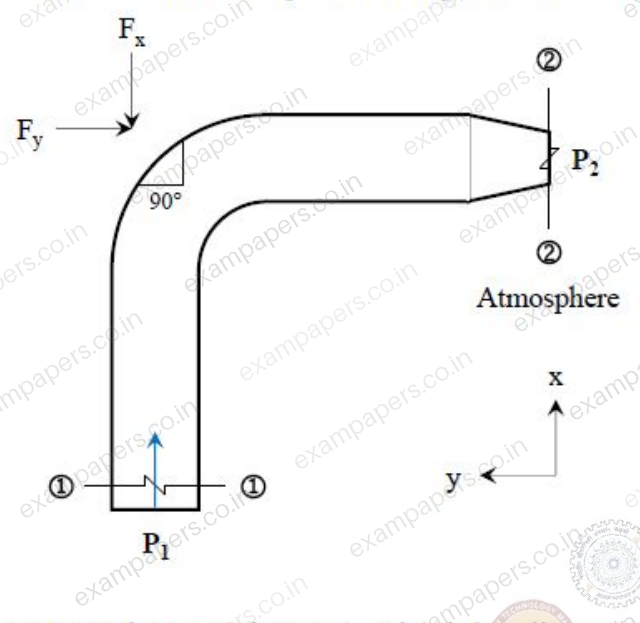
A pressure of 140 kPa is measured at Section 1-1. The inlet diameter marked at Section 1-1 is
cm, while the nozzle diameter marked at Section 2-2 is
cm. Assume the following:
(i) Acceleration due to gravity = 10 m/s
.
(ii) Weights of both the bent pipe segment as well as water are negligible.
(iii) Friction across the bend is negligible.The magnitude of the force (in kN, up to two decimal places) that would be required to hold the pipe section is
Log in to check the answer
You can attempt this question now. Sign in to view the answer key, explanations and discussion.Log in to check answerQuestion 49
Open questionCE-2NAT2 marksNeeds review
Water is pumped at a steady uniform flow rate of 0.01 m
/s through a horizontal smooth circular pipe of 100 mm diameter. Given that the Reynolds number is 800 and
is 9.81 m/s
, the head loss (in meters, up to one decimal place) per km length due to friction would beLog in to check the answer
You can attempt this question now. Sign in to view the answer key, explanations and discussion.Log in to check answerQuestion 50
Open questionCENAT2 marksNeeds review
A consolidated undrained (CU) triaxial compression test is conducted on a normally consolidated clay at a confining pressure of 100 kPa. The deviator stress at failure is 80 kPa, and the pore-water pressure measured at failure is 50 kPa. The effective angle of internal friction (in degrees, up to one decimal place) of the soil is
Log in to check the answer
You can attempt this question now. Sign in to view the answer key, explanations and discussion.Log in to check answerQuestion 50
Open questionCE-2NAT2 marksNeeds review
The composition of a municipal solid waste sample is given below:
Component | Percent by Mass | Moisture Content (%) | Energy Content (kJ/kg, on as-discarded basis) |
|---|---|---|---|
Food Waste | 20 | 70 | 2500 |
Paper | 10 | 4 | 1000 |
Cardboard | 10 | 4 | 800 |
Plastics | 10 | 1 | 14000 |
Garden Trimmings | 40 | 60 | 350 |
Wood | 5 | 20 | 14000 |
Tin Cans | 5 | 2 | 100 |
The difference between the energy content of the waste sample calculated on dry basis and as-discarded basis (in kJ/kg) would be
Log in to check the answer
You can attempt this question now. Sign in to view the answer key, explanations and discussion.Log in to check answer