
Civil Engineering
GATE CE topic:analytical-aptitude PYQs
Build your understanding with focused practice from past exam papers.
How to practice topic:analytical-aptitude
Attempt a question, record the concept and assumptions, then check the available answer. Rework mistakes after revising the relevant concepts. Topic tags can overlap; review the question context.
Questions 1–10 of 33. Imported answers require independent review unless marked reviewed.
Question 4
Open questionGAMCQ1 markNeeds review
‘All the mangoes in the basket are good.’
If the above statement is false, then which one of the following statements is necessarily true?
Your answerChoose one option.
Log in to check the answer
You can attempt this question now. Sign in to view the answer key, explanations and discussion.Log in to check answerQuestion 5
Open questionGAMCQ1 markNeeds review
Consider the following statements about four numbers:
(S1) The average of the four numbers is 25
(S2) Each number is at most 40
(S3) Each number is at least 20
Choose the option that is necessarily correct.
Your answerChoose one option.
Log in to check the answer
You can attempt this question now. Sign in to view the answer key, explanations and discussion.Log in to check answerQuestion 9
Open questionGAMCQ2 marksNeeds review
Consider a linear arrangement of seven bulbs, each of which can be in the ON or OFF states. The initial configuration of the bulbs is shown in the figure. In every Step, the states of the bulbs are changed based on the following rules:
• Any OFF bulb with exactly one ON neighbor at the end of the previous Step is turned ON.
• Any ON bulb with both neighbors ON at the end of the previous Step is turned OFF.
• The state of any bulb not meeting the conditions above is left unchanged.
The state of bulbs at the end of Step 1 and Step 2 are also shown in the figure.

The number of bulbs which are ON at the end of Step 8 is ______
Your answerChoose one option.
Log in to check the answer
You can attempt this question now. Sign in to view the answer key, explanations and discussion.Log in to check answerQuestion 9
Open questionGAMCQ2 marksNeeds review
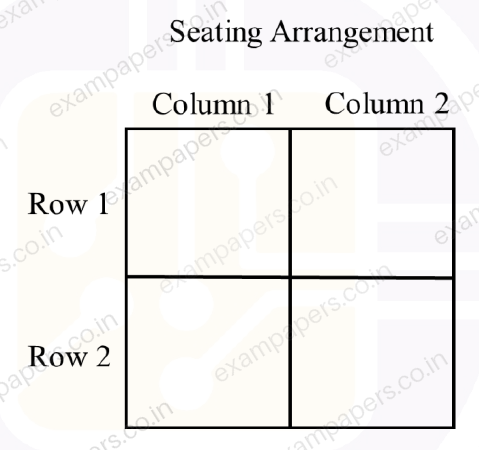
The Roman senator Merorius, his brother, his son, and his daughter have varying oratory skill levels. They are seated in rows and columns as shown in the figure with exactly one person sitting in each box. It is known that
(i) Merorius’ daughter and his brother are seated in the same column.
(ii) His son is seated diagonally across the sibling of the worst orator.
(iii) The best and worst orators are seated in the same row.
Who is the best orator?
Your answerChoose one option.
Log in to check the answer
You can attempt this question now. Sign in to view the answer key, explanations and discussion.Log in to check answerQuestion 4
Open questionGAMCQ1 markNeeds review
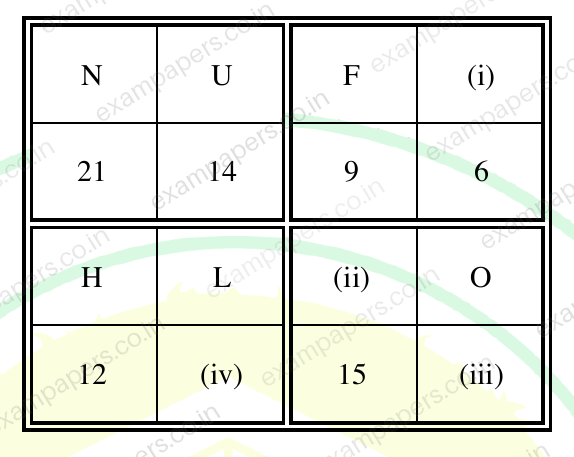
In the context of the given figure, which one of the following options correctly represents the entries in the blocks labelled (i), (ii), (iii), and (iv), respectively?
Your answerChoose one option.
Log in to check the answer
You can attempt this question now. Sign in to view the answer key, explanations and discussion.Log in to check answerQuestion 7
Open questionGAMCQ2 marksNeeds review
For the clock shown in the figure, if
, and
,
then which one among the given options is most appropriate for
?

Your answerChoose one option.
Log in to check the answer
You can attempt this question now. Sign in to view the answer key, explanations and discussion.Log in to check answerQuestion 2
Open questionGAMCQ1 markNeeds review
Statements:
All heroes are winners.
All winners are lucy people.
Inferences:
I. All lucky people are heroes.
II. Some lucky people are heroes.
III. Some winners are heroes.
Which of the above inferences can be logically deduced from statements 1 and 2?
Your answerChoose one option.
Log in to check the answer
You can attempt this question now. Sign in to view the answer key, explanations and discussion.Log in to check answerQuestion 9
Open questionGAMCQ2 marksNeeds review
In the 4 × 4 array shown below, each cell of the first three columns has either a cross (X) or a number, as per the given rule.

Rule: The number in a cell represents the count of crosses around its immediate neighboring cells (left, right, top, bottom, diagonals).
As per this rule, the maximum number of crosses possible in the empty column is
Your answerChoose one option.
Log in to check the answer
You can attempt this question now. Sign in to view the answer key, explanations and discussion.Log in to check answerQuestion 4
Open questionGAMCQ1 markNeeds review
A duck named Donald Duck says “All ducks always lie.”
Based only on the information above, which one of the following statements can be logically inferred with certainty?
Your answerChoose one option.
Log in to check the answer
You can attempt this question now. Sign in to view the answer key, explanations and discussion.Log in to check answerQuestion 4
Open questionGAMCQ1 markNeeds review
There are 4 red, 5 green, and 6 blue balls inside a box. If
number of balls are picked simultaneously, what is the smallest value of
that guarantees there will be at least two balls of the same colour?One cannot see the colour of the balls until they are picked.
Your answerChoose one option.
Log in to check the answer
You can attempt this question now. Sign in to view the answer key, explanations and discussion.Log in to check answer