
Civil Engineering
GATE CE topic:civil-engineering PYQs
Build your understanding with focused practice from past exam papers.
Questions 501–510 of 1300. Imported answers require independent review unless marked reviewed.
Question 56
Open questionceNAT2 marksNeeds review
A soil having the average properties, bulk unit weight = 19 kN/m
; angle of internal friction = 25° and cohesion = 15 kPa, is being formed on a rock slope existing at an inclination of 35° with the horizontal. The critical height (in m) of the soil formation up to which it would be stable without any failure is ______ (round off to one decimal place).[Assume the soil is being formed parallel to the rock beding plane and there is no ground water effect.]
Log in to check the answer
You can attempt this question now. Sign in to view the answer key, explanations and discussion.Log in to check answerQuestion 56
Open questionCE-2NAT2 marksNeeds review
A 2D thin plate with modulus of elasticity,
N/m
, and Poisson’s ratio,
, is in plane stress condition. The displacement field in the plate is given by
and
, where
and
are displacements (in m) along the
and
directions, respectively, and
is a constant (in m
). The distances x and y along
and
, respectively, are in m. The stress in the
direction is
N/m
, and the shear stress is
N/m
. What is the value of
(in N/m
, in integer)? ____________Log in to check the answer
You can attempt this question now. Sign in to view the answer key, explanations and discussion.Log in to check answerQuestion 57
Open questionceNAT2 marksNeeds review
A smooth vertical retaining wall supporting layered soils is shown in figure. According to Rankine’s earth pressure theory, the lateral active earth pressure acting at the base of the wall is ______ kPa (round off to one decimal place).
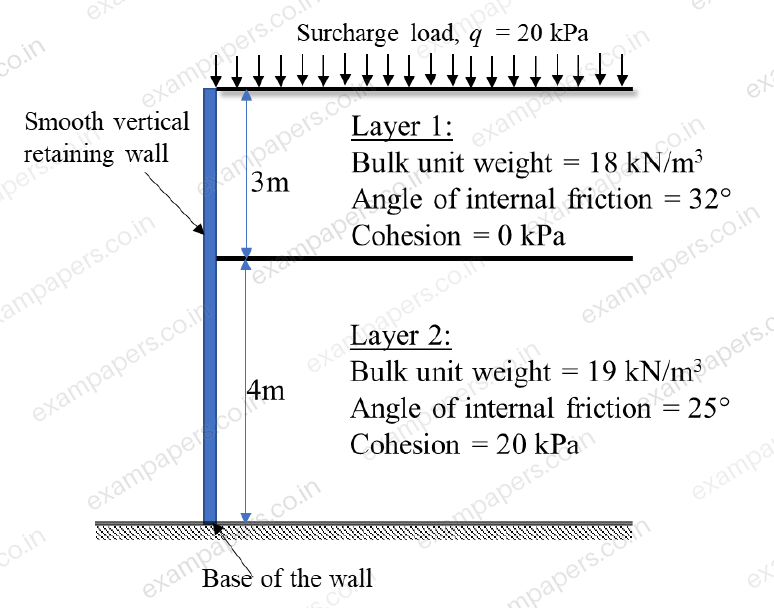
Log in to check the answer
You can attempt this question now. Sign in to view the answer key, explanations and discussion.Log in to check answerQuestion 57
Open questionCE-2NAT2 marksNeeds review
An idealised frame supports a load as shown in the figure. The horizontal component of the force transferred from the horizontal member PQ to the vertical member RS at P is ______ N (round off to one decimal place).
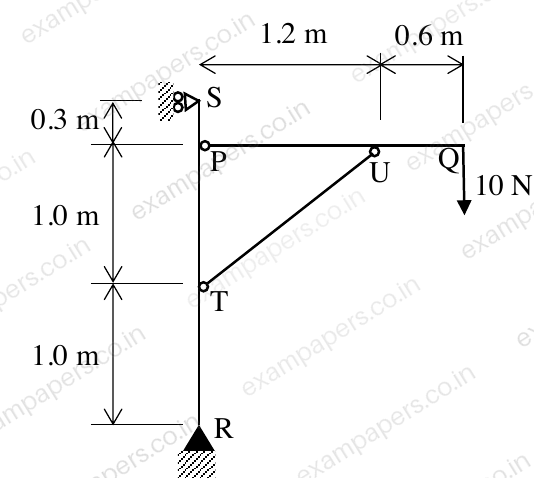
Log in to check the answer
You can attempt this question now. Sign in to view the answer key, explanations and discussion.Log in to check answerQuestion 58
Open questionceNAT2 marksNeeds review
A vertical trench is excavated in a clayey soil deposit having a surcharge load of 30 kPa. A fluid of unit weight 12 kN/m
is poured in the trench to prevent collapse as the excavation proceeds. Assume that the fluid is not seeping through the soil deposit. If the undrained cohesion of the clay deposit is 20 kPa and saturated unit weight is 18 kN/m
, what is the maximum depth of unsupported excavation (in m, rounded off to two decimal places)?Log in to check the answer
You can attempt this question now. Sign in to view the answer key, explanations and discussion.Log in to check answerQuestion 58
Open questionCE-2NAT2 marksNeeds review
A square footing is to be designed to carry a column load of 500 kN which is resting on a soil stratum having the following average properties: bulk unit weight = 19 kN/m
; angle of internal friction = 0° and cohesion = 25 kPa. Considering the depth of the footing as 1 m and adopting Meyerhof’s bearing capacity theory with a factor of safety of 3, the width of the footing (in m) is __________________ (round off to one decimal place)[Assume the applicable shape and depth factor values as unity; ground water level at greater depth.]
Log in to check the answer
You can attempt this question now. Sign in to view the answer key, explanations and discussion.Log in to check answerQuestion 59
Open questionceNAT2 marksNeeds review
A 12-hour storm occurs over a catchment and results in a direct runoff depth of 100 mm. The time-distribution of the rainfall intensity is shown in the figure (not to scale). The
-index of the storm is (in mm, rounded off to two decimal places) ____________________.
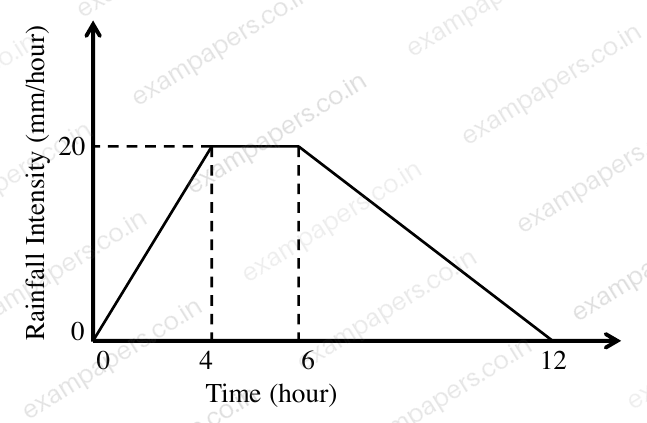
Log in to check the answer
You can attempt this question now. Sign in to view the answer key, explanations and discussion.Log in to check answerQuestion 59
Open questionCE-2NAT2 marksNeeds review
A circular pile of diameter 0.6 m and length 8 m was constructed in a cohesive soil stratum having the following properties: bulk unit weight = 19 kN/m
; angle of internal friction = 0° and cohesion = 25 kPa.The allowable load the pile can carry with a factor of safety of 3 is ________________ kN (round off to one decimal place).
[Adopt: Adhesion factor,
= 1.0 and Bearing capacity factor,
= 9.0]Log in to check the answer
You can attempt this question now. Sign in to view the answer key, explanations and discussion.Log in to check answerQuestion 60
Open questionceNAT2 marksNeeds review
A hydraulic jump occurs in a 1.0 m wide horizontal, frictionless, rectangular channel, with a pre-jump depth of 0.2 m and a post-jump depth of 1.0 m. The value of g may be taken as 10 m/s
. The values of the specific force at the pre-jump and post-jump sections are same and are equal to (in m
, rounded off to two decimal places) ____________ .Log in to check the answer
You can attempt this question now. Sign in to view the answer key, explanations and discussion.Log in to check answerQuestion 60
Open questionCE-2NAT2 marksNeeds review
For the flow setup shown in the figure (not to scale), the hydraulic conductivities of the two soil samples, Soil 1 and Soil 2, are 10 m/s and 1 mm/s, respectively. Assume the unit weight of water as 10 kN/m
and ignore the velocity head. At steady state, what is the total head (in m, rounded off to two decimal places) at any point located at the junction of the two samples? __________________________ 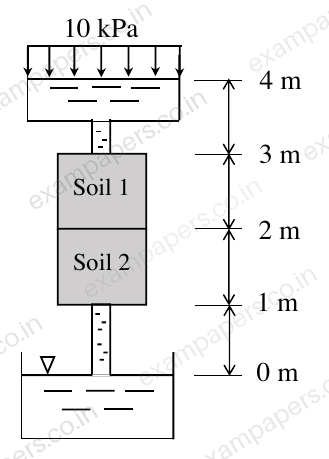
Log in to check the answer
You can attempt this question now. Sign in to view the answer key, explanations and discussion.Log in to check answer