
Civil Engineering
GATE CE topic:foundation-engineering PYQs
Build your understanding with focused practice from past exam papers.
Questions 21–30 of 78. Imported answers require independent review unless marked reviewed.
Question 54
Open questionce-1NAT2 marksNeeds review
An infinite slope is made up of cohesionless soil with seepage parallel to and up to the sloping surface. The angle of slope is 30° with respect to horizontal ground surface. The unit weights of the saturated soil and water are 20 kN/m
and 10 kN/m
, respectively.The minimum angle of shearing resistance of the soil (in degrees) for the critically stable condition of the slope is ____________ (rounded off to the nearest integer).
Log in to check the answer
You can attempt this question now. Sign in to view the answer key, explanations and discussion.Log in to check answerQuestion 17
Open questionCEMCQ1 markNeeds review
A group of 9 friction piles are arranged in a square grid maintaining equal spacing in all directions. Each pile is of diameter 300 mm and length 7 m. Assume that the soil is cohesionless with effective friction angle of
. What is the center-to-center spacing of the piles (in m) for the pile group efficiency of 60%?Your answerChoose one option.
Log in to check the answer
You can attempt this question now. Sign in to view the answer key, explanations and discussion.Log in to check answerQuestion 18
Open questionCE-2MCQ1 markNeeds review
A standard penetration test (SPT) was carried out at a location by using a manually operated hammer dropping system with 50% efficiency. The recorded SPT value at a particular depth is 28. If an automatic hammer dropping system with 70% efficiency is used at the same location, the recorded SPT value will be ______.
Your answerChoose one option.
Log in to check the answer
You can attempt this question now. Sign in to view the answer key, explanations and discussion.Log in to check answerQuestion 28
Open questionCE-2MSQ1 markNeeds review
The reason(s) of the nonuniform elastic settlement profile below a flexible footing, resting on a cohesionless soil while subjected to uniform loading, is/are:
Your answerSelect all correct options. You can choose more than one.
Log in to check the answer
You can attempt this question now. Sign in to view the answer key, explanations and discussion.Log in to check answerQuestion 41
Open questionCEMCQ2 marksNeeds review
Consider that a force P is acting on the surface of a half-space (Bousinesq’s problem). The expression for the vertical stress (
) at a point (r, z), within the half-space is given as,
where r is the radial distance and z is the depth with downward direction taken as positive. At any given r, there is a variation of
along z and at a specific z, the value of
will be maximum. What is the locus of the maximum
?Your answerChoose one option.
Log in to check the answer
You can attempt this question now. Sign in to view the answer key, explanations and discussion.Log in to check answerQuestion 42
Open questionCEMCQ2 marksNeeds review
A square footing of size 2.5 m × 2.5 m is placed 1.0 m below the ground surface on a cohesionless homogeneous soil stratum. Considering that the groundwater table is located at the base of the footing, the unit weights of soil above and below the groundwater table are 18 kN/m³ and 20 kN/m³, respectively, and the bearing capacity factor
is 58, the net ultimate bearing capacity of the soil is estimated as 1706 kPa (unit weight of water = 10 kN/m³).Earlier, a plate load test was carried out with a circular plate of 30 cm diameter in the same foundation pit during a dry season, when the water table was located beyond the plate influence zone. Using Terzaghi’s bearing capacity formula, what is the ultimate bearing capacity (in kPa) of the plate?
Your answerChoose one option.
Log in to check the answer
You can attempt this question now. Sign in to view the answer key, explanations and discussion.Log in to check answerQuestion 42
Open questionCE-2MCQ2 marksNeeds review
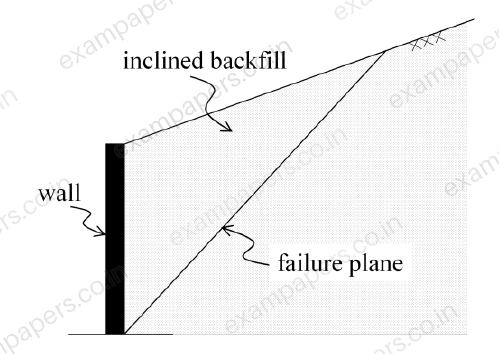
The figure shows a vertical retaining wall with backfill consisting of cohesive-frictional soil and a failure plane developed due to passive earth pressure. The forces acting on the failure wedge are: P as the reaction force between the wall and the soil, R as the reaction force on the failure plane, C as the cohesive force along the failure plane and W as the weight of the failure wedge. Assuming that there is no adhesion between the wall and the wedge, identify the most appropriate force polygon for the wedge.
Your answerChoose one option.
Log in to check the answer
You can attempt this question now. Sign in to view the answer key, explanations and discussion.Log in to check answerQuestion 56
Open questionceNAT2 marksNeeds review
A soil having the average properties, bulk unit weight = 19 kN/m
; angle of internal friction = 25° and cohesion = 15 kPa, is being formed on a rock slope existing at an inclination of 35° with the horizontal. The critical height (in m) of the soil formation up to which it would be stable without any failure is ______ (round off to one decimal place).[Assume the soil is being formed parallel to the rock beding plane and there is no ground water effect.]
Log in to check the answer
You can attempt this question now. Sign in to view the answer key, explanations and discussion.Log in to check answerQuestion 57
Open questionceNAT2 marksNeeds review
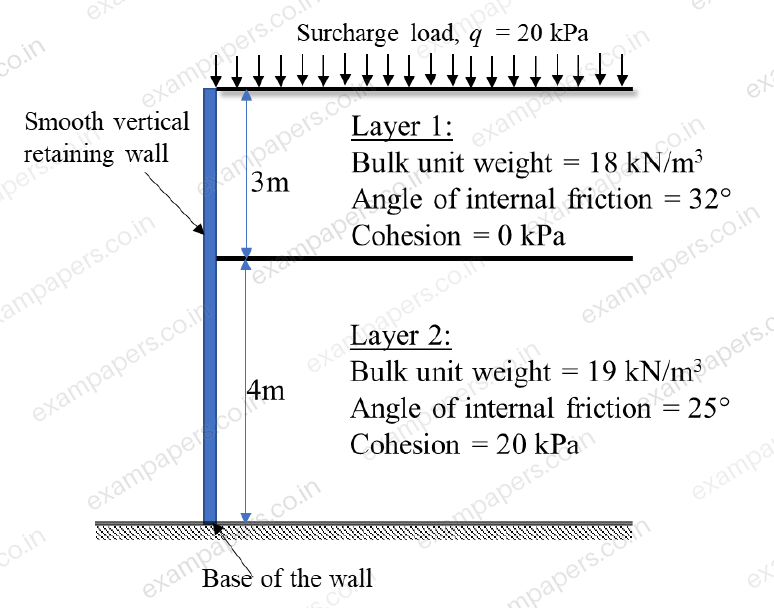
A smooth vertical retaining wall supporting layered soils is shown in figure. According to Rankine’s earth pressure theory, the lateral active earth pressure acting at the base of the wall is ______ kPa (round off to one decimal place).
Log in to check the answer
You can attempt this question now. Sign in to view the answer key, explanations and discussion.Log in to check answerQuestion 58
Open questionceNAT2 marksNeeds review
A vertical trench is excavated in a clayey soil deposit having a surcharge load of 30 kPa. A fluid of unit weight 12 kN/m
is poured in the trench to prevent collapse as the excavation proceeds. Assume that the fluid is not seeping through the soil deposit. If the undrained cohesion of the clay deposit is 20 kPa and saturated unit weight is 18 kN/m
, what is the maximum depth of unsupported excavation (in m, rounded off to two decimal places)?Log in to check the answer
You can attempt this question now. Sign in to view the answer key, explanations and discussion.Log in to check answer