
Civil Engineering
GATE CE topic:infrastructure PYQs
Build your understanding with focused practice from past exam papers.
Questions 471–480 of 1300. Imported answers require independent review unless marked reviewed.
Question 41
Open questionCEMCQ2 marksNeeds review
Consider that a force P is acting on the surface of a half-space (Bousinesq’s problem). The expression for the vertical stress (
) at a point (r, z), within the half-space is given as,
where r is the radial distance and z is the depth with downward direction taken as positive. At any given r, there is a variation of
along z and at a specific z, the value of
will be maximum. What is the locus of the maximum
?Your answerChoose one option.
Log in to check the answer
You can attempt this question now. Sign in to view the answer key, explanations and discussion.Log in to check answerQuestion 41
Open questionCE-2MCQ2 marksNeeds review
In the given figure, Point O indicates the stress point of a soil element at initial non-hydrostatic stress condition. For the stress path (OP), which of the following loading conditions is correct?
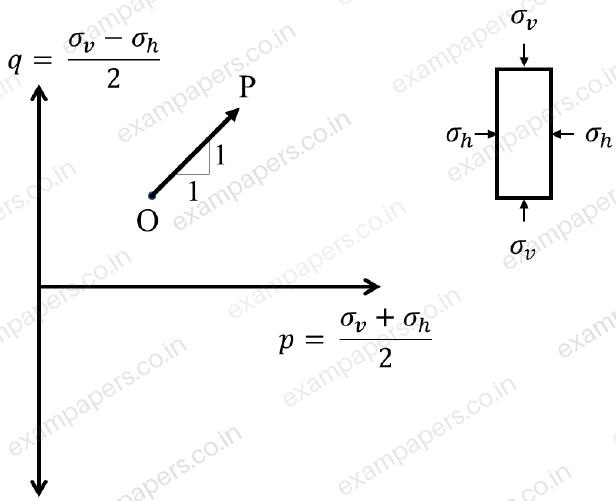
Your answerChoose one option.
Log in to check the answer
You can attempt this question now. Sign in to view the answer key, explanations and discussion.Log in to check answerQuestion 42
Open questionCEMCQ2 marksNeeds review
A square footing of size 2.5 m × 2.5 m is placed 1.0 m below the ground surface on a cohesionless homogeneous soil stratum. Considering that the groundwater table is located at the base of the footing, the unit weights of soil above and below the groundwater table are 18 kN/m³ and 20 kN/m³, respectively, and the bearing capacity factor
is 58, the net ultimate bearing capacity of the soil is estimated as 1706 kPa (unit weight of water = 10 kN/m³).Earlier, a plate load test was carried out with a circular plate of 30 cm diameter in the same foundation pit during a dry season, when the water table was located beyond the plate influence zone. Using Terzaghi’s bearing capacity formula, what is the ultimate bearing capacity (in kPa) of the plate?
Your answerChoose one option.
Log in to check the answer
You can attempt this question now. Sign in to view the answer key, explanations and discussion.Log in to check answerQuestion 42
Open questionCE-2MCQ2 marksNeeds review
The figure shows a vertical retaining wall with backfill consisting of cohesive-frictional soil and a failure plane developed due to passive earth pressure. The forces acting on the failure wedge are: P as the reaction force between the wall and the soil, R as the reaction force on the failure plane, C as the cohesive force along the failure plane and W as the weight of the failure wedge. Assuming that there is no adhesion between the wall and the wedge, identify the most appropriate force polygon for the wedge.
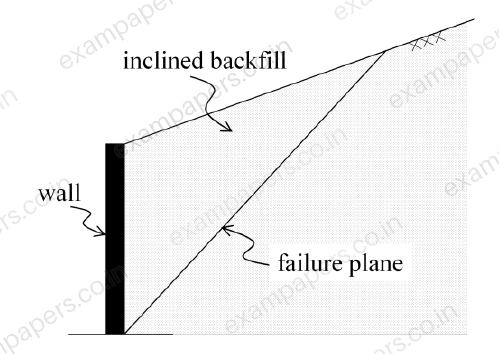
Your answerChoose one option.
Log in to check the answer
You can attempt this question now. Sign in to view the answer key, explanations and discussion.Log in to check answerQuestion 43
Open questionCEMCQ2 marksNeeds review
A very wide rectangular channel carries a discharge (Q) of 70 m³/s per meter width. Its bed slope changes from 0.001 to 0.009 at a point P, as shown in the figure (not to scale). The Manning’s roughness coefficient of the channel is 0.01. What water surface profile(s) exist(s) near the point P?
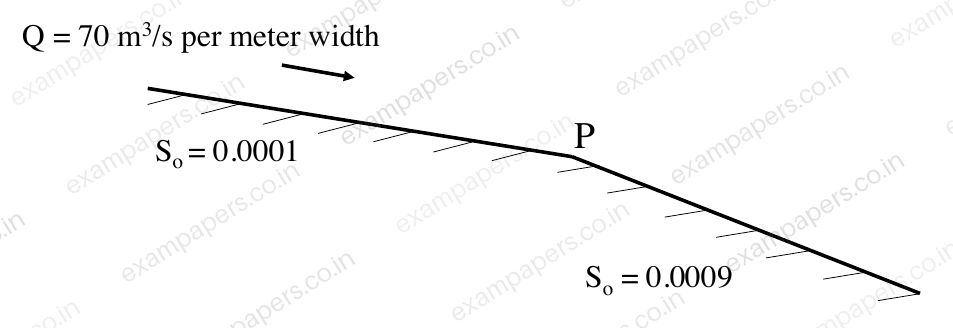
Your answerChoose one option.
Log in to check the answer
You can attempt this question now. Sign in to view the answer key, explanations and discussion.Log in to check answerQuestion 43
Open questionCE-2MCQ2 marksNeeds review
A compound symmetrical open channel section as shown in the figure has a maximum of ______ critical depth(s).
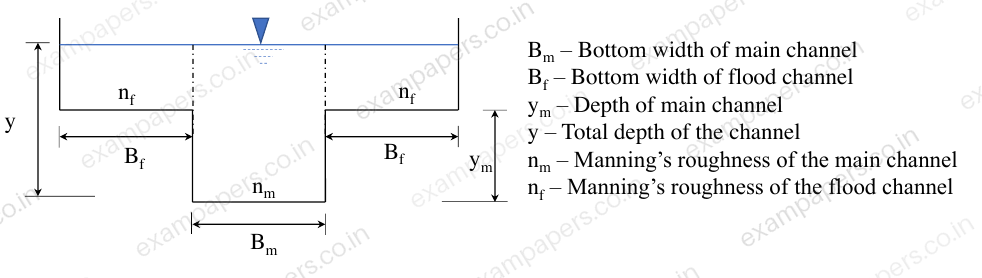
Your answerChoose one option.
Log in to check the answer
You can attempt this question now. Sign in to view the answer key, explanations and discussion.Log in to check answerQuestion 44
Open questionCEMCQ2 marksNeeds review
A jet of water having a velocity of 20 m/s strikes a series of plates fixed radially on a wheel revolving in the same direction as the jet at 15 m/s. What is the percentage efficiency of the plates? (round off to one decimal place)
Your answerChoose one option.
Log in to check the answer
You can attempt this question now. Sign in to view the answer key, explanations and discussion.Log in to check answerQuestion 44
Open questionCE-2MCQ2 marksNeeds review
The critical flow condition in a channel is given by ______.
[Note:
– kinetic energy correction factor;
– discharge;
– cross-sectional area of flow at critical flow condition;
– top width of flow at critical flow condition;
– acceleration due to gravity]Your answerChoose one option.
Log in to check the answer
You can attempt this question now. Sign in to view the answer key, explanations and discussion.Log in to check answerQuestion 45
Open questionCEMCQ2 marksNeeds review
In the following table, identify the correct set of associations between the entries in Column-1 and Column-2.
Column-1 | Column-2 |
|---|---|
P: Reverse Osmosis | I: Ponding |
Q: Trickling Filter | II: Freundlich Isotherm |
R: Coagulation | III: Concentration Polarization |
S: Adsorption | IV: Charge Neutralization |
Your answerChoose one option.
Log in to check the answer
You can attempt this question now. Sign in to view the answer key, explanations and discussion.Log in to check answerQuestion 45
Open questionCE-2MCQ2 marksNeeds review
Match the following air pollutants with the most appropriate adverse health effects:
Air pollutant | Health effect to human and/or test animal |
|---|---|
(P) Aromatic hydrocarbons | (I) Reduce the capability of the blood to carry oxygen |
(Q) Carbon monoxide | (II) Bronchitis and pulmonary emphysema |
(R) Sulfur oxides | (III) Damage of chromosomes |
(S) Ozone | (IV) Carcinogenic effect |
Your answerChoose one option.
Log in to check the answer
You can attempt this question now. Sign in to view the answer key, explanations and discussion.Log in to check answer