
Civil Engineering
GATE CE topic:infrastructure PYQs
Build your understanding with focused practice from past exam papers.
Questions 71–80 of 1300. Imported answers require independent review unless marked reviewed.
Question 36
Open questionCEMCQ2 marksNeeds review
Let
be a continuous function defined in
and satisfying the equation
The value of
isYour answerChoose one option.
Log in to check the answer
You can attempt this question now. Sign in to view the answer key, explanations and discussion.Log in to check answerQuestion 36
Open questionCEMCQ2 marksNeeds review
Let
where p is a constant. The value of
isYour answerChoose one option.
Log in to check the answer
You can attempt this question now. Sign in to view the answer key, explanations and discussion.Log in to check answerQuestion 37
Open questionCEMCQ2 marksNeeds review
An ordinary differential equation is given below.
Considering
and
as arbitrary constants, the general solution of the equation isYour answerChoose one option.
Log in to check the answer
You can attempt this question now. Sign in to view the answer key, explanations and discussion.Log in to check answerQuestion 37
Open questionCEMCQ2 marksNeeds review
Vector field
is defined as
. The curl of
at point
isYour answerChoose one option.
Log in to check the answer
You can attempt this question now. Sign in to view the answer key, explanations and discussion.Log in to check answerQuestion 38
Open questionCEMCQ2 marksNeeds review
A plane truss consists of two linearly elastic, homogeneous, identical members, namely PQ and QR. Both members have length
, cross-sectional area
, and modulus of elasticity
. The members are inclined at
as shown in the figure. The truss has hinge supports at P and R. The translational degrees-of-freedom (u and v) are shown at joint Q. 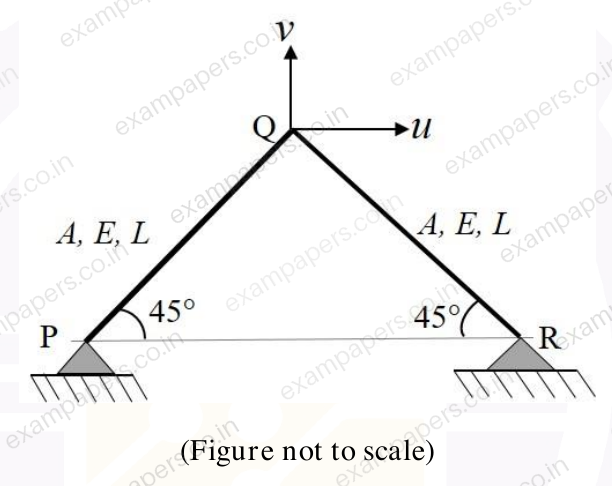
After application of the boundary conditions, the stiffness matrix of the truss becomes:
Your answerChoose one option.
Log in to check the answer
You can attempt this question now. Sign in to view the answer key, explanations and discussion.Log in to check answerQuestion 38
Open questionCEMCQ2 marksNeeds review
A simply supported, linearly elastic, homogeneous, prismatic beam of length L and flexural rigidity EI is shown in the figure.
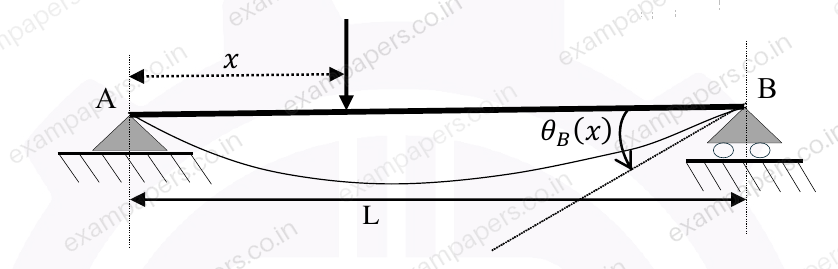
The expression for the Influence Line Diagram (ILD) of the rotation
at the support B isYour answerChoose one option.
Log in to check the answer
You can attempt this question now. Sign in to view the answer key, explanations and discussion.Log in to check answerQuestion 39
Open questionCEMCQ2 marksNeeds review
The plane frame has a hinge and a roller support, and is loaded as shown in the figure. Both the columns have same height.
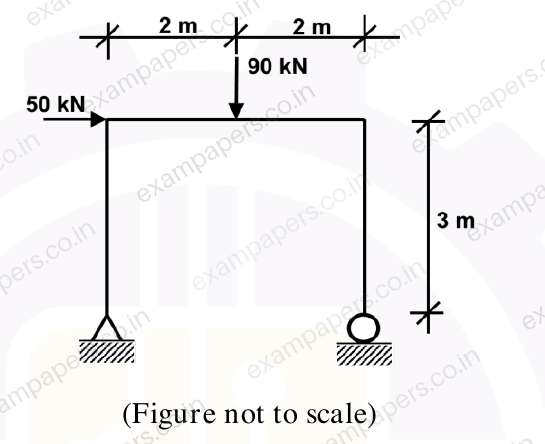
What is the absolute value of the maximum bending moment (in kN-m) in the frame?
Your answerChoose one option.
Log in to check the answer
You can attempt this question now. Sign in to view the answer key, explanations and discussion.Log in to check answerQuestion 39
Open questionCEMCQ2 marksNeeds review
The plane truss shown in the figure is hinge-supported at E and F. The truss is subjected to vertical downward force at R and horizontal force at G.
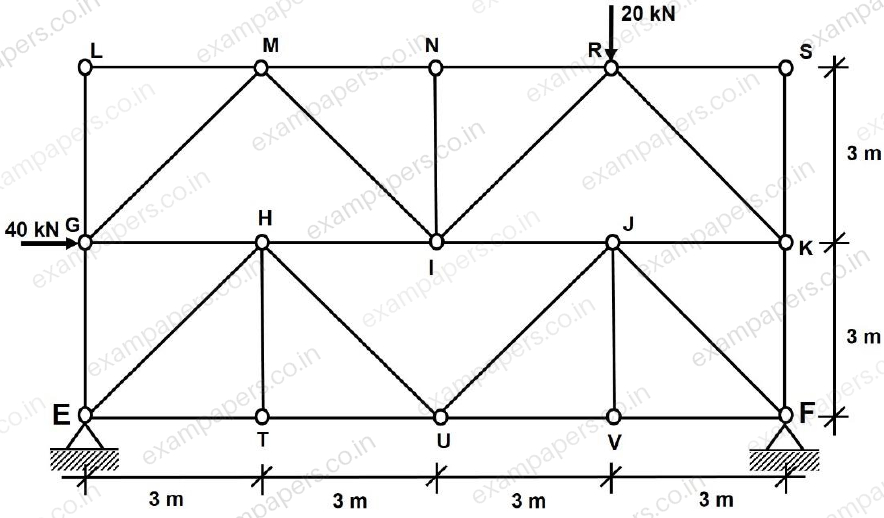
The force (in kN) along with its nature in member JF is
Your answerChoose one option.
Log in to check the answer
You can attempt this question now. Sign in to view the answer key, explanations and discussion.Log in to check answerQuestion 40
Open questionCEMCQ2 marksNeeds review
For a hydraulic jump formed in a rectangular horizontal channel, the sequent depth ratio is 2. The Froude number of supercritical stream is
Your answerChoose one option.
Log in to check the answer
You can attempt this question now. Sign in to view the answer key, explanations and discussion.Log in to check answerQuestion 40
Open questionCEMCQ2 marksNeeds review
Consider the following statements with respect to rigid pavements:
Statement-1: Bottom-up cracking (BU) in rigid pavements is caused at the edge of the slab due to combined effect of single or tandem rear axle load and positive temperature differential.
Statement-2: Top-down fatigue cracking (TD) in rigid pavements is caused due to repeated cycles of axle loads and negative temperature differential.
The CORRECT option is:
Your answerChoose one option.
Log in to check the answer
You can attempt this question now. Sign in to view the answer key, explanations and discussion.Log in to check answer