
Civil Engineering
GATE CE topic:infrastructure PYQs
Build your understanding with focused practice from past exam papers.
Questions 81–90 of 1300. Imported answers require independent review unless marked reviewed.
Question 41
Open questionCEMCQ2 marksNeeds review
In a laminar flow of a Newtonian fluid through a circular pipe of radius 5 cm, the maximum velocity is found to be 2 m/s. The velocity (in m/s) at a radial distance of 2.50 cm from the axis of the pipe is
Your answerChoose one option.
Log in to check the answer
You can attempt this question now. Sign in to view the answer key, explanations and discussion.Log in to check answerQuestion 41
Open questionCEMCQ2 marksNeeds review
For the traverse given below, the benchmark is at ground point L. The Reduced Level (RL) of L is 150.000 m. The direction of the traverse is from L to N. The readings on levelling staff using the same levelling instrument kept at Stations S1 and S2 during the traversing are shown in the figure.
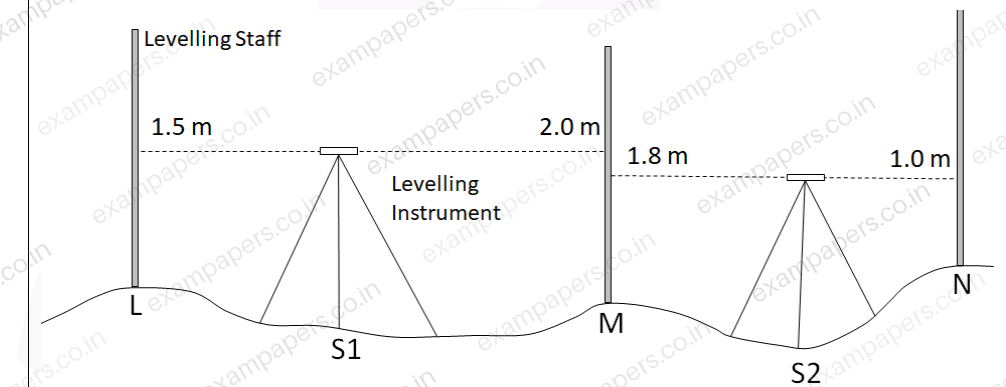
Column 1 | Column 2 |
|---|---|
(I) Sum of Back Sights | (P) 3.300 m |
(II) Sum of Fore Sights | (Q) 2.500 m |
(III) RL of Point N | (R) 150.300 m |
| (S) 3.000 m |
| (T) 150.500 m |
Matching the information given under Column 1 and Column 2, which one of the following options is CORRECT?
Your answerChoose one option.
Log in to check the answer
You can attempt this question now. Sign in to view the answer key, explanations and discussion.Log in to check answerQuestion 42
Open questionCEMCQ2 marksNeeds review
A road is divided into four sections having varying widths as shown in the figure. Section-2 (S2) represents a capacity constrained condition with respect to the traffic flow passing through Section-1 (S1). Section-3 (S3) and Section-4 (S4) do not face any such capacity constraint with respect to the flow. A flow-density relationship for unconstrained and constrained flow conditions is shown in the figure.
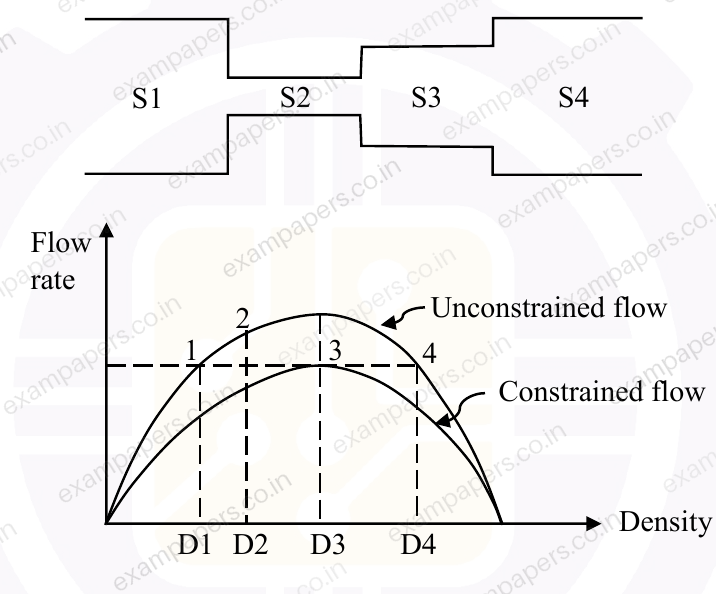
If Section-1 observes density D2, the option representing the correct state of density in Sections 2, 3 and 4 is:
Your answerChoose one option.
Log in to check the answer
You can attempt this question now. Sign in to view the answer key, explanations and discussion.Log in to check answerQuestion 42
Open questionCEMCQ2 marksNeeds review
The 2.4 ml of raw sewage is diluted to 240 ml. The Dissolved Oxygen (DO) of the diluted sample at the beginning of Biochemical Oxygen Demand (BOD) test was 8 mg/l and it was 6 mg/l after 5-day incubation at 20 °C.
The BOD₅ (in mg/l) of the raw sewage is
Your answerChoose one option.
Log in to check the answer
You can attempt this question now. Sign in to view the answer key, explanations and discussion.Log in to check answerQuestion 43
Open questionCEMCQ2 marksNeeds review
Locations P and Q are separated by a wide valley. The difference in levels of locations P and Q measured by a levelling instrument stationed near P is 3.0 m. The same instrument stationed near Q measures the difference in levels of locations P and Q as −1.0 m. Assume that the atmosphere refraction is same during the measurements. The true difference in levels (in m) of locations P and Q is
Your answerChoose one option.
Log in to check the answer
You can attempt this question now. Sign in to view the answer key, explanations and discussion.Log in to check answerQuestion 43
Open questionCEMSQ2 marksNeeds review
Types of flood routing and methods are given in the table below.
Column 1 — Type of Flood Routing:
(P) Hydrologic routing
(Q) Hydraulic routing
(R) Reservoir routing
(S) Channel routing
Column 2 — Method:
(i) Muskingum method
(ii) Modified Pul’s method
(iii) Method of Characteristics
Option(s) giving the CORRECT match(es) between Column 1 and Column 2 is/are:
Your answerSelect all correct options. You can choose more than one.
Log in to check the answer
You can attempt this question now. Sign in to view the answer key, explanations and discussion.Log in to check answerQuestion 44
Open questionCEMCQ2 marksNeeds review
The average sewage from a city is 90 million litres per day and the average 5-day Biochemical Oxygen Demand (BOD₅) is 300 mg/l. Average standard BOD₅ of the domestic sewage is 0.08 kg/day/person. The population equivalent of the city is
Your answerChoose one option.
Log in to check the answer
You can attempt this question now. Sign in to view the answer key, explanations and discussion.Log in to check answerQuestion 44
Open questionCEMSQ2 marksNeeds review
A shallow footing is subjected to a vertical load. Within the elastic limit of the underlying soil, the TRUE statement(s) is/are:
Your answerSelect all correct options. You can choose more than one.
Log in to check the answer
You can attempt this question now. Sign in to view the answer key, explanations and discussion.Log in to check answerQuestion 45
Open questionCEMSQ2 marksNeeds review
Select ALL CORRECT option(s) which can be considered to check whether the flexural stresses in a prestressed concrete beam are within the allowable stresses at the transfer and the service stages.
Your answerSelect all correct options. You can choose more than one.
Log in to check the answer
You can attempt this question now. Sign in to view the answer key, explanations and discussion.Log in to check answerQuestion 45
Open questionCEMSQ2 marksNeeds review
Which of the following statements is/are TRUE with respect to the type of stresses to be considered for the design of rigid pavements?
Your answerSelect all correct options. You can choose more than one.
Log in to check the answer
You can attempt this question now. Sign in to view the answer key, explanations and discussion.Log in to check answer