
Civil Engineering
GATE CE topic:traffic-engineering PYQs
Build your understanding with focused practice from past exam papers.
How to practice topic:traffic-engineering
Attempt a question, record the concept and assumptions, then check the available answer. Rework mistakes after revising the relevant concepts. Topic tags can overlap; review the question context.
Questions 1–10 of 44. Imported answers require independent review unless marked reviewed.
Question 33
Open questionCENAT1 markNeeds review
The travel times of three vehicles on a 2 km stretch of road are 4, 5, and 8 minutes. Assuming the speed of each vehicle to be constant in this stretch, the Space Mean Speed (in km/h) of the vehicles is __________ (rounded off to two decimal places).
Log in to check the answer
You can attempt this question now. Sign in to view the answer key, explanations and discussion.Log in to check answerQuestion 42
Open questionCEMCQ2 marksNeeds review
A road is divided into four sections having varying widths as shown in the figure. Section-2 (S2) represents a capacity constrained condition with respect to the traffic flow passing through Section-1 (S1). Section-3 (S3) and Section-4 (S4) do not face any such capacity constraint with respect to the flow. A flow-density relationship for unconstrained and constrained flow conditions is shown in the figure.
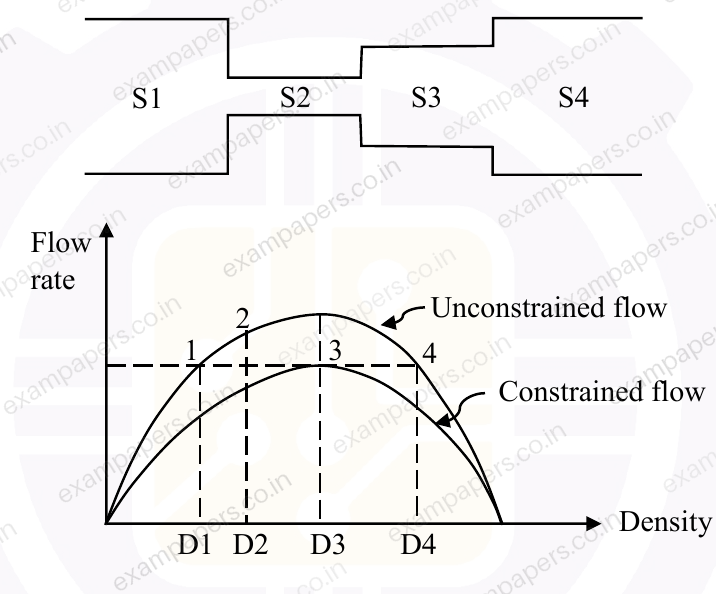
If Section-1 observes density D2, the option representing the correct state of density in Sections 2, 3 and 4 is:
Your answerChoose one option.
Log in to check the answer
You can attempt this question now. Sign in to view the answer key, explanations and discussion.Log in to check answerQuestion 60
Open questionCENAT2 marksNeeds review
Traffic is moving on a 6-lane dual carriageway road. Traffic volume per direction during peak hour (08:00 am to 09:00 am) is 600 veh/h. It is assumed that the traffic is distributed uniformly across the lanes in each direction. Just at 08:00 am, a truck goes out of order on the middle lane of one side, thus disrupting the traffic on that lane in one direction. The lane capacity under normal conditions is 200 veh/h/ln and under queue formation it is 160 veh/h/ln. The traffic resumes at 08:30 am on removing the truck from the middle lane. Hourly traffic volume after 09:00 am reduces to 500 veh/h/dir.
The number of vehicles in the queue at 10:00 am is _____ (in integer).
Log in to check the answer
You can attempt this question now. Sign in to view the answer key, explanations and discussion.Log in to check answerQuestion 60
Open questionCENAT2 marksNeeds review
For a given traffic stream, the speed-density relationship is given as:
where
is the mean speed (in km/h), and
is the density (in veh/km).Considering
as 45 km/h, and
as 200 veh/km, the maximum flow (in veh/h) for the given stream is ______ (rounded off to the nearest integer).Log in to check the answer
You can attempt this question now. Sign in to view the answer key, explanations and discussion.Log in to check answerQuestion 23
Open questionCEMCQ1 markNeeds review
All the vehicles that come during a particular peak hour come during a 10-minute period within this hour. The 15-minute peak hour factor for this peak hour is
Your answerChoose one option.
Log in to check the answer
You can attempt this question now. Sign in to view the answer key, explanations and discussion.Log in to check answerQuestion 40
Open questionCEMCQ2 marksNeeds review
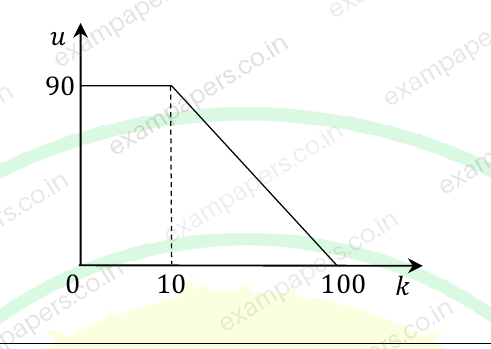
The speed-density relation on a one-way, single lane road is shown in the figure, where speed
is in km/hour and density
is in vehicles/km. The maximum flow (in vehicles/hour) on this road is
Your answerChoose one option.
Log in to check the answer
You can attempt this question now. Sign in to view the answer key, explanations and discussion.Log in to check answerQuestion 43
Open questionCEMCQ2 marksNeeds review
Match the following in Column I with Column II.
Column I | Column II |
|---|---|
(1) Vehicle Damage Factor | A. Stability of subgrade soil |
(2) Passenger Car Unit | B. Capacity of a roadway |
(3) Perception Reaction Time | C. Design rigid pavement |
(4) California Bearing Ratio | D. Design flexible pavement |
| E. Stopping sight distance |
Your answerChoose one option.
Log in to check the answer
You can attempt this question now. Sign in to view the answer key, explanations and discussion.Log in to check answerQuestion 50
Open questionCEMSQ2 marksNeeds review
The free flow speed of a highway is 100 km/h and its capacity is 4000 vehicle/h. Assume speed density relation is linear.
For a traffic volume of 2000 vehicle/h, choose all the possible speeds (in km/h) from the options given below (round off to two decimal places).
Your answerSelect all correct options. You can choose more than one.
Log in to check the answer
You can attempt this question now. Sign in to view the answer key, explanations and discussion.Log in to check answerQuestion 43
Open questionCE2MCQ2 marksNeeds review
The consolidated data of a spot speed study for a certain stretch of a highway is given in the table.
Speed range (kmph) | Number of observations |
|---|---|
0 - 10 | 7 |
10 - 20 | 31 |
20 - 30 | 76 |
30 - 40 | 129 |
40 - 50 | 104 |
50 - 60 | 78 |
60 - 70 | 29 |
70 - 80 | 24 |
80 - 90 | 13 |
90 - 100 | 9 |
The “upper speed limit” (in kmph) for the traffic sign is
Your answerChoose one option.
Log in to check the answer
You can attempt this question now. Sign in to view the answer key, explanations and discussion.Log in to check answerQuestion 44
Open questionce-1MCQ2 marksNeeds review
The free mean speed is 60 km/hr on a given road. The average space headway at jam density on this road is 8 m. For a linear speed-density relationship, the maximum flow (in veh/hr/lane) expected on the road is
Your answerChoose one option.
Log in to check the answer
You can attempt this question now. Sign in to view the answer key, explanations and discussion.Log in to check answer