
Civil Engineering
GATE CE topic:water-and-wastewater-treatment PYQs
Build your understanding with focused practice from past exam papers.
Questions 41–50 of 81. Imported answers require independent review unless marked reviewed.
Question 12
Open questionCEMCQ1 markNeeds review
Which one of the following is correct?
Your answerChoose one option.
Log in to check the answer
You can attempt this question now. Sign in to view the answer key, explanations and discussion.Log in to check answerQuestion 15
Open questionCEMCQ1 markNeeds review
The hardness of a water sample is measured directly by titration with 0.01 M solution of ethylenediamine tetraacetic acid (EDTA) using eriochrome black T (EBT) as an indicator. The EBT reacts and forms complexes with divalent metal cations present in the water. During titration, the EDTA replaces the EBT in the complex. When the replacement of EBT is complete at the end point of the titration, the colour of the solution changes from
Your answerChoose one option.
Log in to check the answer
You can attempt this question now. Sign in to view the answer key, explanations and discussion.Log in to check answerQuestion 28
Open questionCEMCQ2 marksNeeds review
A 50 mL sample of industrial wastewater is taken into a silica crucible. The empty weight of the crucible is 54.352 g. The crucible with the sample is dried in a hot air oven at 104 °C till a constant weight of 55.129 g. Thereafter, the crucible with the dried sample is fired at 600 °C for 1 h in a muffle furnace, and the weight of the crucible along with residue is determined as 54.783 g. The concentration of total volatile solids is ______.
Your answerChoose one option.
Log in to check the answer
You can attempt this question now. Sign in to view the answer key, explanations and discussion.Log in to check answerQuestion 33
Open questionCEMCQ2 marksNeeds review
A water sample is analyzed for coliform organisms by the multiple-tube fermentation method. The results of confirmed test are as follows:
Sample size (mL) | Number of positive results out of 5 tubes | Number of negative results out of 5 tubes |
|---|---|---|
0.01 | 5 | 0 |
0.001 | 3 | 2 |
0.0001 | 1 | 4 |
The most probable number (MPN) of coliform organisms for the above results is to be obtained using the following MPN Index.
Combination of positive tubes | MPN Index per 100 mL |
|---|---|
0 – 2 – 4 | 11 |
1 – 3 – 5 | 19 |
4 – 2 – 0 | 22 |
5 – 3 – 1 | 110 |
The MPN of coliform organisms per 100 mL is
Your answerChoose one option.
Log in to check the answer
You can attempt this question now. Sign in to view the answer key, explanations and discussion.Log in to check answerQuestion 33
Open questionCEMCQ2 marksNeeds review
A water filtration unit is made of uniform-size sand particles of 0.4 mm diameter with a shape factor of 0.84 and specific gravity of 2.55. The depth of the filter bed is 0.70 m and the porosity is 0.35. The filter bed is to be expanded to a porosity of 0.65 by hydraulic backwash. If the terminal settling velocity of sand particles during backwash is 4.5 cm/s, the required backwash velocity is
Your answerChoose one option.
Log in to check the answer
You can attempt this question now. Sign in to view the answer key, explanations and discussion.Log in to check answerQuestion 34
Open questionCEMCQ2 marksNeeds review
Ammonia nitrogen is present in a given wastewater sample as the ammonium ion (NH₄⁺) and ammonia (NH₃). If pH is the only deciding factor for the proportion of these two constituents, which of the following is a correct statement?
Your answerChoose one option.
Log in to check the answer
You can attempt this question now. Sign in to view the answer key, explanations and discussion.Log in to check answerQuestion 51
Open questionCENAT2 marksNeeds review
An activated sludge process (ASP) is designed for secondary treatment of 750 m³/day of municipal wastewater. After primary clarifier, the ultimate BOD of the influent, which enters into ASP reactor is 200 mg/L. Treated effluent after secondary clarifier is required to have an ultimate BOD of 20 mg/L. Mix liquor volatile suspended solids (MLVSS) concentration in the reactor and the underflow is maintained as 3000 mg/L and 12000 mg/L, respectively. The hydraulic retention time and mean cell residence time are 0.2 day and 10 days, respectively. A representative flow diagram of the ASP is shown below. The underflow volume (in m³/day, round off to one decimal place) of sludge wastage is ________.
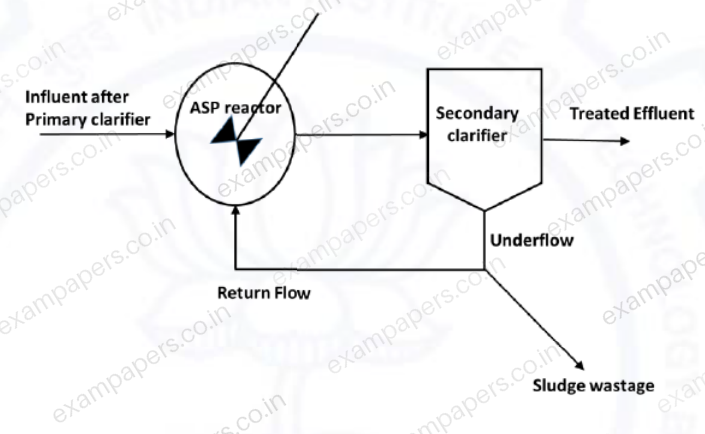
Log in to check the answer
You can attempt this question now. Sign in to view the answer key, explanations and discussion.Log in to check answerQuestion 52
Open questionCENAT2 marksNeeds review
A secondary clarifier handles a total flow of 9600 m³/d from the aeration tank of a conventional activated-sludge treatment system. The concentration of solids in the flow from the aeration tank is 3000 mg/L. The clarifier is required to thicken the solids to 1200 mg/L, and hence it is to be designed for a solid flux of 3.2 kg/m².h. The surface area of the designed clarifier for thickening (in m², in integer) is ________.
Log in to check the answer
You can attempt this question now. Sign in to view the answer key, explanations and discussion.Log in to check answerQuestion 52
Open questionCENAT2 marksNeeds review
A grit chamber of rectangular cross-section is to be designed to remove particles with diameter of 0.25 mm and specific gravity of 2.70. The terminal settling velocity of the particles is estimated as 2.5 cm/s. The chamber is having a width of 0.50 m and has to carry a peak wastewater flow of 9720 m³/d giving the depth of flow as 0.75 m. If a flow-through velocity of 0.3 m/s has to be maintained using a proportional weir at the outlet end of the chamber, the minimum length of the chamber (in m, in integer) to remove 0.25 mm particles completely is ________.
Log in to check the answer
You can attempt this question now. Sign in to view the answer key, explanations and discussion.Log in to check answerQuestion 16
Open questionCEMCQ1 markNeeds review
During chlorination process, aqueous (aq) chlorine reacts rapidly with water to form Cl⁻, HOCl, and H⁺ as shown below
Cl₂ (aq) + H₂O ⇌ HOCl + Cl⁻ + H⁺
The most active disinfectant in the chlorination process from amongst the following, is
Your answerChoose one option.
Log in to check the answer
You can attempt this question now. Sign in to view the answer key, explanations and discussion.Log in to check answer