
Civil Engineering
GATE CE Transportation Infrastructure PYQs
Build your understanding with focused practice from past exam papers.
Questions 11–20 of 50. Imported answers require independent review unless marked reviewed.
Question 35
Open questionCENAT1 markNeeds review
Road A and Road B are joined by a circular horizontal curve of radius 200 m as shown in the figure. Road A and Road B are tangent to the curve at the points C and D, respectively. Had the curve not been there, straight roads A and B would have met at the point E. The distance from C to E is 92 m. The value of angle
(in degrees) is __________ (rounded off to 1 decimal place).Note: The value of angle
is to be calculated only from the consideration of Euclidean geometry and the data given in the problem.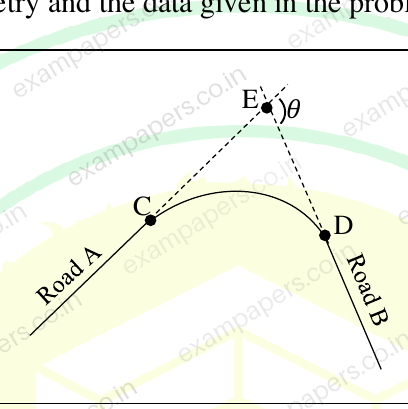
Log in to check the answer
You can attempt this question now. Sign in to view the answer key, explanations and discussion.Log in to check answerQuestion 64
Open questionCENAT2 marksNeeds review
On a two-lane highway, a horizontal curve of radius 300 m is provided. The design speed is 80 km/h.
If the long wheelbase of vehicle expected on this highway is 7 m, then the extra widening required (in m) is ______ (round off to two decimal places).
Log in to check the answer
You can attempt this question now. Sign in to view the answer key, explanations and discussion.Log in to check answerQuestion 22
Open questionce-1MCQ1 markNeeds review
A car is traveling at a speed of 60 km/hr on a section of a National Highway having a downward gradient of 2%. The driver of the car suddenly observes a stopped vehicle on the car path at a distance 130 m ahead, and applies brake. If the brake efficiency is 60%, coefficient of friction is 0.7, driver’s reaction time is 2.5 s, and acceleration due to gravity is 9.81 m/s², the distance (in meters) required by the driver to bring the car to a safe stop lies in the range
Your answerChoose one option.
Log in to check the answer
You can attempt this question now. Sign in to view the answer key, explanations and discussion.Log in to check answerQuestion 23
Open questionce-1MCQ1 markNeeds review
As per the International Civil Aviation Organization (ICAO), the basic runway length is increased by x (%) for every y (m) raise in elevation from the Mean Sea Level (MSL). The values of x and y, respectively, are
Your answerChoose one option.
Log in to check the answer
You can attempt this question now. Sign in to view the answer key, explanations and discussion.Log in to check answerQuestion 27
Open questionCE2MCQ1 markNeeds review
The longitudinal sections of a runway have gradients as shown in the table.
End to end for sections of runway (m) | Gradient (%) |
|---|---|
0 to 200 | +1.0 |
200 to 600 | −1.0 |
600 to 1200 | +0.8 |
1200 to 1600 | +0.2 |
1600 to 2000 | −0.5 |
Consider the reduced level (RL) at the starting point of the runway as 100 m.
The effective gradient of the runway is
Your answerChoose one option.
Log in to check the answer
You can attempt this question now. Sign in to view the answer key, explanations and discussion.Log in to check answerQuestion 28
Open questionCE2MCQ1 markNeeds review
In general, the outer edge is raised above the inner edge in horizontal curves for
Your answerChoose one option.
Log in to check the answer
You can attempt this question now. Sign in to view the answer key, explanations and discussion.Log in to check answerQuestion 62
Open questionce-1NAT2 marksNeeds review
The number of trains and their corresponding speeds for a curved Broad Gauge section with 437 m radius, are
• 20 trains travel at a speed of 40 km/hr
• 15 trains travel at a speed of 50 km/hr
• 12 trains travel at a speed of 60 km/hr
• 8 trains travel at a speed of 70 km/hr
• 3 trains travel at a speed of 80 km/hr
If the gauge (center-to-center distance between the rail heads) is taken as 1750 mm, the required equilibrium cant (in mm) will be ____________ (rounded off to the nearest integer).
Log in to check the answer
You can attempt this question now. Sign in to view the answer key, explanations and discussion.Log in to check answerQuestion 62
Open questionCE2NAT2 marksNeeds review
A horizontal curve of radius 1080 m (with transition curves on either side) in a Broad Gauge railway track is designed and constructed for an equilibrium speed of 70 kmph. However, a few years after construction, the Railway Authorities decided to run express trains on this track. The maximum allowable cant deficiency is 10 cm.
The maximum restricted speed (in kmph) of the express trains running on this track is ______________ (rounded off to the nearest integer).
Log in to check the answer
You can attempt this question now. Sign in to view the answer key, explanations and discussion.Log in to check answerQuestion 63
Open questionCE2NAT2 marksNeeds review
A vertical summit curve on a freight corridor is formed at the intersection of two gradients, +3.0% and −5.0%.
Assume the following:
Only large-sized trucks are allowed on this corridor
Design speed = 80 kmph
Eye height of truck drivers above the road surface = 2.30 m
Height of object above the road surface for which trucks need to stop = 0.35 m
Total reaction time of the truck drivers = 2.0 s
Coefficient of longitudinal friction of the road = 0.36
Stopping sight distance gets compensated on the gradient
The design length of the summit curve (in meters) to accommodate the stopping sight distance is __________ (rounded off to 2 decimal places).
Log in to check the answer
You can attempt this question now. Sign in to view the answer key, explanations and discussion.Log in to check answerQuestion 21
Open questionCEMCQ1 markNeeds review
and
are the slopes of the approach and departure grades of a vertical curve, respectively.Given
and
Statement 1:
followed by
results in a sag vertical curve.
Statement 2:
followed by
results in a sag vertical curve.
Statement 3:
followed by
results in a crest vertical curve.Which option amongst the following is true?
Your answerChoose one option.
Log in to check the answer
You can attempt this question now. Sign in to view the answer key, explanations and discussion.Log in to check answer