
Chemical Engineering
GATE CH branch:ch PYQs
Build your understanding with focused practice from past exam papers.
Questions 241–250 of 650. Imported answers require independent review unless marked reviewed.
Question 46
Open questionCHMSQ2 marksNeeds review
Which of the following statements is/are CORRECT?
Your answerSelect all correct options. You can choose more than one.
Log in to check the answer
You can attempt this question now. Sign in to view the answer key, explanations and discussion.Log in to check answerQuestion 47
Open questionCHNAT2 marksNeeds review
If a matrix
is defined as
, the sum of all the eigenvalues of
is equal to ________ (in integer).Log in to check the answer
You can attempt this question now. Sign in to view the answer key, explanations and discussion.Log in to check answerQuestion 48
Open questionCHNAT2 marksNeeds review
The first derivative of the function
evaluated at
is ______ (in integer).Log in to check the answer
You can attempt this question now. Sign in to view the answer key, explanations and discussion.Log in to check answerQuestion 49
Open questionCHNAT2 marksNeeds review
Wet air containing 10 mole percent water vapor is dried by continuously passing it through a column of CaCl
pellets. The pellets remove 50 percent of water from wet air entering the column. The mole percent of water vapor in the product stream exiting the column is __________ (rounded off to two decimal places).Log in to check the answer
You can attempt this question now. Sign in to view the answer key, explanations and discussion.Log in to check answerQuestion 50
Open questionCHNAT2 marksNeeds review
Orsat analysis showing the composition (in mol %, on a dry basis) of a stack gas is given in the table below. The humidity measurement reveals that the mole fraction of H
O in the stack gas is 0.07. The mole fraction of N
calculated on a wet basis is _______ (rounded off to two decimal places).Species | N | CO | CO | O |
|---|---|---|---|---|
mol % | 65 | 15 | 10 | 10 |
Log in to check the answer
You can attempt this question now. Sign in to view the answer key, explanations and discussion.Log in to check answerQuestion 51
Open questionCHNAT2 marksNeeds review
A pump draws water (density = 1000 kg·m
) at a steady rate of 10 kg·s
. The pressures at the suction and discharge sides of the pump are −20 kPa (gauge) and 350 kPa (gauge), respectively. The pipe diameters at the suction and discharge side are 70 mm and 50 mm, respectively. The suction and discharge lines are at the same elevation, and the pump operates at an efficiency of 80 %. Neglecting frictional losses in the system, the power (in kW) required to drive the pump is _____ (rounded off to two decimal places).Log in to check the answer
You can attempt this question now. Sign in to view the answer key, explanations and discussion.Log in to check answerQuestion 52
Open questionCHNAT2 marksNeeds review
A cylindrical tank with a diameter of 500 mm contains water (density = 1 g·cm
) up to a height
. A 5 mm diameter round nozzle, whose center is 1 cm above the base of the tank, has its exit open to the atmosphere as shown in the schematic below. The pressure above the water level in the tank is maintained at 2 bar (absolute). Neglect all frictional and entry-exit losses. Use acceleration due to gravity as 10 m·s
and atmospheric pressure as 1 bar. The absolute value of initial
(in mm·s
) when
cm is equal to _______ (rounded off to two decimal places). 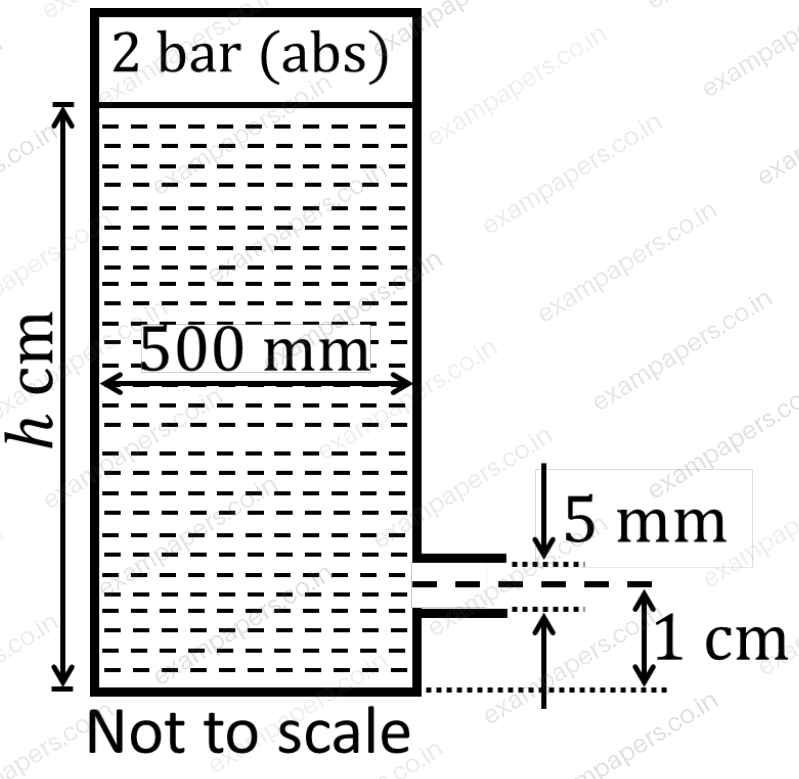
Log in to check the answer
You can attempt this question now. Sign in to view the answer key, explanations and discussion.Log in to check answerQuestion 53
Open questionCHNAT2 marksNeeds review
A large tank is filled with water (density = 1 g·cm
) up to a height of 5 m. A 100 μm diameter solid spherical particle (density = 0.8 g·cm
) is released at the bottom of the tank. The particle attains terminal velocity (
) after traveling to a certain height in the tank. Use acceleration due to gravity as 10 m·s
and water viscosity as 10
Pa·s. Neglect wall effects on the particle. If Stokes law is applicable, the absolute value of
(in mm·s
) is __________(rounded off to two decimal places).Log in to check the answer
You can attempt this question now. Sign in to view the answer key, explanations and discussion.Log in to check answerQuestion 54
Open questionCHNAT2 marksNeeds review
A fluid is flowing steadily under laminar conditions over a thin rectangular plate at temperature
as shown in the figure below. The velocity and temperature of the free stream are
and
, respectively. When the fluid flow is only in the
-direction,
is the local heat transfer coefficient. Similarly, when the fluid flow is only in the
-direction,
is the corresponding local heat transfer coefficient. Use the correlation
for the local heat transfer coefficient, where, Nu, Re and Pr are the appropriate Nusselt, Reynolds and Prandtl numbers. The average heat transfer coefficients are defined as
and
. If
m and
m, the value of the ratio of
to
is ______ (in integer). 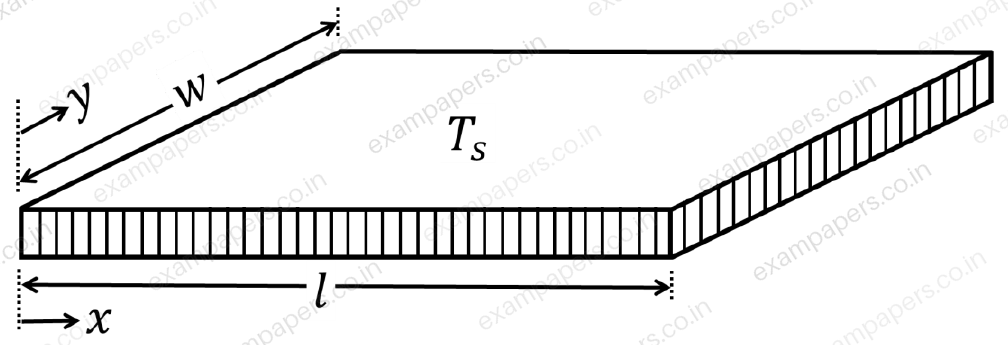
Log in to check the answer
You can attempt this question now. Sign in to view the answer key, explanations and discussion.Log in to check answerQuestion 55
Open questionCHNAT2 marksNeeds review
A perfectly insulated, concentric tube countercurrent heat exchanger is used to cool lubricating oil using water as a coolant (see figure below). Oil enters the outer annulus at a mass flow rate of 2 kg·s
with a temperature of 100 °C and leaves at 40 °C. Water enters the inner tube at a mass flow rate of 1 kg·s
with a temperature of 20 °C and leaves at 80 °C. Use specific heats of oil and water as 2089 J·kg
·K
and 4178 J·kg
·K
, respectively. There is no phase change in both the streams. Under steady-state conditions, the number of transfer units (NTU) is ______ (in integer). 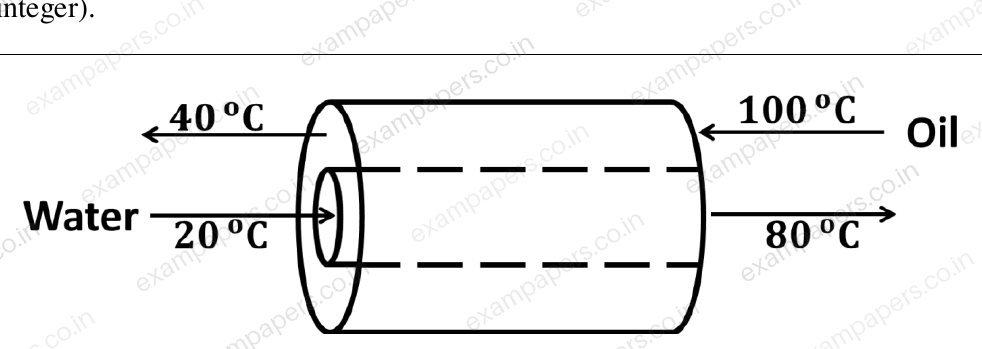
Log in to check the answer
You can attempt this question now. Sign in to view the answer key, explanations and discussion.Log in to check answer