
Chemical Engineering
GATE CH branch:ch PYQs
Build your understanding with focused practice from past exam papers.
Questions 511–520 of 650. Imported answers require independent review unless marked reviewed.
Question 46
Open questionCHNAT2 marksNeeds review
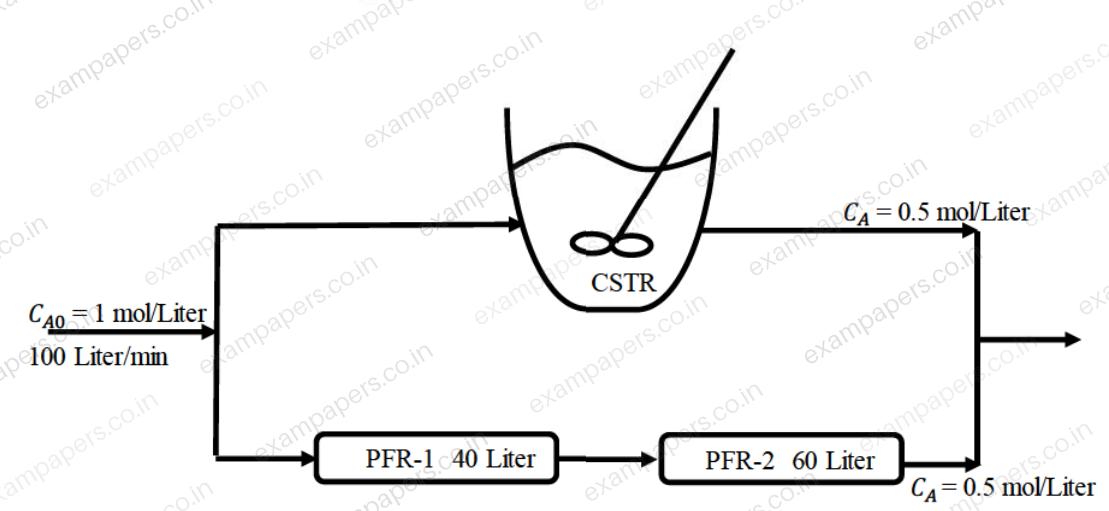
A first-order irreversible liquid phase reaction A → B (
min⁻¹) is carried out under isothermal, steady state conditions in the following reactor arrangement comprising an ideal CSTR (Continous-Stirred Tank Reactor) and two ideal PFRs (Plug Flow Reactors). From the information in the figure, the volume of the CSTR (in Liters) is __________ (rounded off to the nearest integer).
Log in to check the answer
You can attempt this question now. Sign in to view the answer key, explanations and discussion.Log in to check answerQuestion 47
Open questionCHNAT2 marksNeeds review
The elementary liquid-phase irreversible reactions
take place in an isothermal ideal CSTR (Continuous-Stirred Tank Reactor). Pure A is fed to the reactor at a concentration of 2 mol/Liter. For the residence time that maximizes the exit concentration of B, the percentage yield of B, defined as
, is __________ (rounded off to the nearest integer).Log in to check the answer
You can attempt this question now. Sign in to view the answer key, explanations and discussion.Log in to check answerQuestion 48
Open questionCHNAT2 marksNeeds review
The elementary irreversible gas-phase reaction A → B + C is carried out adiabatically in an ideal CSTR (Continuous Stirred Tank Reactor) operating at 10 atm. Pure A enters the CSTR at a flow rate of 10 mol/s and a temperature of 450 K. Assume A, B and C to be ideal gases. The specific heat capacity at constant pressure (
) and heat of formation (
), of component
(
), are:
The reaction rate constant
(per second)
, where
kJ/mol and universal gas constant
L atm/(mol K) = 8.314 J/(mol K). The shaft work may be neglected in the analysis, and specific heat capacities do not vary with temperature. All heats of formation are referenced to 273 K. The reactor volume (in Liters) for 75% conversion is __________ (rounded off to the nearest integer).Log in to check the answer
You can attempt this question now. Sign in to view the answer key, explanations and discussion.Log in to check answerQuestion 49
Open questionCHNAT2 marksNeeds review
For the closed loop system shown in figure,
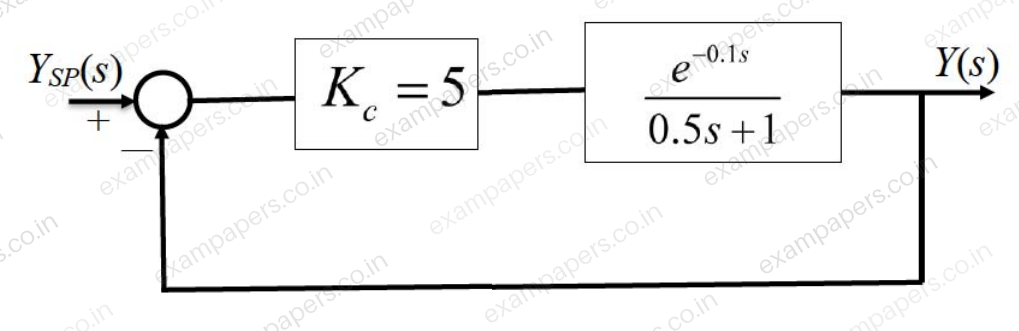
the phase margin (in degrees) is __________ (rounded off to one decimal place).
Log in to check the answer
You can attempt this question now. Sign in to view the answer key, explanations and discussion.Log in to check answerQuestion 50
Open questionCHNAT2 marksNeeds review
Two spherical camphor particles of radii 20 cm and 5 cm, far away from each other, are undergoing sublimation in a stream of air. The mass transfer coefficient is proportional to
, where
is the radius of the sphere at time
. Assume that the partial pressure of camphor far away from the surface of the particle is zero. Also, assume quasi-steady state, identical ambient conditions, and negligible heat effects. If
and
are the times required for complete sublimation of the 20 cm and 5 cm camphor particles, respectively, the ratio
is __________ (rounded off to one decimal place).Log in to check the answer
You can attempt this question now. Sign in to view the answer key, explanations and discussion.Log in to check answerQuestion 51
Open questionCHNAT2 marksNeeds review
A countercurrent absorption tower is designed to remove 95% of component A from an incoming binary gas mixture using pure solvent B. The mole ratio of A in the inlet gas is 0.02. The carrier gas flow rate is 50 kmol/h. The equilibrium relation is given by
, where Y and X are the mole ratios of A in the gas and liquid phases, respectively. If the tower is operated at twice the minimum solvent flow rate, the mole ratio of A in the exit liquid stream is __________ (rounded off to three decimal places).Log in to check the answer
You can attempt this question now. Sign in to view the answer key, explanations and discussion.Log in to check answerQuestion 52
Open questionCHNAT2 marksNeeds review
A binary mixture with components A and B is to be separated in a distillation column to obtain 95 mol% A as the top product. The binary mixture has a constant relative volatility
. The column feed is a saturated liquid containing 50 mol% A. Under the usual simplifying assumptions such as constant molal overflow, negligible heat loss, ideal trays, the minimum reflux ratio for this separation is __________ (rounded off to one decimal place).Log in to check the answer
You can attempt this question now. Sign in to view the answer key, explanations and discussion.Log in to check answerQuestion 53
Open questionCHNAT2 marksNeeds review
Consider the reactor-separator-recycle process operating under steady state conditions as shown in the figure. The reactor is an ideal Continuous-Stirred Tank Reactor (CSTR), where the reaction A + B → C occurs. Assume that there is no impurity in the product and recycle streams. Other relevant information are provided in the figure.
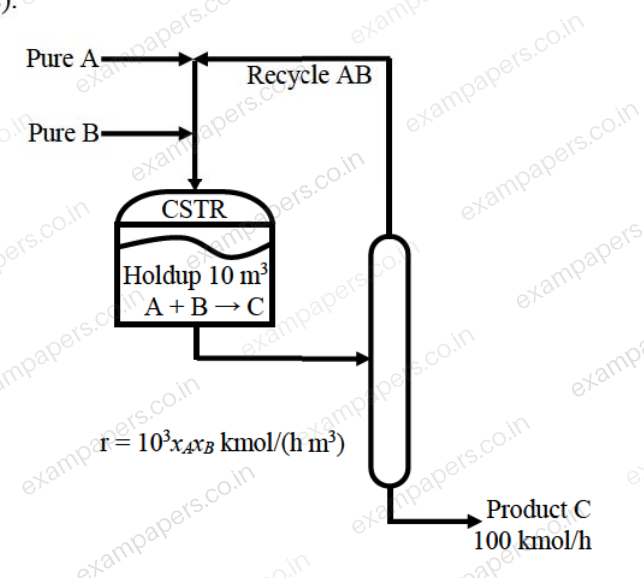
The mole fraction of B (
) in the reactor that minimizes the recycle rate is __________ (rounded off to two decimal places).Log in to check the answer
You can attempt this question now. Sign in to view the answer key, explanations and discussion.Log in to check answerQuestion 54
Open questionCHNAT2 marksNeeds review
Consider two competing equipment A and B. For a compound interest rate of 10% per annum, in order for equipment B to be the economically cheaper option, its minimum life (in years) is __________ (rounded off to the next higher integer).
Equipment | Capital Cost (Rs) | Yearly Operating Cost (Rs) | Equipment Life (Years) |
|---|---|---|---|
A | 80,000 | 20,000 | 4 |
B | 1,60,000 | 15,000 | ? |
Log in to check the answer
You can attempt this question now. Sign in to view the answer key, explanations and discussion.Log in to check answerQuestion 55
Open questionCHNAT2 marksNeeds review
A taxi-car is bought for Rs 10 lakhs. Its salvage value is zero. The expected yearly income after paying all expenses and applicable taxes is Rs 3 lakhs. The compound interest rate is 9% per annum. The discounted payback period (in years) is __________ (rounded off to the next higher integer).
Log in to check the answer
You can attempt this question now. Sign in to view the answer key, explanations and discussion.Log in to check answer