
Chemical Engineering
GATE CH Chemical Reaction Engineering PYQs
Build your understanding with focused practice from past exam papers.
How to practice Chemical Reaction Engineering
Attempt a question, record the concept and assumptions, then check the available answer. Rework mistakes after revising the relevant concepts. Topic tags can overlap; review the question context.
Questions 1–10 of 70. Imported answers require independent review unless marked reviewed.
Question 17
Open questionCHMCQ1 markNeeds review
An irreversible chemical reaction occurs on a porous catalyst. All the pores are of same size. In strong pore diffusion regime, the observed activation energy is 120 kJ mol⁻¹. The activation energy of diffusion is 10 kJ mol⁻¹. Assuming Arrhenius temperature dependency for both reaction and diffusion, which one of the following is the true activation energy (in kJ mol⁻¹) of the reaction?
Your answerChoose one option.
Log in to check the answer
You can attempt this question now. Sign in to view the answer key, explanations and discussion.Log in to check answerQuestion 42
Open questionCHMCQ2 marksNeeds review
Consider the following homogeneous isothermal liquid-phase parallel reactions carried out in three reactor configurations (having identical volumes and same operating temperatures), as shown in the figure.
where D is the desired product and U is the undesired product. The inlet concentrations of A and B are the same in all three configurations (
mol L
). The total molar feed flow rate of A (
) and that of B (
) are the same in all three configurations (
mol min
). In configuration I,
is equally distributed among all the inlets. Similarly, in configuration III,
is equally distributed among all the inlets. Assuming plug flow behavior at steady state, which one of the following statements is CORRECT? 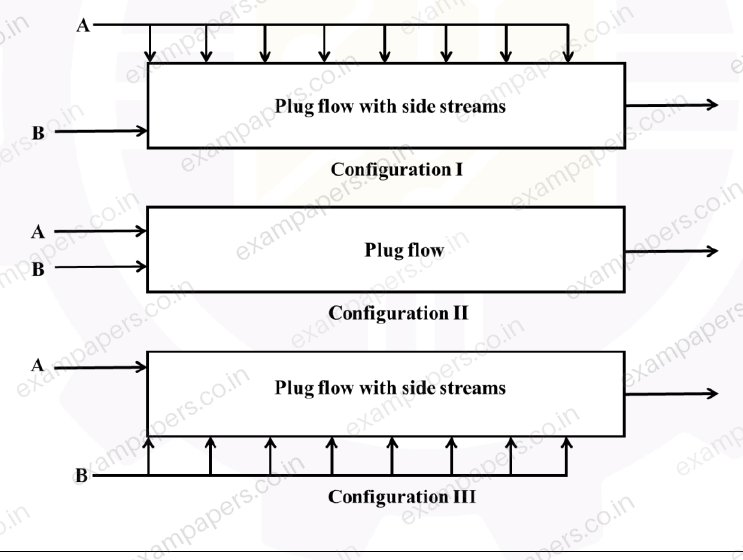
Your answerChoose one option.
Log in to check the answer
You can attempt this question now. Sign in to view the answer key, explanations and discussion.Log in to check answerQuestion 43
Open questionCHMCQ2 marksNeeds review
The reaction rate constants of two reactions follow Arrhenius’ law. The activation energies of Reaction 1 and Reaction 2 are
and
, respectively, and
. Assuming same value for the frequency factor for both the reactions, which one of the following statements is CORRECT?Your answerChoose one option.
Log in to check the answer
You can attempt this question now. Sign in to view the answer key, explanations and discussion.Log in to check answerQuestion 54
Open questionCHNAT2 marksNeeds review
Methanol is formed by the following gas phase homogeneous reaction:
CO (g) + 2H₂ (g) ⇌ CH₃OH (g)
The standard Gibbs free energies of formation at 298 K for CO and CH₃OH are −137 kJ mol⁻¹ and −162 kJ mol⁻¹, respectively. The value of universal gas constant is 8.314 J mol⁻¹ K⁻¹. The equilibrium constant for the given reaction at 298 K is _____ × 10⁴ (rounded off to one decimal place).
Log in to check the answer
You can attempt this question now. Sign in to view the answer key, explanations and discussion.Log in to check answerQuestion 55
Open questionCHNAT2 marksNeeds review
A first-order homogeneous liquid-phase reaction (A→B) occurs in an adiabatic, ideal mixed flow reactor operating at steady state. The volumetric flow rate of the feed is 4 L min⁻¹ and volume of the reactor is 20 L. At the reactor temperature of 500 K, the reaction rate constant is 1 min⁻¹, and heat of reaction is −20 kcal mol⁻¹. The average heat capacity of the feed as well as the reaction mixture in the temperature range of interest is 0.3 cal mol⁻¹ K⁻¹.
At the inlet, the feed temperature (in K) is ________ (rounded off to one decimal place).
Log in to check the answer
You can attempt this question now. Sign in to view the answer key, explanations and discussion.Log in to check answerQuestion 56
Open questionCHNAT2 marksNeeds review
A first-order homogeneous liquid-phase reaction (A→B) occurs in a non-ideal isothermal reactor operating at steady state. The variance (σ²) of residence time distribution (RTD) from a pulse tracer experiment is 4 min². The volumetric flow rate of the feed is 5 L min⁻¹ and volume of the reactor is 25 L. The reaction rate constant is 0.4 min⁻¹. Based on the tanks-in-series model, the conversion (in %) is ______ (rounded off to one decimal place).
Log in to check the answer
You can attempt this question now. Sign in to view the answer key, explanations and discussion.Log in to check answerQuestion 20
Open questionCHMCQ1 markNeeds review
Choose the CORRECT ordering of the diameter
of the different types of pores in a solid catalyst.Your answerChoose one option.
Log in to check the answer
You can attempt this question now. Sign in to view the answer key, explanations and discussion.Log in to check answerQuestion 23
Open questionCHMCQ1 markNeeds review
Choose the CORRECT statement that describes the dependence of the variance (
) of the residence time distribution (RTD) with respect to the number of tanks (
) in the Tanks-in-Series model of non-ideal reactors.Your answerChoose one option.
Log in to check the answer
You can attempt this question now. Sign in to view the answer key, explanations and discussion.Log in to check answerQuestion 29
Open questionCHMCQ1 markNeeds review
Choose the option that correctly matches the items in Group 1 with those in Group 2.
Group 1 | Group 2 |
|---|---|
(P) Coking | (I) Prolonged exposure of catalyst to high temperature |
(Q) Poisoning | (II) Deposition of carbonaceous material on catalyst surface |
(R) Sintering | (III) Irreversible chemisorption of molecules on active sites of catalyst |
Your answerChoose one option.
Log in to check the answer
You can attempt this question now. Sign in to view the answer key, explanations and discussion.Log in to check answerQuestion 31
Open questionCHMSQ1 markNeeds review
Consider an enzymatic reaction that follows Michaelis-Menten kinetics. Let
,
, and
denote the Michaelis constant, substrate concentration, and maximum reaction rate, respectively. Which of the following statements is/are TRUE?Your answerSelect all correct options. You can choose more than one.
Log in to check the answer
You can attempt this question now. Sign in to view the answer key, explanations and discussion.Log in to check answer