
Chemical Engineering
GATE CH Chemical Reaction Engineering PYQs
Build your understanding with focused practice from past exam papers.
Questions 11–20 of 70. Imported answers require independent review unless marked reviewed.
Question 35
Open questionCHNAT1 markNeeds review
The residence-time distribution (RTD) function of a reactor (in min
) is
The mean residence time of the reactor is ____ min (rounded off to 2 decimal places).Log in to check the answer
You can attempt this question now. Sign in to view the answer key, explanations and discussion.Log in to check answerQuestion 39
Open questionCHMCQ2 marksNeeds review
The first-order irreversible liquid phase reaction
occurs inside a constant volume (
) isothermal CSTR with the initial steady state conditions shown in the figure. The gain, in
, of the transfer function relating the reactor effluent
concentration,
, to the inlet flow rate,
, is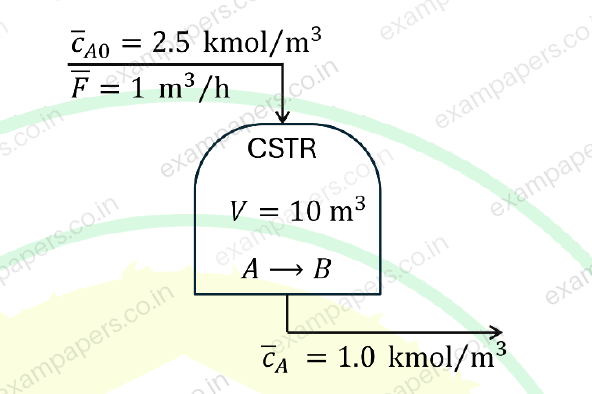
Your answerChoose one option.
Log in to check the answer
You can attempt this question now. Sign in to view the answer key, explanations and discussion.Log in to check answerQuestion 42
Open questionCHMCQ2 marksNeeds review
A zero-order gas phase reaction
with rate
mol/(L min) is carried out in a mixed flow reactor of volume 1 L. Pure A is fed to the reactor at a rate of 1 mol/min. At time
, the outlet flow is stopped while the inlet flow rate and reactor temperature remain unchanged. Assume that the reactor was operating under steady state before the flow was stopped (
). The rate of consumption of
,
, in mol/(L min), at
min isYour answerChoose one option.
Log in to check the answer
You can attempt this question now. Sign in to view the answer key, explanations and discussion.Log in to check answerQuestion 58
Open questionCHNAT2 marksNeeds review
The reaction
with reaction rate,
, occurs in an isothermal PFR operating at steady state. The conversion (
) at two axial locations (1 and 2) of the PFR is shown in the figure.
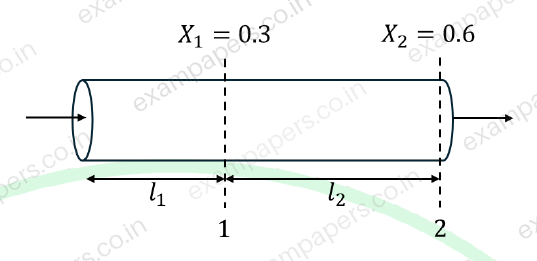
The value of
is ____ (rounded off to 2 decimal places).Log in to check the answer
You can attempt this question now. Sign in to view the answer key, explanations and discussion.Log in to check answerQuestion 59
Open questionCHNAT2 marksNeeds review
The catalytic gas phase reaction
is carried out in an isothermal batch reactor of 10 L volume using 0.1 kg of a solid catalyst. The reaction is first-order with
where
and
is the concentration of
in mol/L.The catalyst activity
undergoes first order decay with rate constant
per hour and
.The reactant conversion after 1 day of operation is ____ (rounded off to 2 decimal places).
Log in to check the answer
You can attempt this question now. Sign in to view the answer key, explanations and discussion.Log in to check answerQuestion 64
Open questionCHNAT2 marksNeeds review
Consider the flowsheet in the figure for manufacturing
via the reaction
in an isothermal CSTR. The split in the separator is perfect so that the recycle stream is free of
and the product stream is pure
. Let
denote the mole fraction of species
(
) in the CSTR, which is operated in excess
with
. The reaction is first-order in
with the reaction rate
, where
kmol/(m
h).
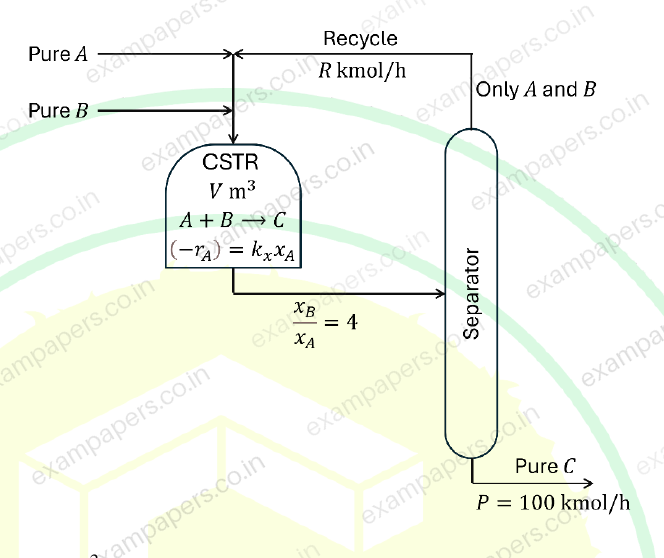
The reactor volume
in m
is to be optimized to minimize the cost objective
, where
is the recycle rate in kmol/h. For a product rate
kmol/h, the optimum value of
is ____ m
(rounded off to the nearest integer).GIVEN:
Log in to check the answer
You can attempt this question now. Sign in to view the answer key, explanations and discussion.Log in to check answerQuestion 19
Open questionCHMCQ1 markNeeds review
The ratio of the activation energy of a chemical reaction to the universal gas constant is 1000 K. The temperature-dependence of the reaction rate constant follows the collision theory. The ratio of the rate constant at 600 K to that at 400 K is
Your answerChoose one option.
Log in to check the answer
You can attempt this question now. Sign in to view the answer key, explanations and discussion.Log in to check answerQuestion 20
Open questionCHMCQ1 markNeeds review
The rate of a reaction
is 0.2 mol m
s
at a particular concentration
. The rate constant of the reaction at a given temperature is 0.1 m
mol
s
. If the reactant concentration is increased to
at the same temperature, the reaction rate, in mol m
s
, isYour answerChoose one option.
Log in to check the answer
You can attempt this question now. Sign in to view the answer key, explanations and discussion.Log in to check answerQuestion 21
Open questionCHMCQ1 markNeeds review
Two parallel first-order liquid phase reactions
and
are carried out in a well-mixed isothermal batch reactor. The initial concentration of A in the reactor is 1 kmol m
, while that of B and C is zero. After 2 hours, the concentration of A reduces to half its initial value, and the concentration of B is twice that of C. The rate constants
and
, in h
, are, respectivelyYour answerChoose one option.
Log in to check the answer
You can attempt this question now. Sign in to view the answer key, explanations and discussion.Log in to check answerQuestion 44
Open questionCHMCQ2 marksNeeds review
A first-order heterogeneous reaction
is carried out using a porous spherical catalyst. Assume isothermal conditions, and that intraphase diffusion controls the reaction rate. At a bulk
concentration of 0.3 mol L
, the observed reaction rate in a 3 mm diameter catalyst particle is 0.2 mol s
L
catalyst volume. At a bulk
concentration of 0.1 mol L
, the observed reaction rate, in mol s
L
catalyst volume, in a 6 mm diameter catalyst particle, isYour answerChoose one option.
Log in to check the answer
You can attempt this question now. Sign in to view the answer key, explanations and discussion.Log in to check answer