
Chemical Engineering
GATE CH Chemical Reaction Engineering PYQs
Build your understanding with focused practice from past exam papers.
Questions 21–30 of 70. Imported answers require independent review unless marked reviewed.
Question 45
Open questionCHMCQ2 marksNeeds review
A first-order liquid phase reaction
is carried out in two isothermal plug flow reactors (PFRs) of volume 1 m
each, connected in series. The feed flow rate and concentration of
to the first reactor are 10 m
h
and 1 kmol m
, respectively. At steady-state, the concentration of
at the exit of the second reactor is 0.2 kmol m
. If the two PFRs are replaced by two equal-volume continuously stirred tank reactors (CSTRs) to achieve the same overall steady-state conversion, the volume of each CSTR, in m
, isYour answerChoose one option.
Log in to check the answer
You can attempt this question now. Sign in to view the answer key, explanations and discussion.Log in to check answerQuestion 46
Open questionCHMCQ2 marksNeeds review
The residence time distribution,
, for a non-ideal flow reactor is given in the figure. A first-order liquid phase reaction with a rate constant 0.2 min
is carried out in the reactor. For an inlet reactant concentration of 2 mol L
, the reactant concentration (in mol L
) in the exit stream is 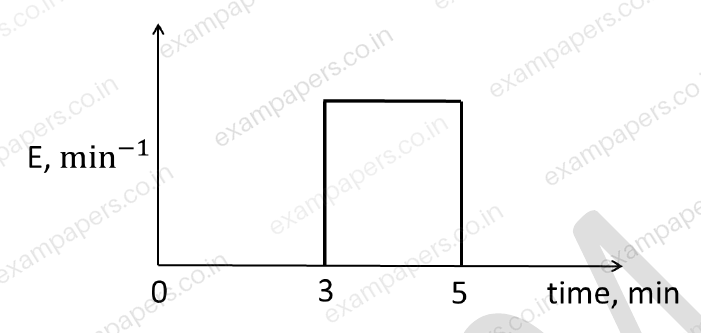
Your answerChoose one option.
Log in to check the answer
You can attempt this question now. Sign in to view the answer key, explanations and discussion.Log in to check answerQuestion 62
Open questionCHNAT2 marksNeeds review
A chemostat with cell recycle is shown in the figure. The feed flow rate and culture volume are
L h
and
L, respectively. The glucose concentration in the feed
g L
. Assume Monod kinetics with specific cell growth rate
, where
h
and
g L
. Assume maintenance and death rates to be zero, input feed to be sterile (
) and steady-state operation. The glucose concentration in the recycle stream,
, in g L
, rounded off to 1 decimal place, is ________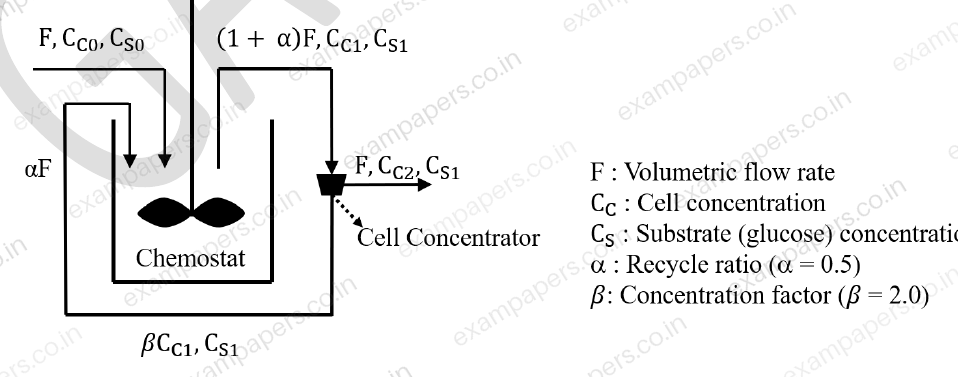
Log in to check the answer
You can attempt this question now. Sign in to view the answer key, explanations and discussion.Log in to check answerQuestion 43
Open questionCHMCQ2 marksNeeds review
CO and H
participate in a catalytic reaction. The partial pressures (in atm) of the reacting species CO and H
in the feed stream are
and
, respectively. While CO undergoes molecular adsorption, H
adsorbs via dissociative adsorption, that is, as hydrogen atoms. The equilibrium constants (in atm
) corresponding to adsorption of CO and H
to the catalyst sites are
and
, respectively. Total molar concentration of active sites per unit mass of the catalyst is
(in mol.(g cat)
). Both the adsorption steps are at equilibrium. Which one of the following expressions is the CORRECT ratio of the concentration of catalyst sites occupied by CO to that by hydrogen atoms?Your answerChoose one option.
Log in to check the answer
You can attempt this question now. Sign in to view the answer key, explanations and discussion.Log in to check answerQuestion 58
Open questionCHNAT2 marksNeeds review
Fresh catalyst is loaded into a reactor before the start of the following catalytic reaction:
The catalyst gets deactivated over time. The instantaneous activity
, at time
, is defined as the ratio of the rate of the reaction
(mol·(g cat)
·hr
) to the rate of reaction with fresh catalyst. Controlled experimental measurements led to an empirical correlation
where
is in hours. The activity of the catalyst at
hr is ______ (rounded off to one decimal place).Log in to check the answer
You can attempt this question now. Sign in to view the answer key, explanations and discussion.Log in to check answerQuestion 59
Open questionCHNAT2 marksNeeds review
A unimolecular, irreversible liquid-phase reaction
was carried out in an ideal batch reactor at temperature
. The rate of the reaction (
) measured at different conversions
is given in the table below. This reaction is also carried out in an ideal continuous stirred tank reactor (CSTR) at the same temperature
with a feed concentration of 1 mol m
, under steady-state conditions. For a conversion of 0.8, the space time (in s) of the CSTR is ______ (in integer).Log in to check the answer
You can attempt this question now. Sign in to view the answer key, explanations and discussion.Log in to check answerQuestion 60
Open questionCHNAT2 marksNeeds review
An irreversible liquid-phase second-order reaction
with rate constant
liter·mol
·min
, is carried out in an isothermal non-ideal reactor. A tracer experiment conducted on this reactor resulted in a residence time distribution (
-curve) as shown in the figure below. The areas of the rectangles (i), (ii) and (iii) are equal. Pure
at a concentration of 1.5 mol·liter
is fed to the reactor. The segregated model mimics the nonideality of the reactor. The percentage conversion of
at the exit of the reactor is _____ (rounded off to the nearest integer). 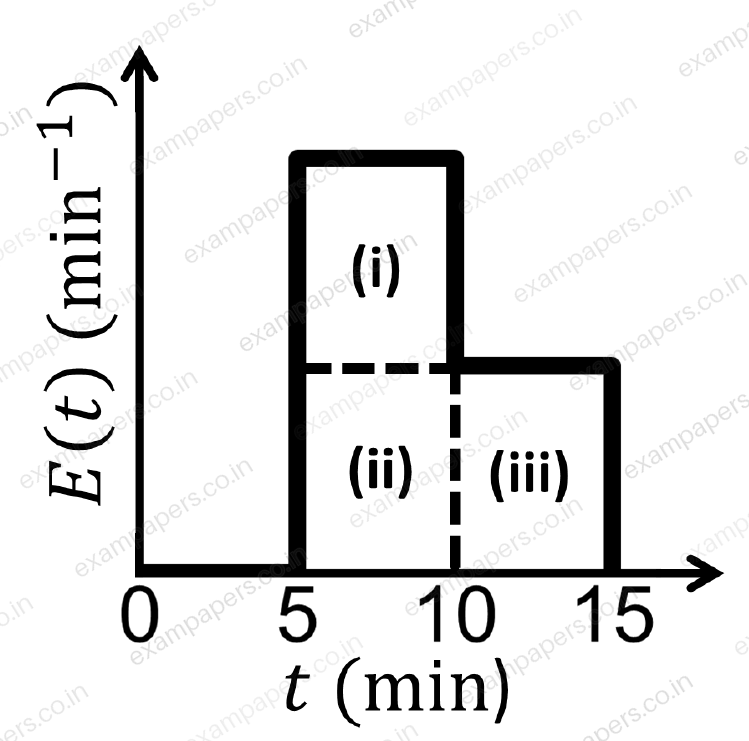
Log in to check the answer
You can attempt this question now. Sign in to view the answer key, explanations and discussion.Log in to check answerQuestion 26
Open questionCHMCQ1 markNeeds review
The reaction
is carried out isothermally on a porous catalyst. The intrinsic reaction rate is
, where
is the rate constant and
is the concentration of
. If the reaction is strong pore-diffusion controlled, the observed order of the reaction isYour answerChoose one option.
Log in to check the answer
You can attempt this question now. Sign in to view the answer key, explanations and discussion.Log in to check answerQuestion 27
Open questionCHMCQ1 markNeeds review
In an enzymatic reaction, an inhibitor (I) competes with the substrate (S) to bind with the enzyme (E), thereby reducing the rate of product (P) formation. The competitive inhibition follows the reaction mechanism shown below. Let [S] and [I] be the concentration of S and I, respectively, and
be the rate of consumption of S. Assuming pseudo-steady state, the correct plot of
vs
is 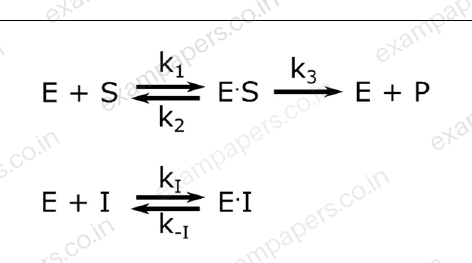
Your answerChoose one option.
Log in to check the answer
You can attempt this question now. Sign in to view the answer key, explanations and discussion.Log in to check answerQuestion 50
Open questionCHNAT2 marksNeeds review
Consider the process flowsheet in the figure. An irreversible liquid-phase reaction
(reaction rate
kmol m
h
) occurs in a 1 m
continuous stirred tank reactor (CSTR), where
is the mole fraction of A. A small amount of inert,
, is added to the reactor. The reactor effluent is separated in a perfect splitter to recover pure
product down the bottoms and a B-free distillate. A fraction of the distillate is purged and the rest is recycled back to the reactor. At a particular steady state, the product rate is 100 kmol h
, the recycle rate is 200 kmol h
and the purge rate is 10 kmol h
. Given the above information, the inert feed rate into the process is __________ kmol h
(rounded off to two decimal places).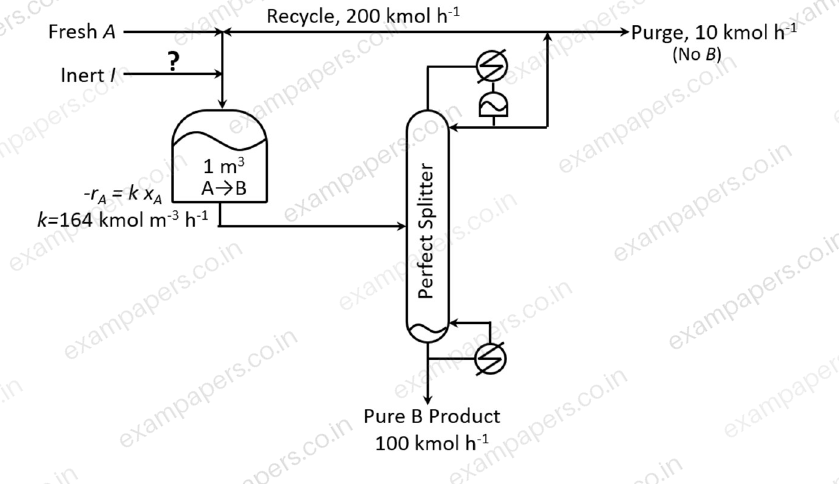
Log in to check the answer
You can attempt this question now. Sign in to view the answer key, explanations and discussion.Log in to check answer