
Chemical Engineering
GATE CH Chemical Reaction Engineering PYQs
Build your understanding with focused practice from past exam papers.
Questions 51–60 of 70. Imported answers require independent review unless marked reviewed.
Question 46
Open questionCHNAT2 marksNeeds review
A first-order irreversible liquid phase reaction A → B (
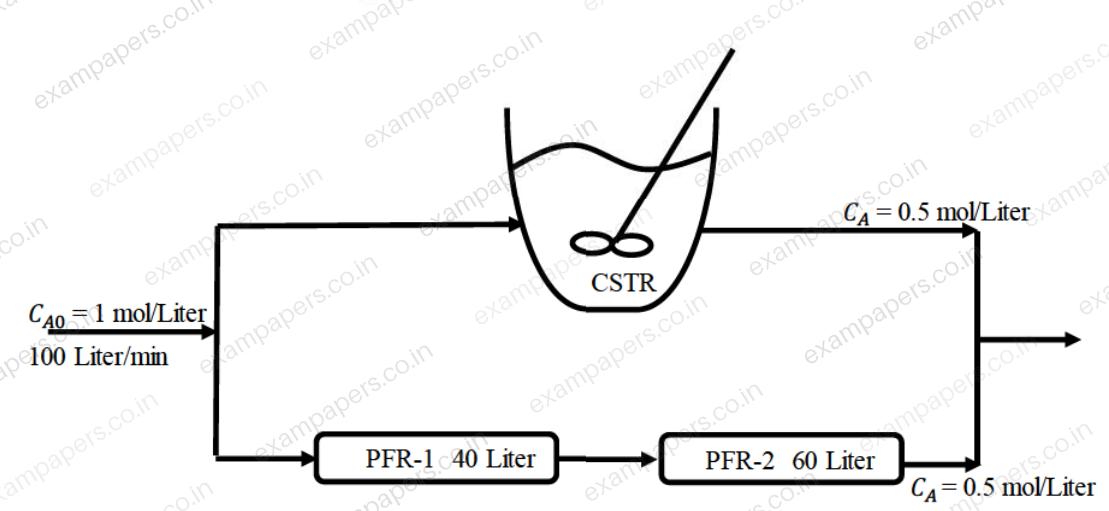
min⁻¹) is carried out under isothermal, steady state conditions in the following reactor arrangement comprising an ideal CSTR (Continous-Stirred Tank Reactor) and two ideal PFRs (Plug Flow Reactors). From the information in the figure, the volume of the CSTR (in Liters) is __________ (rounded off to the nearest integer).
Log in to check the answer
You can attempt this question now. Sign in to view the answer key, explanations and discussion.Log in to check answerQuestion 47
Open questionCHNAT2 marksNeeds review
The elementary liquid-phase irreversible reactions
take place in an isothermal ideal CSTR (Continuous-Stirred Tank Reactor). Pure A is fed to the reactor at a concentration of 2 mol/Liter. For the residence time that maximizes the exit concentration of B, the percentage yield of B, defined as
, is __________ (rounded off to the nearest integer).Log in to check the answer
You can attempt this question now. Sign in to view the answer key, explanations and discussion.Log in to check answerQuestion 48
Open questionCHNAT2 marksNeeds review
The elementary irreversible gas-phase reaction A → B + C is carried out adiabatically in an ideal CSTR (Continuous Stirred Tank Reactor) operating at 10 atm. Pure A enters the CSTR at a flow rate of 10 mol/s and a temperature of 450 K. Assume A, B and C to be ideal gases. The specific heat capacity at constant pressure (
) and heat of formation (
), of component
(
), are:
The reaction rate constant
(per second)
, where
kJ/mol and universal gas constant
L atm/(mol K) = 8.314 J/(mol K). The shaft work may be neglected in the analysis, and specific heat capacities do not vary with temperature. All heats of formation are referenced to 273 K. The reactor volume (in Liters) for 75% conversion is __________ (rounded off to the nearest integer).Log in to check the answer
You can attempt this question now. Sign in to view the answer key, explanations and discussion.Log in to check answerQuestion 53
Open questionCHNAT2 marksNeeds review
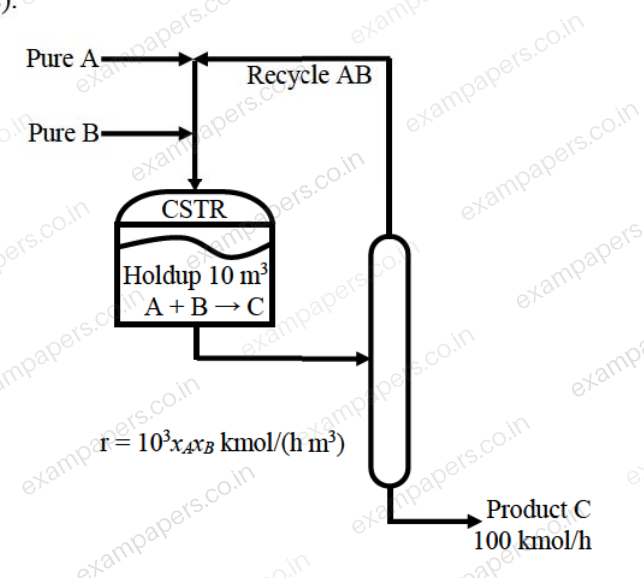
Consider the reactor-separator-recycle process operating under steady state conditions as shown in the figure. The reactor is an ideal Continuous-Stirred Tank Reactor (CSTR), where the reaction A + B → C occurs. Assume that there is no impurity in the product and recycle streams. Other relevant information are provided in the figure.
The mole fraction of B (
) in the reactor that minimizes the recycle rate is __________ (rounded off to two decimal places).Log in to check the answer
You can attempt this question now. Sign in to view the answer key, explanations and discussion.Log in to check answerQuestion 15
Open questionCHMCQ1 markNeeds review
Liquid phase isomerization of o-xylene to p-xylene using a zeolite catalyst was carried out in a CSTR. Three sets of kinetic data at different temperatures and stirring speeds were obtained as shown below.
| set A | | | set B | | | set C | | |
|---|---|---|---|---|---|---|---|---|---|
temperature (K) | 500 | 500 | 500 | 600 | 600 | 600 | 700 | 700 | 700 |
stirring speed (rpm) | 1000 | 2000 | 3000 | 1000 | 2000 | 3000 | 1000 | 2000 | 3000 |
reaction rate (mol L⁻¹ s⁻¹) | 0.020 | 0.025 | 0.025 | 0.037 | 0.047 | 0.047 | 0.069 | 0.078 | 0.086 |
The operating condition at which the reaction rate is not controlled by external mass transfer resistance is
Your answerChoose one option.
Log in to check the answer
You can attempt this question now. Sign in to view the answer key, explanations and discussion.Log in to check answerQuestion 17
Open questionCHMCQ1 markNeeds review
The reactant (M) is converted into product (N) in the presence of catalyst in a fixed bed reactor. All the flow rates (F, G, H, P and R) in mol/s, and mole fraction of reactant (M) in these streams (x_F, x_G, x_H, x_P and x_R) are shown in the diagram.
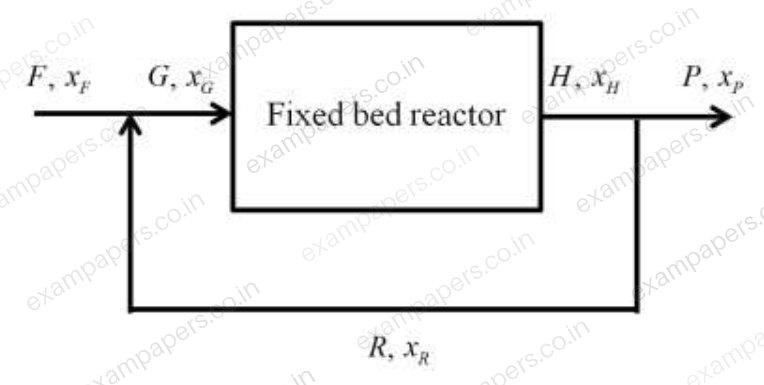
The overall fractional conversion is
Your answerChoose one option.
Log in to check the answer
You can attempt this question now. Sign in to view the answer key, explanations and discussion.Log in to check answerQuestion 21
Open questionCHMCQ1 markNeeds review
For a chemical reaction, the ratio of rate constant at 500 K to that at 400 K is 2.5. Given R = 8.314 J mol⁻¹ K⁻¹, the value of activation energy (in kJ/mol) is
Your answerChoose one option.
Log in to check the answer
You can attempt this question now. Sign in to view the answer key, explanations and discussion.Log in to check answerQuestion 24
Open questionCHNAT1 markNeeds review
The ammonia (NH₃) oxidation process occurs over a catalyst as
4 NH₃ + 5 O₂ → 6 H₂O + 4 NO
Air is supplied such that oxygen (O₂) is 20% in excess of that required for complete conversion of NH₃. The mole fraction of O₂ in inlet gas mixture (NH₃ + air) is ______ (rounded off to third decimal place).
Log in to check the answer
You can attempt this question now. Sign in to view the answer key, explanations and discussion.Log in to check answerQuestion 33
Open questionCHNAT2 marksNeeds review
In a laboratory batch setup, reaction of P over a catalyst was studied at various temperatures. The reactions occurring are
At the end of one hour of operation, the batch contains
,
and
mole fractions of P, Q and R components, respectively. The mole fractions of product components (
and
) were found to vary linearly with temperature as given in the figure. 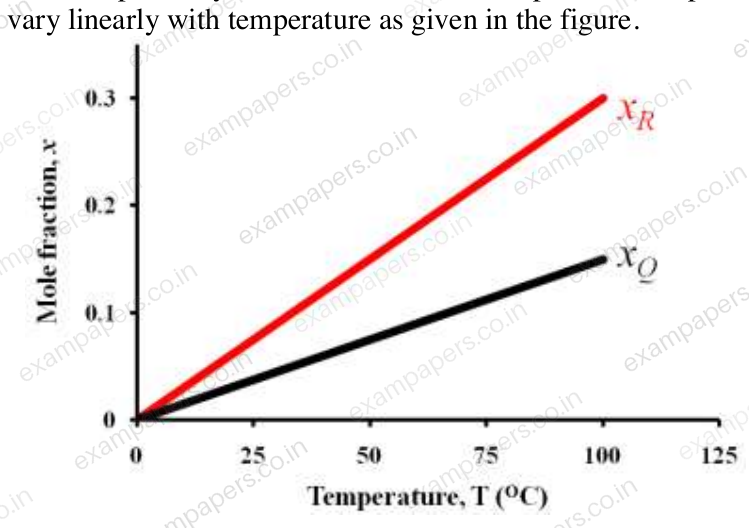
If the yield of Q based on reactant P consumed (
) at 25 °C was found to be 0.40, then the value of
at 60 °C is __________ (rounded off to second decimal place).Log in to check the answer
You can attempt this question now. Sign in to view the answer key, explanations and discussion.Log in to check answerQuestion 39
Open questionCHNAT2 marksNeeds review
A CSTR and a PFR of equal volume are connected in series as shown below to carry out a first-order, isothermal, liquid phase reaction
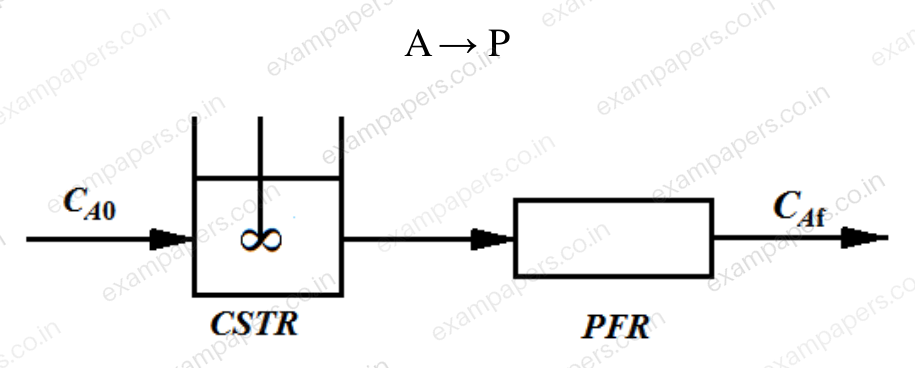
The rate constant is 0.2 s⁻¹. The space-time is 5 s for both the reactors. The overall fractional conversion of A is ____________ (rounded off to third decimal place).
Log in to check the answer
You can attempt this question now. Sign in to view the answer key, explanations and discussion.Log in to check answer