
Chemical Engineering
GATE CH concept:thermal-boundary-layer PYQs
Build your understanding with focused practice from past exam papers.
How to practice concept:thermal-boundary-layer
Attempt a question, record the concept and assumptions, then check the available answer. Rework mistakes after revising the relevant concepts. Topic tags can overlap; review the question context.
Questions 1–3 of 3. Imported answers require independent review unless marked reviewed.
Question 52
Open questionCHNAT2 marksNeeds review
Consider laminar flow of water over a wide flat plate maintained at a uniform temperature of 50 °C as shown in the figure. The freestream velocity and temperature of water are 1.0 m/s (parallel to the plate) and 20 °C, respectively. The distance
from the leading edge, at which the thermal boundary layer thickness
m, is ____ m (rounded off to 1 decimal place).
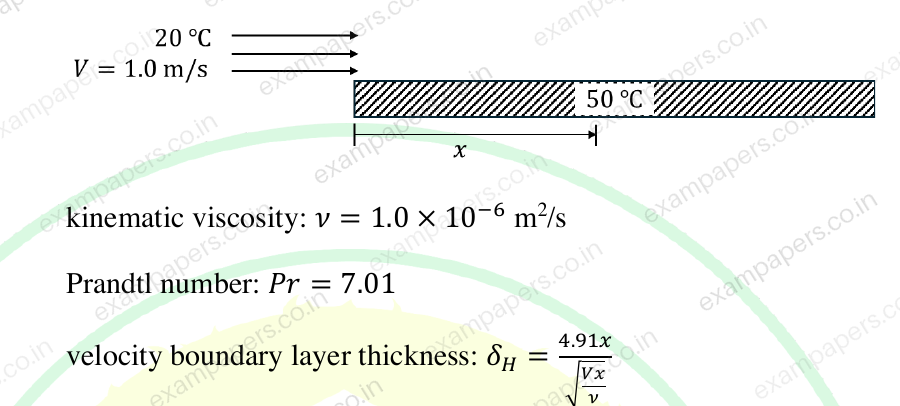
GIVEN:
kinematic viscosity:
m
/sPrandtl number:
velocity boundary layer thickness:
Log in to check the answer
You can attempt this question now. Sign in to view the answer key, explanations and discussion.Log in to check answerQuestion 27
Open questionCHMSQ1 markNeeds review
If the Prandtl number
, which of the following statements is/are correct?Your answerSelect all correct options. You can choose more than one.
Log in to check the answer
You can attempt this question now. Sign in to view the answer key, explanations and discussion.Log in to check answerQuestion 40
Open questionCHMCQ2 marksNeeds review
A fluid flows over a heated horizontal plate maintained at temperature
. The bulk temperature of the fluid is
. The temperature profile in the thermal boundary layer is given by:
Here,
is the vertical distance from the plate,
is the thickness of the thermal boundary layer and
is the thermal conductivity of the fluid.
The local heat transfer coefficient is given byYour answerChoose one option.
Log in to check the answer
You can attempt this question now. Sign in to view the answer key, explanations and discussion.Log in to check answer