
Chemical Engineering
GATE CH discipline:chemical-engineering PYQs
Build your understanding with focused practice from past exam papers.
Questions 301–310 of 650. Imported answers require independent review unless marked reviewed.
Question 41
Open questionCHMCQ2 marksNeeds review
Two large parallel plane walls are maintained at 1000 K and 500 K. Parallel radiation shields are to be installed between the two walls. Assume that the emissivities of the walls and the shields are equal. If the melting temperature of the shields is 900 K, the maximum number of shield(s) that can be installed between the walls is (are)
Your answerChoose one option.
Log in to check the answer
You can attempt this question now. Sign in to view the answer key, explanations and discussion.Log in to check answerQuestion 42
Open questionCHMCQ2 marksNeeds review
Saturated steam condenses on a vertical plate maintained at a constant wall temperature. If
is the vertical distance from the top edge of the plate, then the local heat transfer coefficient
, where
is the local mass flow rate of the condensate per unit plate width. The ratio of the average heat transfer coefficient over the entire plate to the heat transfer coefficient at the bottom of the plate isYour answerChoose one option.
Log in to check the answer
You can attempt this question now. Sign in to view the answer key, explanations and discussion.Log in to check answerQuestion 43
Open questionCHMCQ2 marksNeeds review
Match the product in Group-1 with the manufacturing process in Group-2. The correct combination is
Group-1 | | Group-2 | |
|---|---|---|---|
P | Nitric acid | I | Tona process |
Q | Phosphoric acid | II | Twitchell process |
R | Potassium chloride | III | Ostwald’s process |
S | Stearic acid | IV | Haifa process |
Your answerChoose one option.
Log in to check the answer
You can attempt this question now. Sign in to view the answer key, explanations and discussion.Log in to check answerQuestion 44
Open questionCHNAT2 marksNeeds review
The directional derivative of
at the point
in the direction of the vector
is __________ (rounded off to two decimal places).Log in to check the answer
You can attempt this question now. Sign in to view the answer key, explanations and discussion.Log in to check answerQuestion 45
Open questionCHNAT2 marksNeeds review
Consider a sphere of radius 4, centered at the origin, with outward unit normal
on its surface
. The value of the surface integral
is __________ (rounded off to one decimal place).Log in to check the answer
You can attempt this question now. Sign in to view the answer key, explanations and discussion.Log in to check answerQuestion 46
Open questionCHNAT2 marksNeeds review
The equation
with the initial condition
is to be solved using a predictor-corrector approach. Use a predictor based on the implicit Euler’s method and a corrector based on the trapezoidal rule of integration, each with a full-step size of 0.5. Considering only positive values of
, the value of
at
is __________ (rounded off to three decimal places).Log in to check the answer
You can attempt this question now. Sign in to view the answer key, explanations and discussion.Log in to check answerQuestion 47
Open questionCHNAT2 marksNeeds review
A substance at 4 °C has a thermal expansion coefficient
K
, an isothermal compressibility,
Pa
and a molar volume
m
mol
. If
is the molar entropy, then at 4 °C, the quantity
evaluated for the substance is __________ J mol
K
(rounded off to the nearest integer).Log in to check the answer
You can attempt this question now. Sign in to view the answer key, explanations and discussion.Log in to check answerQuestion 48
Open questionCHNAT2 marksNeeds review
The molar excess Gibbs free energy (
) of a liquid mixture of
and
is given by
where
and
are the mole fraction of
and
, respectively, the universal gas constant,
J K
mol
,
is the temperature in K, and
are temperature-dependent parameters. At 300 K,
and
. If
and
are the activity coefficients of
and
, respectively, the value of
at 300 K and 1 bar is __________ (rounded off to the nearest integer).
Log in to check the answer
You can attempt this question now. Sign in to view the answer key, explanations and discussion.Log in to check answerQuestion 49
Open questionCHNAT2 marksNeeds review
For a pure substance, the following data at saturated conditions are given:
ln (bar) | (K) |
|---|---|
0.693 | 350 |
1.386 | 370 |
Assume that the vapor phase behaves ideally, the molar volume of the liquid is negligible, and the latent heat of vaporization is constant over the given temperature range. The universal gas constant,
J K
mol
. From the above data, the estimated latent heat of vaporization at 360 K is __________ kJ/mol (rounded off to one decimal place).Log in to check the answer
You can attempt this question now. Sign in to view the answer key, explanations and discussion.Log in to check answerQuestion 50
Open questionCHNAT2 marksNeeds review
Consider the process flowsheet in the figure. An irreversible liquid-phase reaction
(reaction rate
kmol m
h
) occurs in a 1 m
continuous stirred tank reactor (CSTR), where
is the mole fraction of A. A small amount of inert,
, is added to the reactor. The reactor effluent is separated in a perfect splitter to recover pure
product down the bottoms and a B-free distillate. A fraction of the distillate is purged and the rest is recycled back to the reactor. At a particular steady state, the product rate is 100 kmol h
, the recycle rate is 200 kmol h
and the purge rate is 10 kmol h
. Given the above information, the inert feed rate into the process is __________ kmol h
(rounded off to two decimal places).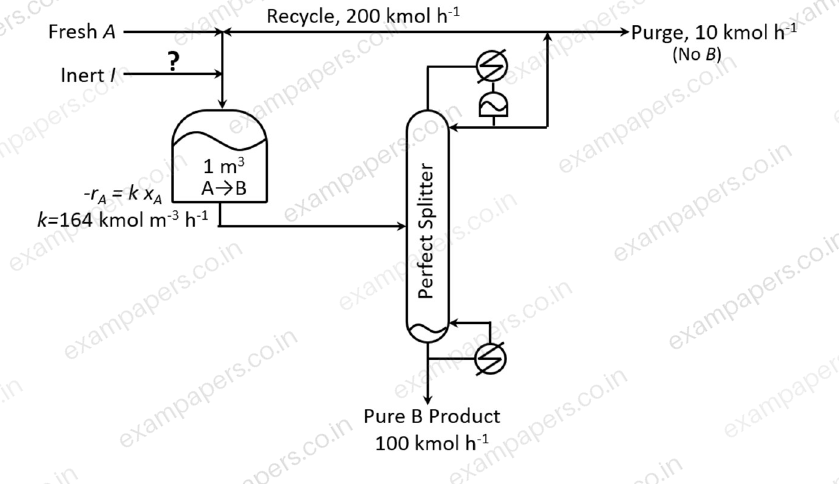
Log in to check the answer
You can attempt this question now. Sign in to view the answer key, explanations and discussion.Log in to check answer